

CLTs offer potential long-term pipelines for modular builders who understand this market.
• Community Land Trusts (CLTs) stabilize housing affordability by separating land ownership from homes. This removes the land from price speculation.
• Modular construction is a good fit for CLTs because it gets residents into homes more quickly, and offers better quality control than site building.
• Builders who want to serve this niche should seek partnerships with CLTs and learn about their mission and long-term goals.
One response to the need for affordable housing is the Community Land Trust, or CLT. It’s a model in which a trust — typically a nonprofit organization — purchases a tract of land then leases individual lots to people who want to build homes. It’s a way to help stabilize housing costs.
It’s also a good market for offsite construction.
Interestingly, the history of CLTs dates to the board game Monopoly. Evolved from The Landlord’s Game, which was patented in 1904 by American game designer Lizzie Magie, Monopoly was intended as an educational tool to explain the teachings of Henry George, a progressive era economist. George wrote the 1897 book Progress and Poverty, in which he observed how cities, as they modernized, created pockets of severe poverty that lacked basic needs like housing.
George’s proposed solution was “The Single Tax”— a property tax on land but not on the improvements to the land. The Single Tax was different from standard property taxes, which are based on the combined value of the land and the structures built upon it.
According to the International Center of Community Land Trusts, George’s thinking helped inspire the modern CLT movement.
The first CLT in the US wasn’t founded until 1969. A group of civil rights protesters who had been jailed together in Albany, Georgia, began taking correspondence courses to learn how to create more equitable communities. The CLT they founded was New Communities, Inc., in Lee County, Georgia.
New Communities, Inc. included over 5,000 acres, making it one of the largest black-owned landholdings in the US at the time. It was paid for by civil rights supporters, member contributions and federal grants. The property went into foreclosure in the early 1980s, an event the Community Preservation Trust in College Park, Maryland attributes to a combination of a drought, promised funds not being delivered and discriminatory lending practices.
Characteristics of a CLT
The lesson of New Communities was that the goal of outright land ownership — that is, without any debt on it — is important for long-term success. Indeed, that is a goal for most of today’s CLTs.
The majority of CLTs are nonprofit organizations that have purchased land using funds from private donations, grants, or other streams of financing. They provide ground leases for homes or buildings built on the land, creating permanent affordable housing. These homes are owned or rented by individuals, but the land ownership continues with the Trust. Although homeowners can’t realize equity from land value appreciation, the home stays affordable for the next owner.
CLTs remove land from speculative markets. They also help protect neighborhoods from gentrification and prevent affordable units from shifting to market-rate, thus keeping essential workers near job centers.
They are usually governed by a board that includes residents of the CLT, community members, lenders, local representatives and other nonprofits. As of 2022, there were more than 300 active CLTs in the United States, according to the Lincoln Institute of Land Policy in Cambridge, Massachusetts.
CLTs + Modular
CLTs are focused on placing community members into housing as soon as possible. Continued challenges with inconsistent timelines from labor shortages, makes offsite construction a viable solution.
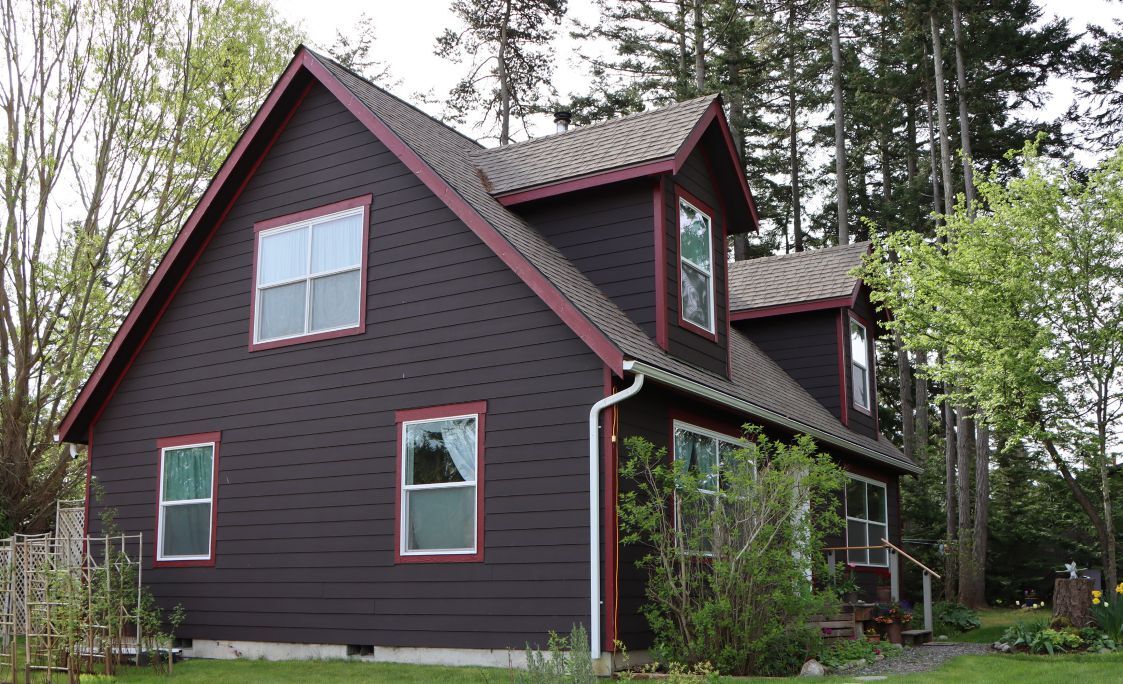
In the mid-1980s, community members on Orcas Island, a small island with a population of around 6000 located in the northwest corner of Washington State, began to see increased tourism driving home and land prices higher. They wanted to find a solution for housing that would be affordable for individuals with moderate to lower incomes and would maintain that affordability moving forward.
When a local tax to fund affordable housing failed to pass, community members went searching for a solution and discovered CLTs. Of People and Land, or OPAL, was founded in 1989. It was one of the first CLTs in the west and has a portfolio consisting of new and renovated single-family homes, townhomes, apartments and relocated homes.
Orcas is one of numerous small US communities that have evolved into expensive luxury markets. Median home prices have risen to well over $1 million, pricing out long-term residents. OPAL is offering some relief.
In 2020, OPAL completed April’s Grove, a community of 45 sitebuilt townhomes with an average cost to build at about $320,000 per home. They are currently finishing a 10-home neighborhood, Kidder Way, with the same type of product — duplexes and townhomes — at an average cost of $610,000.
The Opal CLT obtains grants and private donations to cover costs that buyers can’t afford. For example, homebuyers for the Kidder Way project pay $200,000 while grants and donations cover the other $410,000. The CLT ground lease sets the future resale price, so the house remains affordable.
Executive Director Lisa Byers believes pricing trends have created a need for efforts like this. “I’ve never seen a price jump like that in my 30 years with OPAL,” she says. “I believe housing is a basic need and our current economy is not allowing that need to be met. When people’s needs are met, they can be much healthier, more productive members of our community.”
To finance homes, OPAL relies on local donations and grants, and also works with lenders like Homesite, a mission-oriented nonprofit mortgage lender based in Seattle, Washington. Homesite is a Community Development Financing Institution (CDFI) that provides financial services to community development projects, including affordable housing.
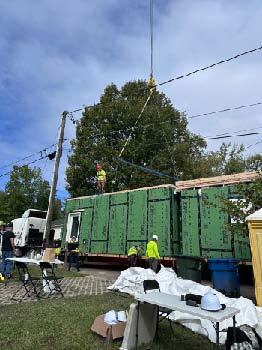
In the early 2000s, OPAL worked with Stratford Homes, a custom modular homebuilder in Rathdrum, Idaho, to build five homes for their Oberon Wood neighborhood on Orcas Island. More recently, they have partnered with West Coast Homes, a vertically integrated custom modular builder based in Lynden, Washington, for their next modular project. They chose modular for that project due to speed of completion and less disruption to existing neighbors.
“[West Coast Homes is] very mission-aligned,” says Byers. “They have been trying to figure out how to deliver an affordable product for the moderate middle-income household in the traditional market and realized that Community Land Trusts are part of that ecosystem, in a way.”
In general, OPAL has not found substantial monetary savings using modular construction. But Byers is hopeful that offsite construction can find a way to stabilize pricing and offer more long-term solutions for Community Land Trusts.
“We’ve wondered if there are a couple of modular builders located in northwest Washington who could serve all of the Community Land Trusts in our area and provide us with a predictable enough pipeline.”
Partnerships Win the Deal
On the other side of the country is Durham Community Land Trustees (DCLT), the third oldest CLT in the country, located in Durham, North Carolina. DCLT is continually searching for the best solutions for their homes and is using modular construction. As licensed General Contractors, the trust’s portfolio includes rehabs and new construction.
It has been experimenting with solar and passive solar homes. “One of our guiding themes is sustainability and accessibility,” says Sherry Taylor, Executive Director of DCLT. She says that the trust is “leaning heavily” into the Living Building Challenge, or LBC, a green building certification program focused on creating buildings “in harmony with nature, and where everyone has access to a fair and equitable future.”
DCLT will be partnering with Module, a modular homebuilder based in Pittsburgh, Pa., to build eight for-sale homes and two rental units to LBC standards in Durham. They chose factory-built methods for better quality and materials control.
They will also be partnering with Mākhers Studio — a construction and project management boutique that specializes in modular real estate solutions, based in Atlanta, Georgia — on Guthrie Village, a 5-unit ADU supportive housing pocket neighborhood for veterans located in Durham.
With a background in urban planning, commercial real estate and development, Taylor is passionate about transforming communities. She considers herself a “translator” of sorts. “I can work with the community, but I also understand very complex real estate deals. And that’s that type of knowledge that needs to be brought to the people and communities that need it,” says Taylor.
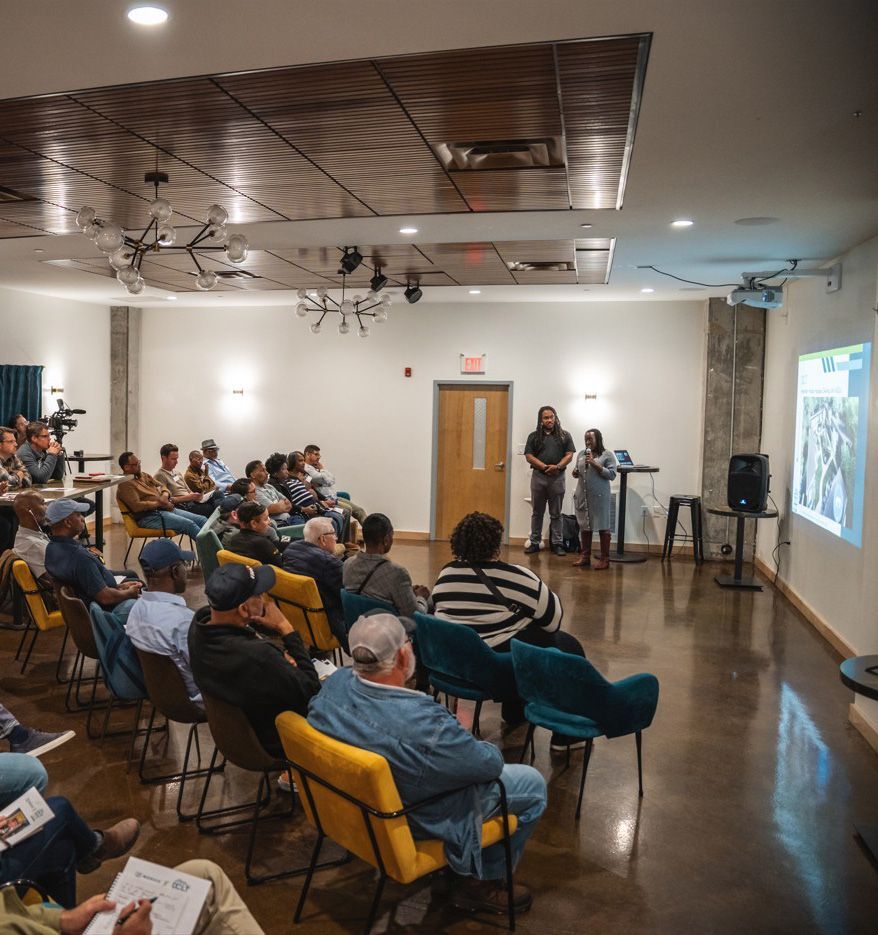
Taylor and DCLT recently cohosted a modular construction training class in partnership with Module where 65 government officials, nonprofit developers, lenders and contractors toured one of their modular units and learned about offsite construction.
What is her advice to CLTs and modular manufacturers interested in working with each other?
“CLTs need a [modular] partner that wants to understand how nonprofits work,” says Taylor. “We’re different from a traditional market-rate client and we have some different concerns. You want to find people who are mission aligned. For manufacturers [my advice is to] not think about CLTs as just another client. This could be a win-win situation where you’re contributing to communities.”
Community Land Trusts are rooted in the belief that stable, long-term housing affordability can transform lives — and they’re learning that partnerships with modular construction can strengthen that mission.
As CLTs and modular builders navigate rising costs, shifting markets and evolving community needs, one thing remains constant: mission alignment matters.
Modular companies interested in working with CLTs should take time to learn how these nonprofit organizations operate and build partnerships that support long-term affordability and community-centered housing solutions.
Heather Wallace is a freelance writer and industry engagement specialist with over two decades of experience in various areas of the building industry. She has covered topics on construction, technology, workforce development, green building, and sustainable living.