


OPAL Architecture uses Passive House strategies, mass timber and prefabrication to shape modern Maine homes.
• Maine architect OPAL combines Passive House, prefabrication and CLT mass timber with regionally responsive modern design principles.
• Site constraints, climate and local materials shape compact forms, porches and glass-rich homes integrated with landscapes.
• Future focus includes automated CLT design, biogenic materials and modular components to improve efficiency and sustainability.
To design a home that can withstand the challenges of a Maine winter, deliver a comfortable living experience and perform at a high level of energy efficiency, OPAL Architecture (OPAL) looks at the context of the site as well as at trends guiding the local market. The firm also integrates Passive House principles and mass-timber products such as cross-laminated timber, or CLT. (Editor’s note: OPAL Architecture is not affiliated with the OPAL Community Land Trust, also featured in this issue.)
Riley Pratt, Design Partner for the Belfast, Maine-based company, describes OPAL’s design philosophy as critical regionalism. “It’s a fundamental idea of modernism that form follows function,” says Pratt, “but local and contextual response should also drive architectural design.” He says the company adapts its design thinking to take advantage of local ways of building, whether construction assemblies, architectural forms, or materials.
OPAL’s portfolio includes many site-built residential and institutional projects, but in recent years it has gravitated more toward prefabrication, something Pratt has worked on for many years. This included a period of time with GO Logic, a prefab builder in Belfast, Maine. “We worked with stick-frame panelization, basically panelizing Passive House building shells and exterior insulation,” he says.
OPAL was the architectural arm of GO Logic before becoming an independent company in 2019. Today, OPAL is pursuing a system based on cross-laminated timber (CLT) panels.
Pratt’s experience has taught him the importance of having the delivery methodology in mind — whether panels, modules, or CLTs — as early as possible in the project. “With panels, for instance, trying to retroactively panelize the project introduces inefficiencies if you don’t understand how to maximize the panels and connections,” says Pratt. “And CLT is entirely different than stick framing and other types of systems.”
Smart Use of Limited Footprint
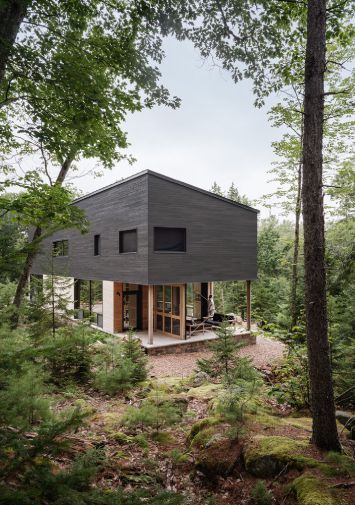
An example of OPAL’s work is “The Roost,” a private residence designed for a wooded, lakefront site in Maine. Intended as a year-round retreat for a large, extended family, the home sits within a conservation easement, which severely limited the buildable footprint.
To make the most of the space, a two-story porch was designed at one end of the building to provide overlapping spaces including a sheltered entry, a screen porch and an upstairs sleeping porch. Large areas of glass allow the slightly elevated living spaces to feel part of the surrounding woods.
The palette of exterior materials includes a stone base that ties the building to the sloping, rocky ground with minimal grading. A lower band of clear, unfinished eastern cedar provides a warm and welcoming tone at the ground floor. An upper band of dark-stained cedar embeds the second story within the surrounding evergreens and reduces the visibility of the home from the lake. Terraces are built with rustic local stone to reflect nearby ledge outcroppings.
The porches are detailed with carefully crafted and exposed white oak framing as a nod to traditional seasonal Maine cottage architecture. The compact building form and simple roofline help mitigate the energy impact of large amounts of glass.
Balance of Volumes and Voids
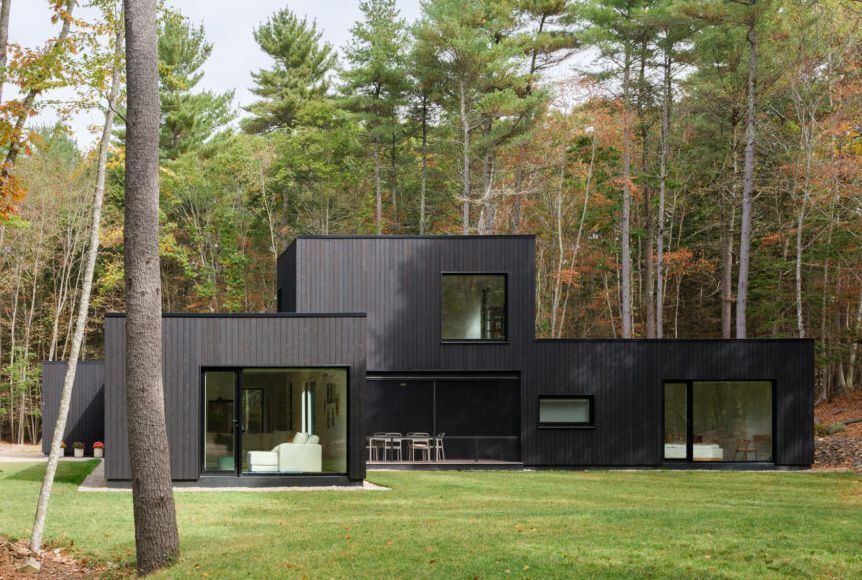
“Elemental,” another private residence in Maine designed by OPAL, was conceived as a contemporary home for a young family of four. The home is a sculptural composition of dark rectangular volumes and carved voids.
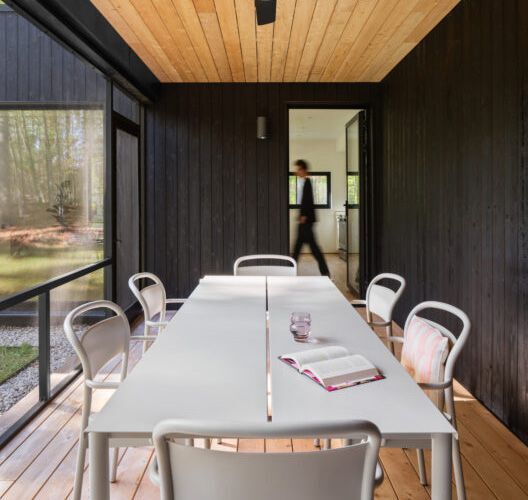
Simple forms, a slab-on-grade foundation and modest structural spans allow for an efficient and cost-effective structure. Large areas of floor-to-ceiling glass create moments of transparency throughout. “The contrast of the glass openings with the dark siding produces a lantern-like effect,” Pratt says.
The L-shaped floor plan separates the driveway and vehicles from a partially sheltered, private yard space. A generous entry porch provides a covered connection to a small garage and shop.
The house has two strong circulation axes, one for gathering spaces and one for private bedrooms. A flexibly programmed second floor provides an away space that functions as an office, den, playroom, or gym. A screen porch is located at the hinge point of the two axes, opening onto the kitchen.
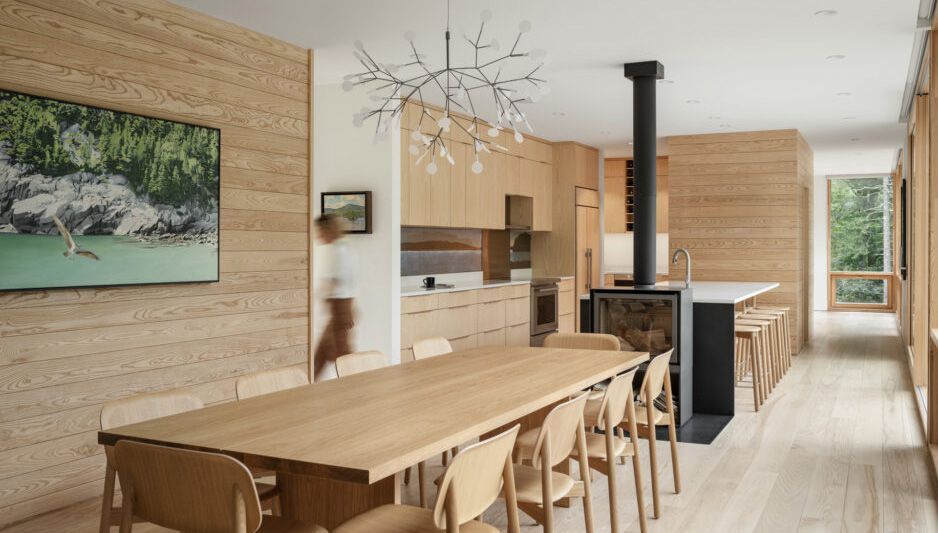
The wood siding is charred in Japanese shou sugi ban style, adding a beautiful and subtle material quality to the exterior surface. The dark exterior contrasts starkly with the airy, bright interior that is accented by locally sourced white ash.
Looking to the Future
OPAL, Pratt says, was founded on the principles of high-performance, or ecological, design. And it continues to push the boundaries of prefabrication. “Accepting Passive House strategies, certainly for the cold climate of the Northeast, makes a lot of sense, but poses certain restrictions on design in the sense that it’s a benchmark of energy usage you’re working against.”
Those constraints, he says, produce a particular architectural response: the walls and roof are quite thick. “It’s a somewhat different look than the absolute thinness you might see in mid-century modern or International Style modern.”
Triple-glazed windows engage the designer’s ability to use larger areas of glass. “There’s also a freedom in the design in that you can rely on the robustness of the system to support that classic modernist ideal of connection,” Pratt explains.
“The system we’re currently pursuing is all biogenic,” he continues. “We’re building with wood, which has a much lower carbon footprint than, say, mineral wool or concrete sandwiched between rigid foam.”
OPAL is looking into leveraging the use of automated processing systems for CLT design. “That would reduce labor on the design and engineering side as well as on the construction side,” he explains. “With CLT, the factory is already set up to fabricate and cut [the wood] and is highly automated.”
At press time, OPAL was also investigating modularized kitchens and baths.
Wildfire Prototype
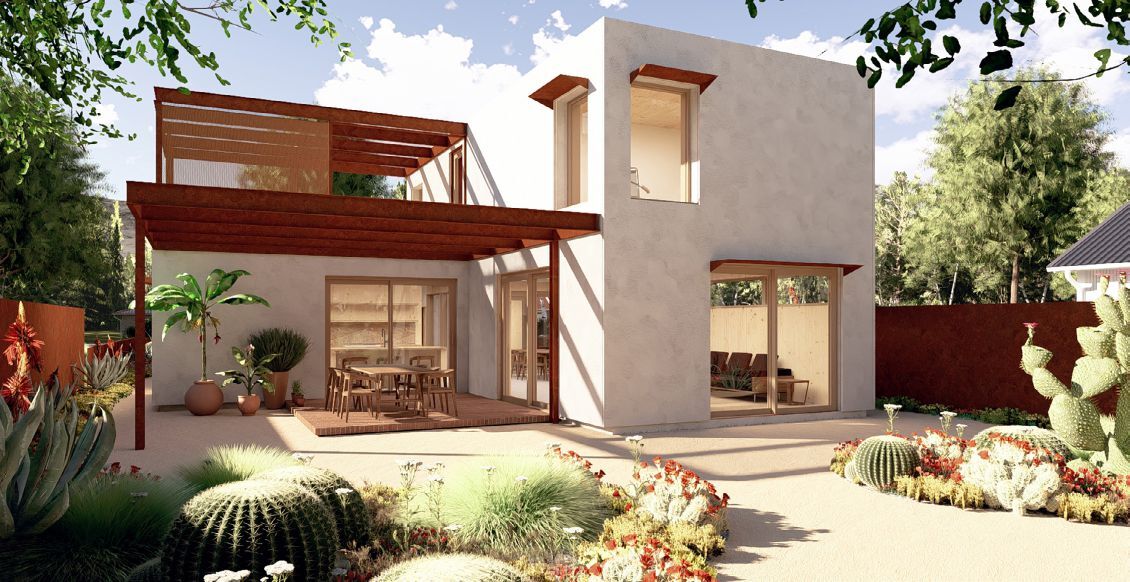
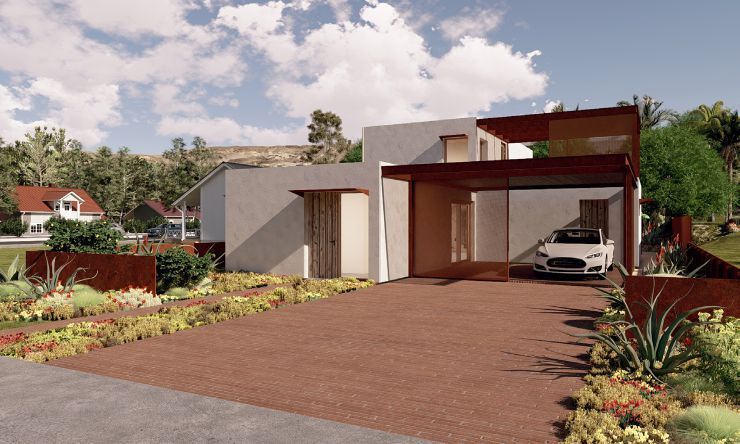
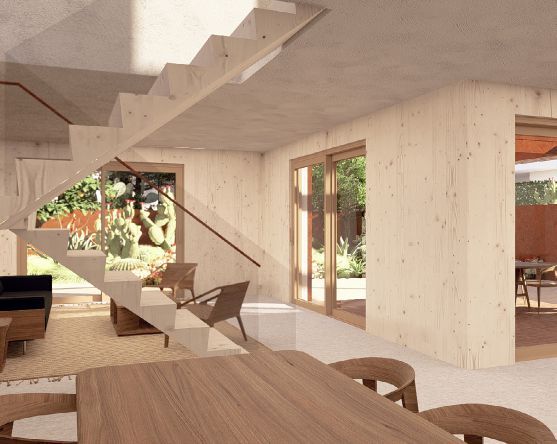
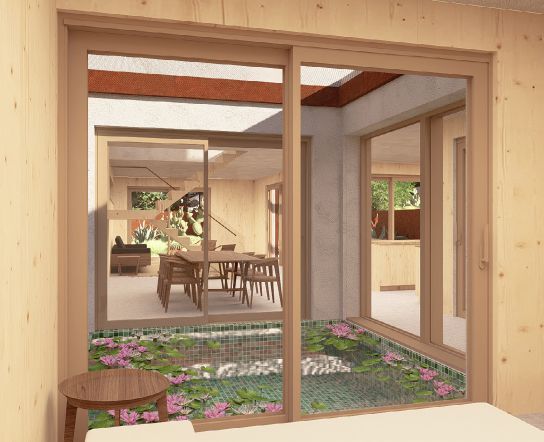
Although based in Maine, OPAL’s Passive House approach can be adapted to any climate. Case in point is a recent project called “Villa Vaga,” which won its category in a Passive House competition that charged entrants with designing prototypes for areas impacted by the California wildfires. Villa Vaga was developed for an infill site indeveloped for an infill site in Altadena, a fire-damaged suburb of Los Angeles.
The home is sited on a typical small lot (48 ft. x 124 ft.). It wraps around a series of partially enclosed outdoor spaces, including the carport, a water garden, a generous patio adjacent to the primary living spaces and a roof terrace.
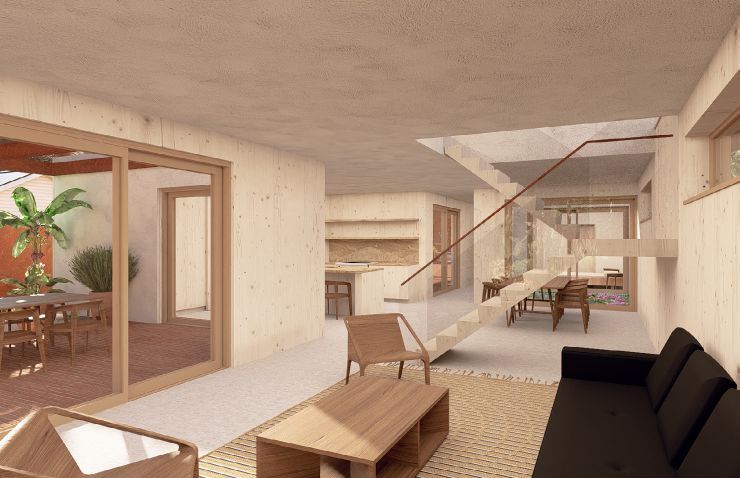
The building shell is composed of biogenic composite panels consisting of a mass-timber CLT base layer with rigid wood-fiber insulation. The entire assembly is covered in a fire-resistant, non-combustible, clay plaster finish. Paired with triple-glazed European-style windows and doors, the assembly is carefully detailed to eliminate thermal bridging and achieve Passive House airtightness.
A ground-floor bedroom enables aging in place, and could easily be converted into a private home office, guest room, or income-generating tenant space. The layout also anticipates the addition of an Accessory Dwelling Unit (ADU) within the lot’s setback boundaries and lot-coverage limitation.
Villa Vaga is more than an inspired answer to disaster recovery. It is a resilient, future-ready model for California’s evolving climate, Pratt says.
Susan Bady is a freelance writer based in Muskegon, Mich., who focuses on residential and commercial design and construction topics including sustainability and building technology.