



Revised appraisal rules will finally quantify energy performance, and will reward builders and manufacturers who provide it.
• Appraisals that consider total cost of ownership, including long-term energy costs, can help qualify more buyers for mortgages.
• New tools that translate utility savings into mortgage capacity are removing barriers to energy-efficient homes.
• Appraisal standards due in late 2026 will encourage appraisers to recognize the value of these features.
Housing challenges are agnostic to construction type. Whether stick-built, modular, panelized, or prefab, the reality is that many homebuyers are not going to be swayed by the offsite versus stickbuilt argument. The more important topic on their mind is attainability.
In early 2026, a National Association of Home Builders (NAHB) study showed that in 39 US states and the District of Columbia, over 65% of households can’t afford the median-priced new home.
Unpredictable and increasing energy bills exacerbate the problem. A report from the Lawrence Berkeley National Laboratory shows that electricity prices rose nationwide between 2019 and 2024. And the challenge continues. In Washington state, for example, if implemented a recent proposal by Puget Sound Energy would mean an increase in residential electricity rates by nearly 30% between 2027 and 2029.
By focusing on Total Cost of Ownership (TCO), including energy bills, conversations about the price of a home can move beyond the initial purchase price and instead focus on a comprehensive financial assessment of all costs associated with the purchase, operation and maintenance of the home over its lifespan. Offsite builders who evaluate the TCO rather than just the purchase price, can evaluate how to market, value and manufacture homes that ensure long-term savings, achieve lower utility bills and increase resale values.
Fortunately, a planned update from the Federal Housing Finance Agency (FHFA) on how new homes are appraised should support the TCO discussion. It’s scheduled for publication in late 2026 and promises consistent recognition of energy-saving features.
Accounting for Utility Bills
Historically, mortgage qualifications have considered the principal, interest, taxes and insurance (PITI) the homeowner will have to pay. Operating costs have mostly been an afterthought. But rising utility bills may change that.
Energy efficiency can sometimes be categorized by builders and buyers as a barrier, rather than a benefit, because of perceived upfront costs for equipment. But what if there was a way to shift that thinking to realize financial differentiators?
Don Worthington, Division President of Primary Residential Mortgage, Inc. (PRMI), a national mortgage lender based in Layton, Utah, says that by reducing or eliminating utility bills through efficiency and on-site generation, the freed-up dollars can be rolled into the mortgage to fund the very upgrades that decrease energy bills even further.
“Homebuyers can maximize the operating cost of a home by using the money they would have spent on a utility bill to instead fund improvements in energy efficiency,” says Worthington. For instance, if energy-saving features reduce utility costs by $300 per month, and if the home’s energy performance is factored into the appraisal, they might qualify for an extra $50,000, enough to fund the upgrades.
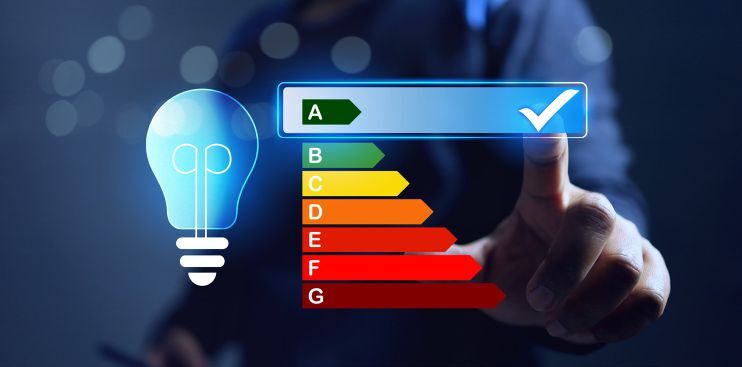
He says that investments in efficiency offer long-term benefits. “Focusing on home improvements that lower the cost of living in the home, versus upgrading countertops for example, creates a return on investment that can be realized in the first month and compound to an even greater return over time,” he explains.
To help homebuyers understand their estimated buying power, Worthington and his team developed Lowtility, a tool aimed at converting projected utility cost savings into mortgage-qualified buying power that funds efficiency, electrification and solar. By rolling energy upgrades into the loan financing, homeowners can reduce utility bills enough to offset or exceed the added loan cost, resulting in lower overall monthly expenses. This also removes a barrier for homeowners who want efficiency, but maybe can’t afford the upfront investment.
Reducing the consequences of rising utility costs provides homeowners with long-term savings through stabilized monthly expenses and protects them against increasing energy prices. The Lowtility equation considers both PITI, plus utilities (PITI + U), and reframes attainability by treating energy costs as part of the mortgage equation. Upcoming changes to appraisals will support this.
New Rules Coming
The Uniform Appraisal Dataset (UAD) is a standardized set of requirements for appraisal reports mandated by Fannie Mae and Freddie Mac, housing-specific Government-Sponsored Enterprises (GSEs), under the direction of the FHFA.
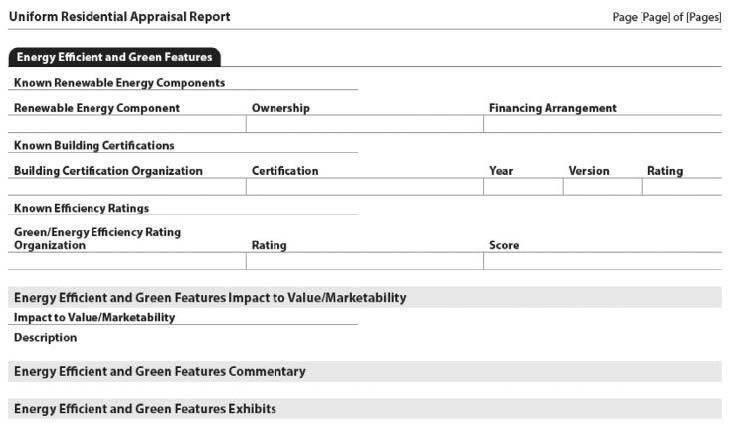
Starting on November 2, 2026, appraisers will be required to use the latest format update, UAD 3.6, for residential properties. The update will replace multiple legacy forms with a single, dynamic Uniform Residential Appraisal Report (URAR) that standardizes data fields to improve consistency, increase data quality and machine readability, and enhance energy efficiency specific insights.
Where past appraisal forms only allowed for general comments about energy systems and performance levels, the updated form will permit appraisers to assign verifiable values to energy-efficient upgrades. Dedicated fields for energy features will allow for specific items like solar systems, insulation and windows, HVAC, storm mitigation or safety features and certifications. The UAD 3.6 update mandates standardized, detailed reporting of energy-efficient and green features that will create a foundation for integrating evolving energy standards, technologies and regulatory requirements that can easily be compared.
Homebuyers have been able to request a green appraisal (a specialized valuation of a property that accounts for energy-efficient, sustainable, and high-performance features) since 2011, but only an accredited Green Appraiser could complete the appraisal. And according to Earth Advantage’s Accredited Green Appraiser’s list, only about 725 of them currently exist in the US.
“There were almost six million [real estate] transactions completed in 2025,” says Worthington. “Finding a Green Appraiser was like looking for a needle in a haystack.”
Path to Attainability
Updated appraisals will not solve the low inventory problem, but could at least provide some relief. Worthington says that in specific areas around the country, the supply doesn’t come close to the potential demand of new homebuyers.
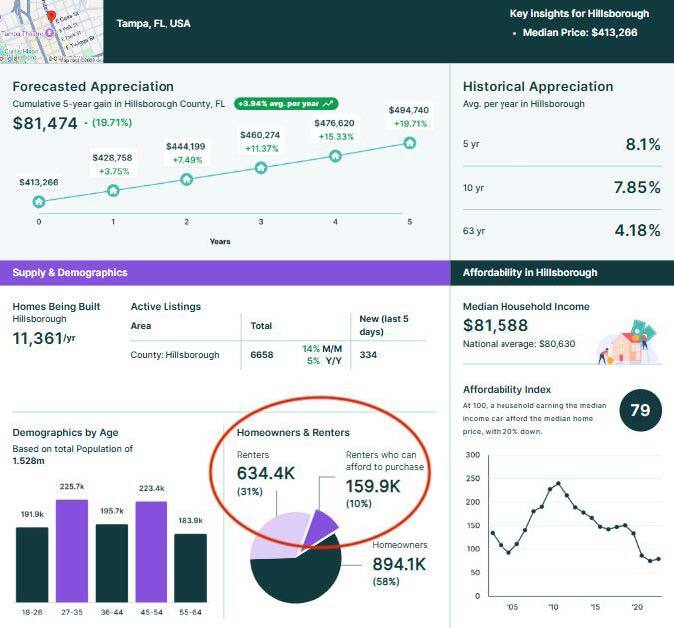
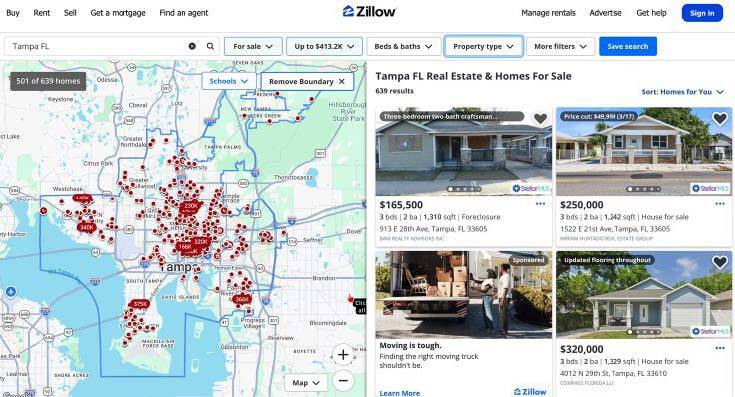
For example, in the Tampa, Florida market there are around 634,000 renters, 159,000 of whom have the means to purchase a median-priced home in that area. However, a Zillow search for housing supply for that market, under the median sales price, showed there are only 639 results (on April 1, 2026). “And that doesn’t even mean they’re good homes,” adds Worthington. “That just means they’re listed.”
However, Worthington believes that whoever can build the house with the lowest utility bills is going to win the attainability contest.
“If two houses are the exact same price, but one is $300 a month cheaper to operate because it doesn’t have the utility expenses, it’s going to drive demand. And demand is going to create value,” says Worthington.
Benefits for Offsite Builders
Offsite construction can provide solutions for the nation’s lack of housing supply. The offsite advantage is the ability to produce consistently, control materials and provide predictable, transparent and verifiable housing.
The UAD 3.6 standards provide manufacturers with a roadmap and an opportunity to leverage productization, repeatability and quality. A spec and performance guide can be created for each unit, highlighting documented energy ratings and verified performance. While this can be valuable at the time of sale, it can also be significant for a homeowner for the future sale of the home proving affordability, predictability and financial performance over time.
Ultimately, affordability will remain the dominant driver of demand, while energy efficiency continues to emerge as a powerful — but often underutilized — financial differentiator. Manufacturers who can clearly translate performance into tangible savings, provide consistent and verifiable data, and align their messaging with specific buyer segments will be best positioned to lead. In a market defined by uncertainty, those who simplify the path to homeownership — and communicate it effectively — will stand out.
Heather Wallace is a freelance writer and industry engagement specialist with over two decades of experience in various areas of the building industry. She has covered topics on construction, technology, workforce development, green building, and sustainable living.