

What modular homebuilders can learn from the company producing more than 200 factory-built coffee shops every year.
- Industrialized construction reaches its full potential when builders think like manufacturers instead of traditional construction companies.
- Standardization, digital design and factory production create buildings faster, more consistently and at greater scale.
- CMC’s success suggests modular housing’s greatest challenge may be industry mindset rather than manufacturing capability alone.
One of the most compelling examples of industrialized construction success doesn’t stem from housing, but from the most popular and heavily traded commodity in the world: coffee.
Creative Modular Construction (CMC), a Springfield, Missouribased manufacturer specializing in commercial modular buildings, has quietly become an important player in this space over the last five years.
CMC produces fully-finished 7 Brew Coffee shops, a company founded in 2017 in Northwest Arkansas, which currently has over 700 drive-through locations across 38 states. Its business model has caught the attention of providers of housing and other repeatable building types.
Committing to Modular
The company’s story begins decades earlier with a friendship between 7 Brew Founder and CMC Owner, Ron Crume, Jr. and another famous coffee entrepreneur.
Crume first met Travis Boersma, Co-Founder and Executive Chairman of Dutch Bros Coffee, while growing up in Grants Pass, Oregon. Long before Dutch Bros became one of America’s fastest-growing coffee chains, the two were classmates when Boersma came up with an idea to begin serving espresso from a VW Bug pulling a single-axle trailer and espresso cart. He made a deal with the city to rent power from a power pole in a parking lot, pulled out a boom box for music and began selling coffee out of a parking lot. That small idea eventually evolved into the drive-thru coffee phenomenon now known as Dutch Bros.
Years later, when Crume was preparing to launch what would become 7 Brew Coffee, he reached out to Boersma for advice. Rather than viewing Crume’s venture as a potential competitor, Boersma had his own engineers review Crume’s plans, and offered feedback to help him succeed. Crume describes that generosity as reflective of Boersma’s philosophy: successful people want to see other people succeed. That guidance helped shape more than just another coffee brand.
With a background in machining, precision grinders, excavation and construction, Crume made one decision early on that would ultimately lead him down the path into industrialized construction — every 7 Brew location would be built using modular construction. The advantages of predictable schedules, a controlled building environment year-round, and no material damages or jobsite theft, allowed 7 Brew to grow rapidly while maintaining consistency and quality.
As 7 Brew expanded nationally, Crume made the decision to launch Creative Modular Construction in 2021 to focus on manufacturing modular buildings for his coffee chain. In 2024, Blackstone announced a growth equity investment in 7 Brew to accelerate its already rapid expansion across the US.
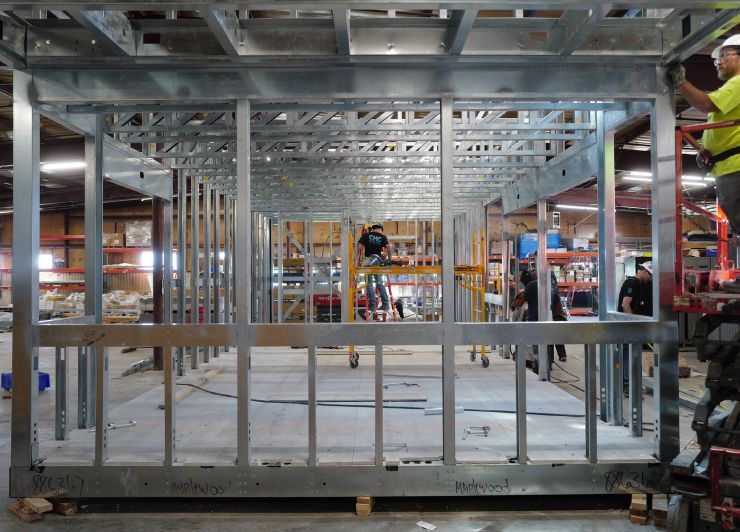
Every CMC structural component is digitally designed before fabrication. Steel framing members are CNC-produced, pre-punched, dimpled and engineered so each piece fits only one location. Plumbing penetrations, electrical openings, floor layouts, wall panels and finishes are manufactured with machine-level precision, dramatically reducing human error while increasing repeatability.
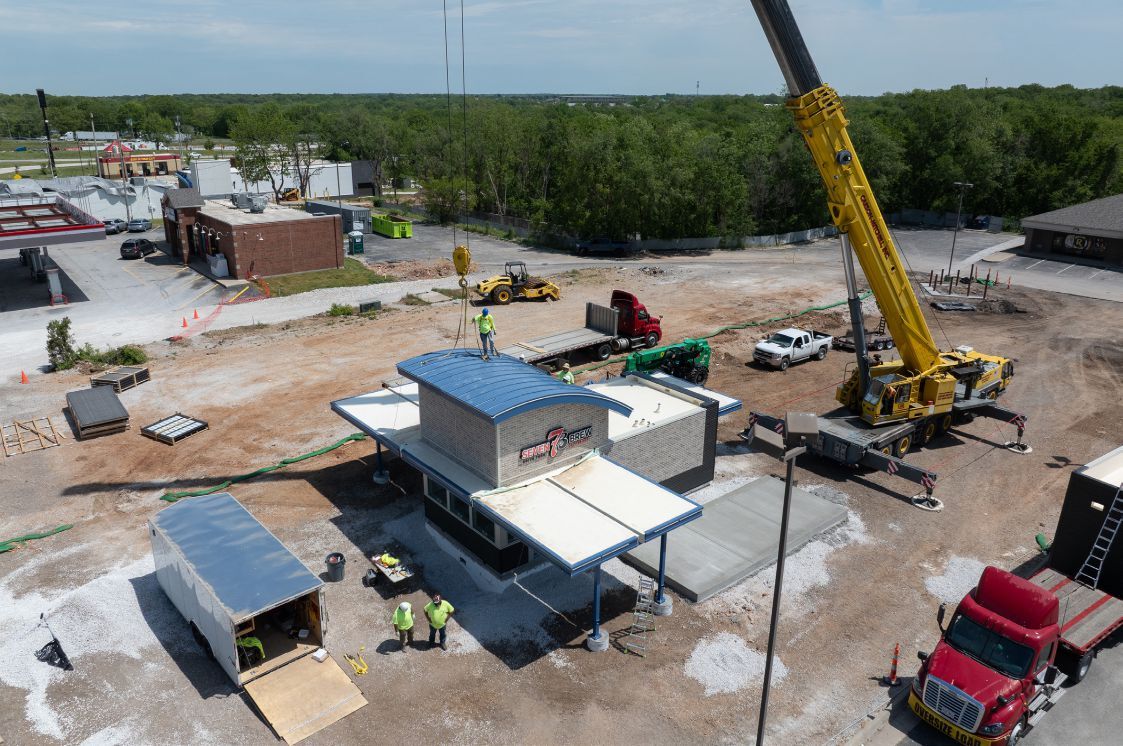
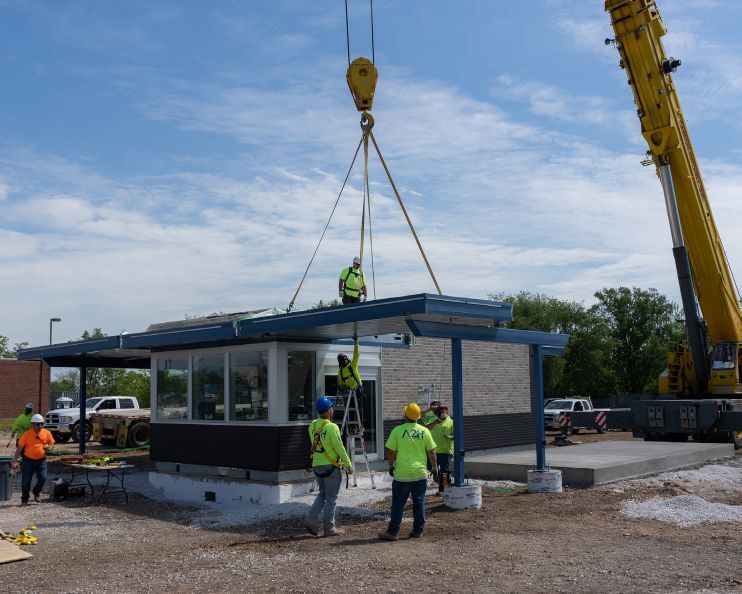
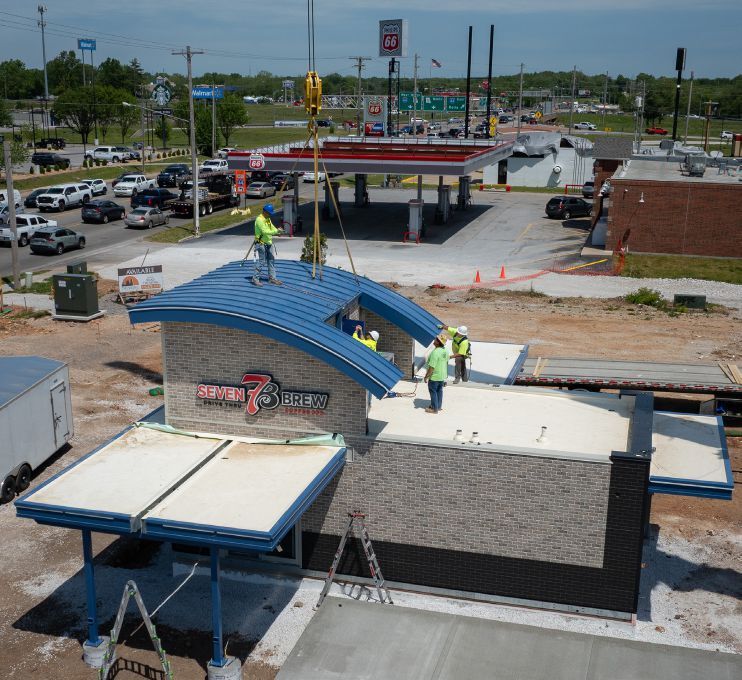
The result is a factory capable of shipping five completed commercial buildings every week — more than 200 7 Brew locations annually — with more than 300 already scheduled for 2027. Once delivered, entire buildings can be craned into place, connected and assembled within two days. In just five years, CMC has grown from approximately 20 employees to more than 585.
Other Potential Markets
But the company’s greatest opportunities still lie ahead.
CMC currently operates from ten separate leased facilities throughout the US and is constructing what will become one of the largest modular manufacturing campuses in the country. The first manufacturing facility on the campus encompasses approximately 750,000 sq. ft., with a second facility of equal size already planned. Together, the campus will total roughly 1.5 million sq. ft. under roof, creating enormous production capacity for future projects. And that scale has implications far beyond coffee shops.
With their focus on repeatability, CMC has the potential to become a steady manufacturer for other companies with scalable products like hotel rooms, military barracks, or standardized housing. The company intentionally avoids one-off projects, instead refining systems through repetition until production becomes highly optimized. Housing could be the next logical application.
Crume acknowledges that communities and public officials have already approached CMC about modular housing developments. He believes the company’s structural system would produce homes that are stronger and more consistent than many conventionally built structures while remaining highly scalable once standardized models are established. Although CMC continues to evaluate the market carefully rather than rushing into residential construction, the manufacturing foundation already exists.
Workforce Innovation
Another impressive part of CMC is their workforce. More than 400 of the company’s 585 employees are individuals who have previously been incarcerated and are seeking a second chance. Rather than hiring people still serving sentences, CMC partners with organizations supporting men and women reentering society after prison. The company surrounds employees with mentoring,accountability, optional faith-based studies and a culture focused on rebuilding lives alongside careers.
According to Crume, they have a 70% retention rate when an employee remains at CMC through their first 90 days. Community leaders, judges and public officials have recognized the program’s exceptional retention and reduced recidivism rates, while monthly company gatherings celebrate milestones that many people take for granted — sobriety anniversaries, obtaining driver’s licenses, stable housing, family reunification and homeownership.
“Culture is everything,” says Crume. “I believe that culture is treating your team members the way you want your team members to treat your customers. How can you walk in and treat your team members in a way that’s not edifying and then ask them to treat your customers differently? You must treat those team members with the same love, compassion, respect and enthusiasm that you want them to show your customers, and we did that at both 7 Brew and CMC.”
For an industry facing growing demand for housing, hospitality, healthcare and military infrastructure, the lesson is clear: the future of modular construction isn’t simply about building faster. It’s about creating building systems that pencil for your business, investing in people and creating factories capable of producing quality buildings at industrial scale.
Creative Modular Construction has already proven that model with coffee shops. The question now is how broadly that success can be applied to the next generation of industrialized construction.
A Repeatable Model
For industry leaders, CMC’s story is about much more than a successful coffee chain expansion. It illustrates what becomes possible when building design, manufacturing, supply chain, workforce development and business strategy are intentionally aligned around repeatability. The organizations that succeed in this type of niche will likely be those that think less like traditional construction companies and more like advanced manufacturers.
CMC has already shown that industrialized construction can deliver consistency, speed and scale in the commercial sector. Whether that model becomes equally transformative for housing may depend less on manufacturing capability and more on the willingness of the industry to embrace standardized products, long-term partnerships and a fundamentally different way of building.
Heather Wallace is a freelance writer and industry engagement specialist with over two decades of experience in various areas of the building industry. She has covered topics on construction, technology, workforce development, green building, and sustainable living.