


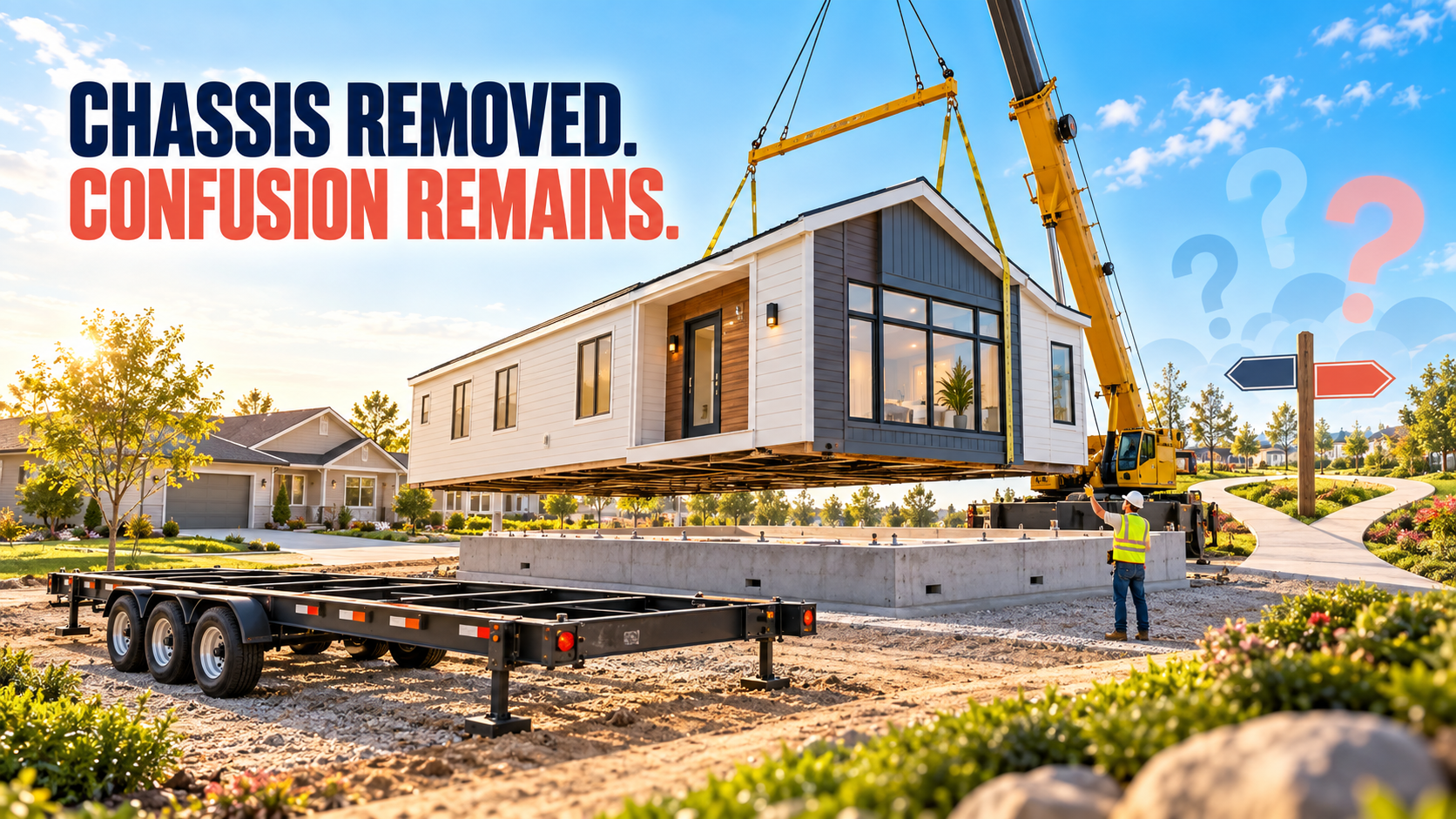
The 21st Century ROAD to Housing Act became law on July 11, 2026. It changed the federal definition of a manufactured home from one built “on a permanent chassis” to one built “with or without a permanent chassis.” The law also requires special labels, data plates, invoices and state-level regulatory parity. This is evidence that Congress itself anticipated identification and classification problems.
For fifty years, the steel chassis served as the tell-tale sign in differentiating between manufactured and modular housing. Congress has removed that dividing line. If the home’s appearance, foundation, transportation system and construction location no longer identify what it is, the definition must now come from the codes, approvals, inspections, certifications, titling and regulations governing it.
Congress has given the states up to two years to prepare their systems for the change and to train their people, but they haven’t provided the funding for that change. How do we think this transition will go?
Removing the chassis may not remove a barrier to housing. It may simply replace a physical barrier with a psychological one.
Will zoning officials understand that a chassis-less module is not necessarily part of a modular home built to the IRC (International Residential Code)? When reviewing plans and performing field inspections, will they know what code they are inspecting for? What happens when they get it wrong?
More confusion comes when appraisers attempt to find comps. What are they comparing the home to? Will local MLS’s update their systems to identify chassis-less manufactured homes? Most MLS’s still struggle to understand the difference between modular and manufactured.
Misclassifications will also flow downstream to the lender, who depends on the appraiser to tell them what they are lending on and its value.
Will lenders, insurers and title agencies classify the home according to its certification, or according to its appearance? And what happens when a unit is foreclosed on, and it’s discovered that what the lender financed isn’t a modular home but a chassis-less manufactured one?
HUD requires manufactured home installers to be certified or licensed, and allows states to act as the Administrative Agency, managing licensing and inspections. In states without such programs, HUD directly regulates installers and enforces the standards. Without a chassis, will excavators, foundation companies, etc., perform work on chassis-less manufactured homes not knowing that they don’t hold the required licensing or certifications to be part of the installation team?
There are other issues as well: Will ‘modular’ become even more misused as a marketing term? What happens at resale when the original paperwork is missing? And finally, do America’s homebuyers even care?
Removing the permanent chassis may open the door to better designs, lower costs and greater innovation. But it also removes the most visible distinction between manufactured and modular housing. If regulators, lenders, appraisers, builders and homebuyers cannot confidently determine which classification a home falls into, which code governs it and how it should be treated, they will hesitate.
In housing, as in life, confusion rarely leads to action. When people are uncertain, they stop. Permits stall, financing pauses and appraisals become more conservative. Homebuyers walk away.
The chassis may be disappearing, but the need for clear definitions is not. If we want this change to expand housing, the industry must replace the certainty once provided by the steel frame with something stronger: clear identification, consistent regulation and relentless education. Otherwise, removing the chassis may not remove a barrier to housing. It may simply replace a physical barrier with a psychological one.
If you liked this article, you can follow Ken Semler on LinkedIn, where he offers daily insights and commentary about offsite construction.