
I get asked several times a month, “How much market share does modular, industrialized construction have?” Today it’s between 3% and 5%, but there was a time when that number was higher. That is, before the Great Recession wiped out about half of the existing factories.
Of course, many site builders were also wiped out. But when demand returned, they simply hired more people, bought more tools and equipment, and were back in business. Not so for modular factories, which can’t just restart the way a builder can. The factories that shut their doors were gone forever.
The challenge isn’t building better buildings. The challenge is learning to speak the language of capital.
Today, however, the opportunity for industrialized construction (IC) is better than ever. It began after the COVID-19 pandemic, when construction was hit with a perfect storm. Material prices went through the roof, labor disappeared and interest rates doubled from what they had been over the previous 10 years. Home prices spiked and have stayed that way: they’re now higher than they have ever been. Academics, developers, investors and others in the industry are increasingly looking to IC as an option, but have not yet identified it as the solution they need. Why?
The answer is that we’re not convincing the customers we need that we have a solution to their problems. Factories and builders lead their marketing with the concepts of faster construction, better quality, reduced labor, factory precision, etc. But developers don’t wake up looking for any of those things.
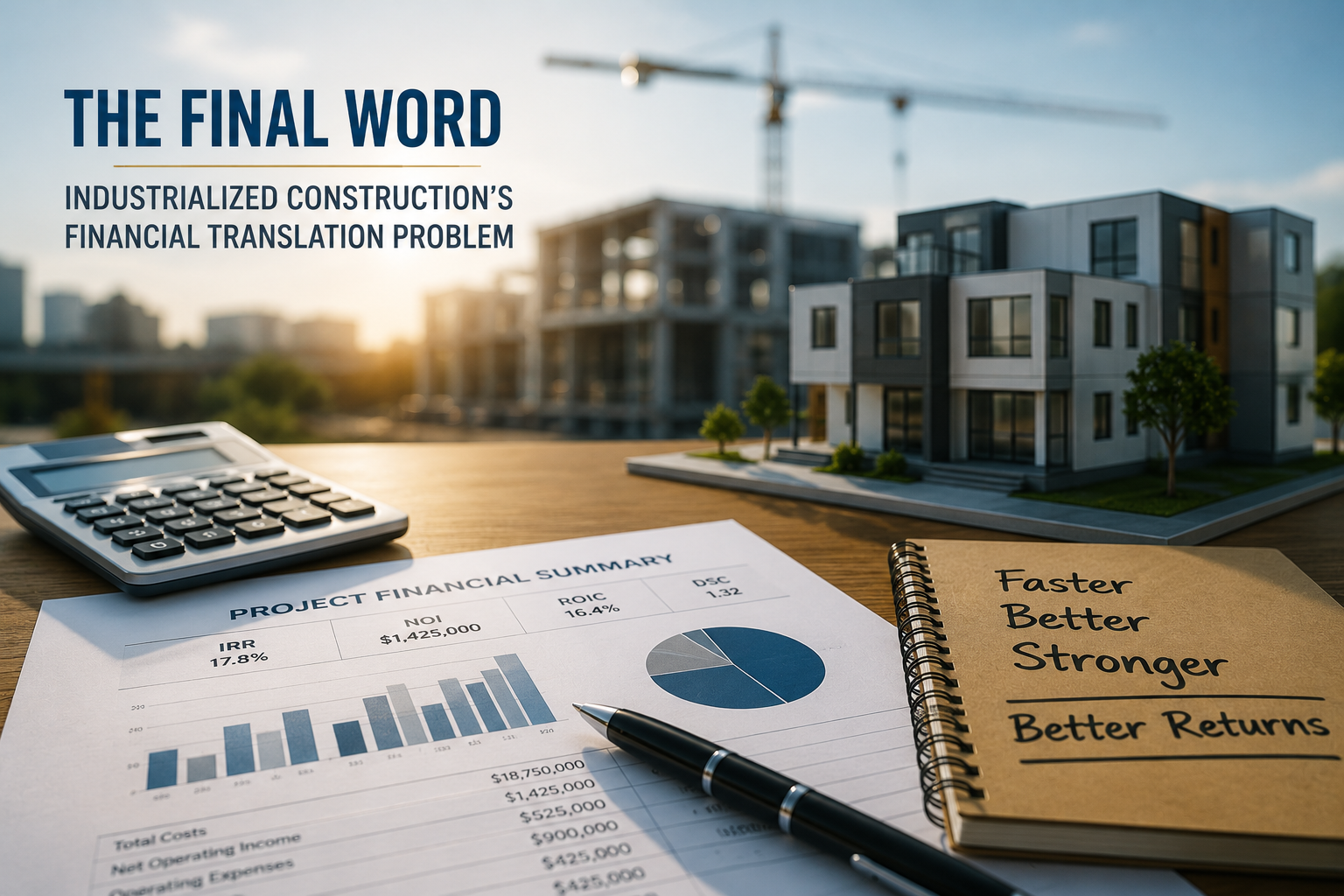
Developers care about Internal Rate of Return (IRR), Net Operating Income (NOI), Return on Invested Capital (ROIC) and Debt Service Coverage (DSC). They aren’t looking to buy modular construction; they are looking to buy financial outcomes. And with the Industrialized Housing industry being hyper-fragmented, there isn’t any one entity big enough to carry the torch and get that message out there.
Well, consider the torch lit.
Rather than talking about speed, lets start monetizing it. Instead of saying “we’re 30% faster,” let’s quantify what a 3-month schedule reduction does to project economics. The answer is earlier lease-up, earlier occupancy, earlier rent collection, reduced interest carry and faster capital recycling. Speed is not the benefit; it’s merely a mechanism. The benefit is improved IRR.
Industrialized construction needs a financial translation layer. Most professionals in the industry come from manufacturing, construction, engineering, or architectural backgrounds. Few come from real estate development, institutional investment, or capital markets. The result is that IC’s technical advantages don’t get translated into compelling financial narratives.
An informed industry would emphasize metrics such as IRR comparisons, carry-cost reductions, capital deployment models, sensitivity analysis and risk-adjusted return scenarios. Developers understand spreadsheets, but the industry keeps showing them factories.
The industry needs to stop selling construction and start selling capital efficiency. This is a mindset shift. A smart builder will position itself not as a builder, but as a “capital efficiency partner,” a “return enhancement platform,” or maybe a “risk mitigation system.” Presentations to potential customers should answer questions such as: How will we help you improve IRR? Reduce risk? Accelerate capital velocity?
The opportunity is bigger than the industry thinks. We have spent many years working to convince developers and investors that modular is faster, and most already believe that. But what they don’t understand yet is how that translates into higher returns.
IC won’t achieve mainstream adoption until the industry proves, in financial terms, that it creates better investments. The challenge isn’t building better buildings. The challenge is learning to speak the language of capital.
If you liked this article, you can follow Ken Semler on LinkedIn, where he offers daily insights and commentary about offsite construction.