


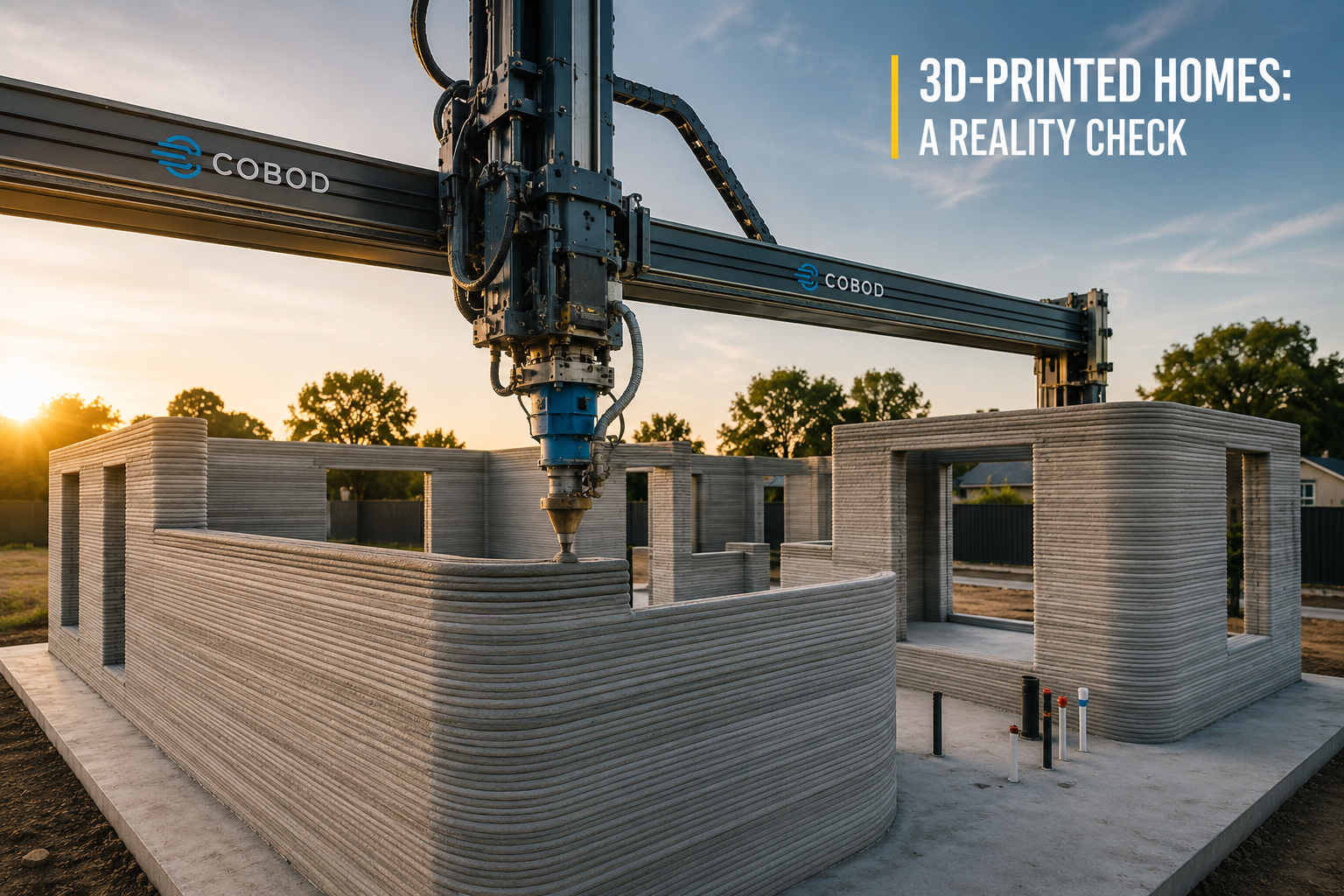
Every few months, another headline announces that a company has “printed a house in 24 hours.” The videos are impressive. A giant robotic concrete printer slowly moves back and forth while layers of concrete rise from the slab like toothpaste from a tube. Investors smile, politicians tour the site, and reporters talk about the future of housing.
Six months later, the home still isn’t finished, because all that was printed were the exterior, and perhaps some interior, structural walls. The rest of the work had to be done same way it always has been done.
To be fair, there are real advantages to 3D-printed concrete homes. The shell can be completed much faster than a conventional frame, and in areas with severe labor shortages, that matters. In disaster recovery situations, it could matter even more. Printed concrete walls can also offer durability advantages in hurricane- or fire-prone regions, while some companies report lower material scrap and the need for fewer on-site workers during the shell construction phase.
But once the shell is complete, the project’s pace slows because the rest of the work depends on traditional trades, inspections, scheduling, deliveries and subcontractors. That’s a very different story than “houses built overnight.”
Then there’s the cost question. Ask ten people in the 3D-printed housing space whether these homes are truly cheaper, and you will likely get ten different carefully worded responses because the honest answer is: sometimes.
The printing equipment itself is extremely expensive (the operators require specialized training), concrete mixtures are often proprietary, engineering approvals can be complicated, insurance and financing are still evolving, and many municipalities are uncertain about their permitting requirements.
Some projects have absolutely shown savings while others ended up costing about the same as conventional construction.
One reason I’m skeptical about the industry-changing nature of this technology is that offsite has a long history of revolutionary announcements that eventually collide with reality. Panelization was going to completely transform housing. Then, modular was going to dominate the market. Then, volumetric high-rises were set to replace conventional apartments. Then, robotics would eliminate labor problems. Then, AI would redesign everything overnight.
Most of those technologies did advance the industry, but none eliminated the messy realities of land costs, zoning, labor shortages, financing, transportation, inspections, local politics, utility delays, or developer risk. 3D printing won’t eliminate them, either.
Ironically, the future of 3D concrete printing may not be complete homes at all. It may end up being far more useful in smaller, targeted applications where its advantages outweigh its complications.
Printing foundations could become common. Small ADUs might make sense. Emergency housing and disaster recovery structures could become ideal applications, while certain military or remote-site buildings may benefit greatly. Low-labor regions may eventually adopt the systems more aggressively than the traditional residential market.
I imagine modular factories using printed wall systems, printed foundations, or hybrid structural components combined with traditional offsite methods. That may prove far more practical than trying to completely reinvent every part of residential construction.
A new technology doesn’t always replace the old system. Sometimes it simply becomes another tool inside it.