

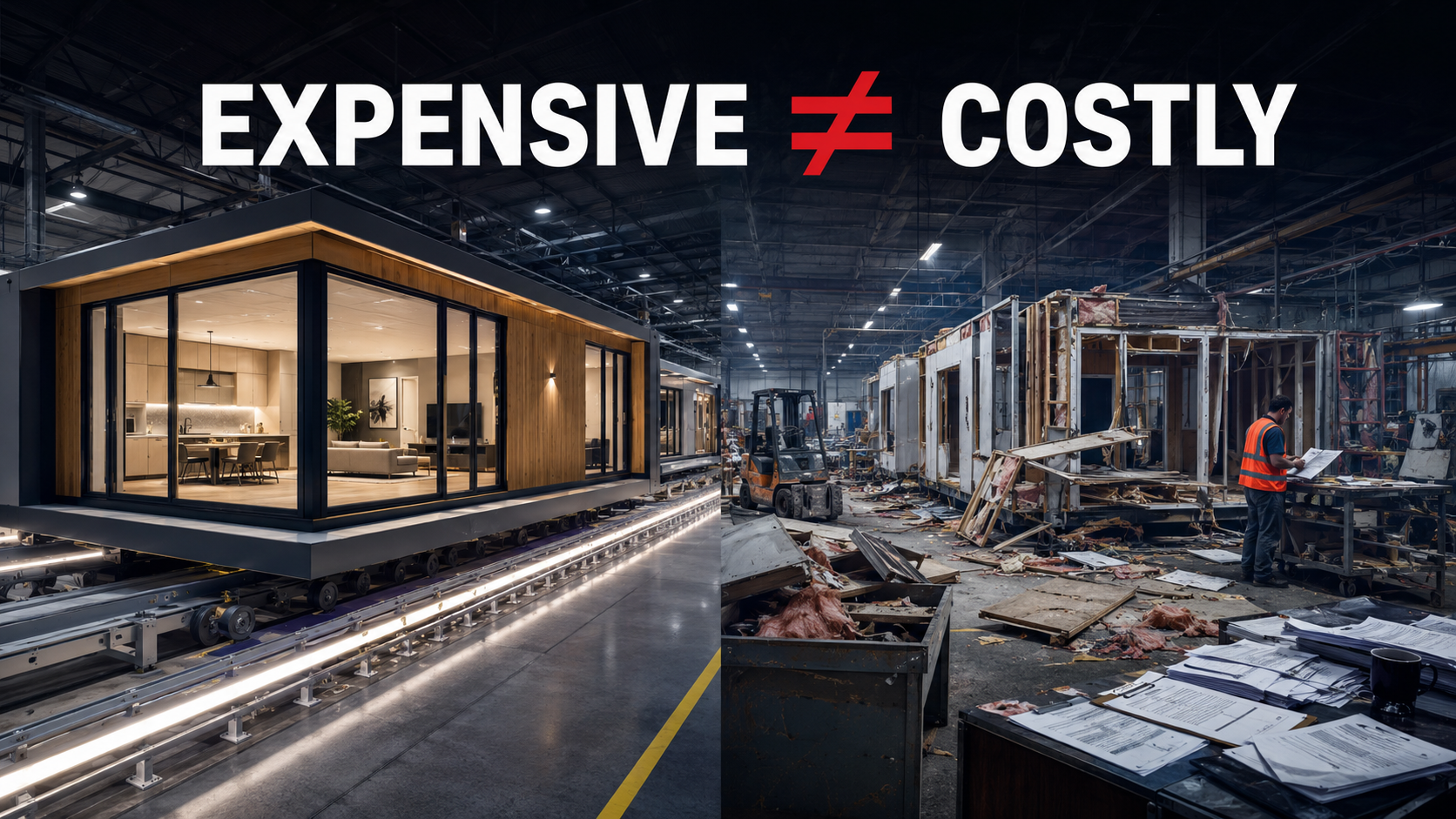
One of the more interesting conversations I had recently centered around two words that many use interchangeably: expensive and costly. At first glance, they mean the same thing. Both suggest something requires a lot of money. But in offsite construction, whether management understands the difference can be a big factor in how efficiently a factory operates and whether it’s focused on solving the right problems.
An expensive product is one that commands a higher selling price. Premium materials, custom floor plans, superior energy performance, advanced technology, architectural design and luxury finishes all add value that customers can see and appreciate.
A $600,000 modular home isn’t necessarily overpriced compared to a $350,000 model. If buyers perceive the value and are willing to pay for that value, a higher price becomes part of a product’s market position. In fact, many successful manufacturers don’t compete on price: they compete on quality, reliability, speed, or features. Their homes are expensive because they deliver what buyers want.
Costly is a different story. A costly operation is one where money disappears into inefficiencies, mistakes, delays and waste. The factory might be plagued with excessive overtime, material damage, poor scheduling, late design revisions, transportation delays, inventory problems, or constant rework. None of these add value to the product; they simply raise the cost of producing it.
In many cases, the buyer is totally unaware of these problems. The home arrives looking exactly as expected. The factory absorbs the financial pain.
As an illustration, imagine two factories building virtually identical modular homes.
Factory A has streamlined operations, efficient workflows, and very little rework. It produces a home for $350,000 and sells it for $400,000. Factory B sells the same home for $400,000 but because of production delays, material waste, overtime and management inefficiencies, the build cost is $390,000. One operation is profitable while the other is costly.
Over the years, I’ve noticed that many factories focus heavily on reducing selling prices to increase sales volume, which they assume will make them more profitable. Management meetings often revolve around questions like:
“How can we make our homes more affordable?”
“How can we lower our selling price?”
“What features can we eliminate?”
Those questions may be relevant, but they tend to overlook a bigger issue. The better question may be: “Why does it cost us so much to build what we’re already building?” Management needs to address the inefficiencies that can cost hundreds of thousands of dollars annually.
Improving efficiency has the added value of creating options. A factory that reduces operational costs can earn more profits, reduce its prices, invest in equipment, improve wages, or strengthen its balance sheet. Sometimes it can do several of those at once.
When production becomes more efficient, manufacturers gain flexibility. They can decide to remain a premium-priced producer if the market supports it, or they can pass savings along to customers if competitive conditions require it.
Either way, they win.