

An inadequate grasp of revenue and profit has sunk a lot of businesses.
• The factory-built portion of a modular home likely accounts for just 1/3 to 1/2 of that final $450,000 selling cost.
• Many industry newcomers don’t understand that FOB (free on board) costs are just a starting point.
• The real story of offsite construction is not factory production, but managing a complex housing delivery system.
A lot of people in the modular industry — including startup entrepreneurs, developers, investors and even some factory owners — need a serious wake-up call about what really goes into the final selling price of a modular home project. The truth is that the factory may only see a fraction of that final price.
I can’t tell you how many times I’ve heard someone proudly point to a modular home selling for $450,000 in a planned community, then immediately assume that the factory must be making enormous profits. Some even convince themselves that modular factories are sitting on giant margins simply because the retail selling prices sound impressive.
The reality is very different. Misunderstanding that reality has probably contributed to more failed startups and to more unrealistic business plans than almost anything else in offsite construction.
The Factory: Part of a Machine
When a buyer purchases a completed modular home in a planned community, they are not simply buying a factory-built structure. They are purchasing a finished real estate product for a price that includes land, infrastructure, permits, engineering, utility connection, site work, landscaping, project management, financing costs, scheduling coordination and builder overhead.
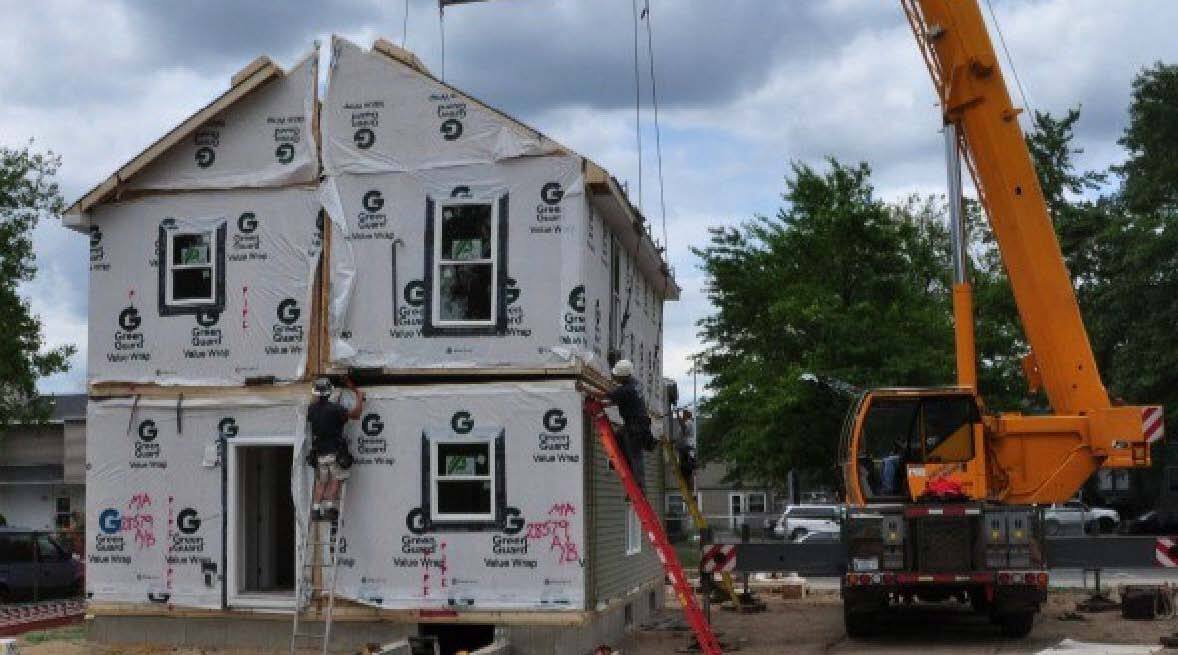
The factory may have built the modules, but someone else had to make the entire project come together.
That distinction matters because many people entering the industry focus entirely on the modular structure itself while underestimating everything surrounding it. The modular industry has always done a good job of selling the efficiency of factory construction, but sometimes we unintentionally create the impression that the factory accounts for most of the project’s value. In reality, many other hands are reaching into the same pot long before the buyer receives the keys.
Where the Money Goes
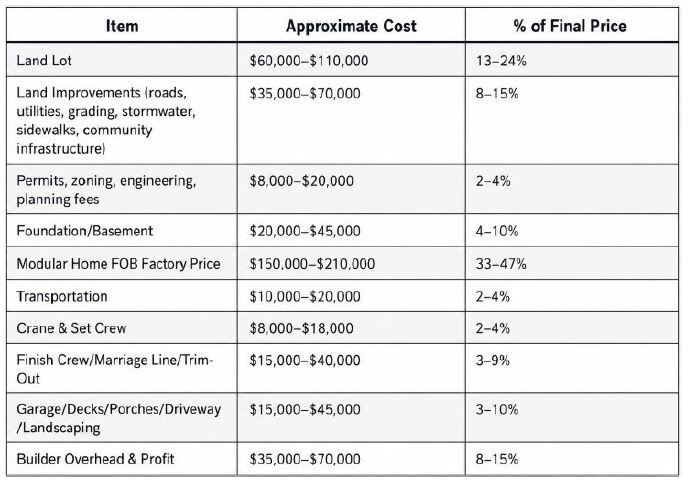
Here’s a fairly realistic breakdown for a mid-level modular home built to theInternational Residential Code and selling in today’s market for around $450,000.
When people take a good look at the numbers, many are shocked to discover that the factory-built portion leaving the plant may only account for $170,000 to $190,000 of the completed project’s value. Yet consumers, reporters and even some people in the construction industry still tend to look at the final selling price and assume most of that money somehow belongs to the factory.
It doesn’t.
Development Costs Devour Budgets
One of the biggest hidden cost centers in planned communities is land development. Before the first module ever arrives on-site, developers may already have hundreds of thousands, or even millions, of dollars tied up in infrastructure and approvals.
Roads must be built, utility lines installed, stormwater systems engineered, sidewalks poured, retention ponds approved, environmental studies completed, grading work performed and financing must be carried month after month while municipalities slowly work through approvals.
None of those costs creates visible square footage inside the home, but every one of them becomes part of the final selling price.
This is one reason modular construction alone does not automatically solve affordable housing. Factory efficiency can absolutely reduce labor waste, improve scheduling, shorten timelines and improve quality control, but it cannot eliminate high land prices, local impact fees, infrastructure expenses, permit costs, financing charges, or zoning delays.
That reality frustrates many people who enter offsite construction believing modular alone is the magic answer to high housing prices.
FOB Confuses Almost Everyone
Another major misunderstanding revolves around the FOB factory price itself. FOB stands for “free on board,” and in the domestic modular industry, refers to the price of the module at the factory, loaded and ready for shipment. Many newcomers assume the factory quote includes everything necessary to complete the home. In most cases, it does not.
Depending on the project and the, builder, the FOB quote may or may not include upgraded finishes appliance packages, garages, decks, porches, drywall completion, flooring upgrades, HVAC work, utility hookups, site-built additions, smart home systems, or premium kitchens and bathrooms.
Two modular homes that appear almost identical from the street can have dramatically different factory costs depending on specifications and scope. Experienced modular builders understand this completely, but newcomers often don’t discover it until change orders, site conditions and upgrade requests begin stacking up during the project.
That’s when the “easy profits” they imagined start disappearing.
I honestly believe this misunderstanding is one reason many startup modular entrepreneurs fail. They look at finished retail selling prices and assume that factories capture most of that revenue. On paper, the numbers look incredible.
Then reality arrives.
Transportation costs fluctuate, finish crews become unavailable, municipal approvals stall projects That creates unrealistic expectations for months, site conditions create unexpected expenses, utility companies delay hookups and interest expenses keep accumulating while homes wait to be set.
Suddenly, the beautiful spreadsheet that looked so profitable during the planning stage begins bleeding cash from ten different directions.
The modular industry isn’t “easy money.” It’s a complicated coordination business involving manufacturing, logistics, real estate development, construction management, municipal approvals, scheduling and customer service all happening simultaneously.
Factories are only one part of that equation.
Better Explanations Needed
Sometimes our own industry contributes to the confusion. We showcase beautiful, finished homes in glossy marketing photos without fully explaining the enormous amount of work, coordination and expense that exists outside the factory walls. among consumers, investors, local officials and entrepreneurs looking to enter the business.
The truth is impressive enough on its own. Modular factories are not building houses in a vacuum. They are one component inside a much larger integrated housing delivery system that depends on developers, site contractors, transportation companies, municipalities, finish crews, lenders, utility providers and dozens of moving parts all working together.
That’s the real story of modern offsite construction.
So, if you really want to understand the offsite industry, stop staring only at the selling price of the finished home and start following where every dollar really goes. The modular factory may be the heart of the process, but land developers, municipalities, utility companies, site contractors, lenders finish crews and overhead costs are all standing around that heart with their hands out too.
And sometimes, after everybody gets paid, the factory owner is left wondering where all the supposedly “easy money” went.
Gary Fleischer is Editor-in-Chief of Offsite Builder magazine.