
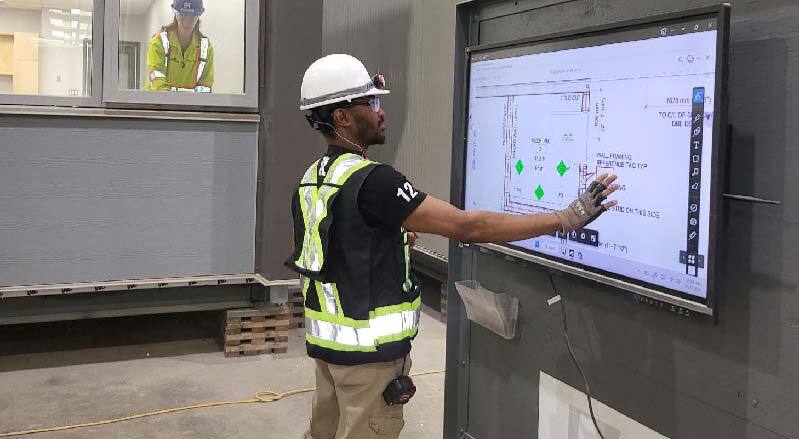
Modular manufacturer Modus Structures shows how documented quality systems are a powerful competitive advantage.
• The company built its reputation by matching QA/QC processes to each client’s quality, durability and compliance priorities.
• Director Ron Hegdahl relies on layered inspections, stop points, audits and witness testing to prevent costly mistakes.
• Modus turns quality into a competitive advantage by documenting performance, tracking KPIs and showcasing processes to clients.
What does a robust QA/QC program look like in practice? And how can you use such a program to enhance your reputation and win clients?
For some perspective on that question, we spoke with industry veteran Ron Hegdahl. Hegdahl has spent 36 years in the construction industry, his last six as Director of QA/QC and Compliance at Modus Structures (Modus), a Canadian modular manufacturer based in Crossfield, Alberta.
Modus has built roughly 90% of the modular classrooms constructed in the province over the past two decades — close to 4,000 units. It has recently expanded into multifamily housing, office buildings, police stations and large institutional projects such as the Siksika Recovery Centre, a 45,000 sq. ft., 65-module addiction recovery center in southern Alberta.
Know What the Client Needs
One of the first things Hegdahl points out is that quality isn’t a single standard. It shifts depending on who you’re building for and what they need from the finished product.
On the commercial and institutional side, clients are primarily concerned with durability and code compliance. “You’re dealing with a Part 3 building, typically, so you’re in a more stringent area of the building code,” Hegdahl says. (Part 3 of the National Building Code of Canada deals with fire protection, occupant safety and accessibility for specific building classifications, based on what a building’s used for, its floor area and its height.) He says these clients need to understand the processes the manufacturer uses to make sure everything that’s being built will meet the code as well as the job specifications. In addition, many government projects require LEED certification.
Material choices reflect the importance of durability. Modus uses wood veneer cabinetry in classrooms because it “handles a lot of abuse and is easy to repair over time.” Doors, windows and flooring are all selected with longevity and wear in mind. “If we’re doing a dentist office, for example, then they might want a high-end appearance but there’s a lot of foot traffic with dirty shoes, so the wear surface of the of LVP [luxury vinyl plank] flooring has to be considered when selecting the specific product.” Whereas for a multifamily building with multiple floors, “the acoustic properties of a flooring product are critical to keep noise levels down, ” he explains.
Homeowners have different priorities. They’re focused more on aesthetics, fit and finish. “Wear and tear are likely less critical,” Hegdahl says. “But you typically have to work with tighter tolerances on your finishes in residential than in commercial.” A homeowner scrutinizes the quality of a paint job or the operation of doors and drawers more carefully than a facilities manager at a school district or the developer of an office building.
Build Layered Inspections
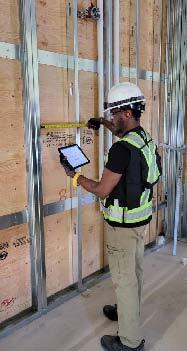
The Modus QC team is five inspectors, including a supervisor, who each spend about 70% of their time on the floor doing inspections and observations. The company has different types of inspection processes: observations, audits, stop points and witness tests.
“When an inspector isn’t doing a formal check, they’re just walking through the plant and making observations, which they document.” If the inspector spots a deficiency, they let the lead hand — the person who directs the crew in question on the shop floor — know that, before the formal inspection happens, they need to correct it and document the correction.
Auditing is spot-checking. “It’s random, which keeps the lead hands on their toes,” Hegdahl says.
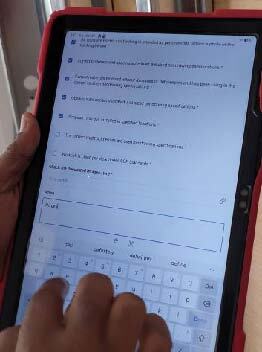
Stop points are mandatory holds where no work can proceed until a QC inspector has reviewed the stage. Hegdahl says, “Thou shalt not proceed on work until we lay eyes on it, because your next step is going to cover it up,” making it effectively inaccessible. Modus has approximately a dozen hard stop points across a typical module build. These include structural framing before the subfloor goes on, rough ins for electrical and plumbing before insulation, insulation and vapor barrier before drywall and cladding installation.
Hegdahl emphasizes how much is at stake at some of these stops. “Insulation and vapor barrier — those are items that cost a lot of money, either within our warranty or over the lifetime of a building,” he says. Getting it wrong is invisible until it becomes very expensive.
Beyond stop points, Modus conducts witness tests for key systems — electrical insulation tests, water pressure tests — where a QC inspector observes the test being conducted, records the values and signs off. “Electrical is one of the leading causes of building fires and a dielectric test ensures that none of the wiring insulation is nicked. It confirms the wiring is done right,” Hegdal says. If there’s any damage, the wire will need to be repaired or replaced.
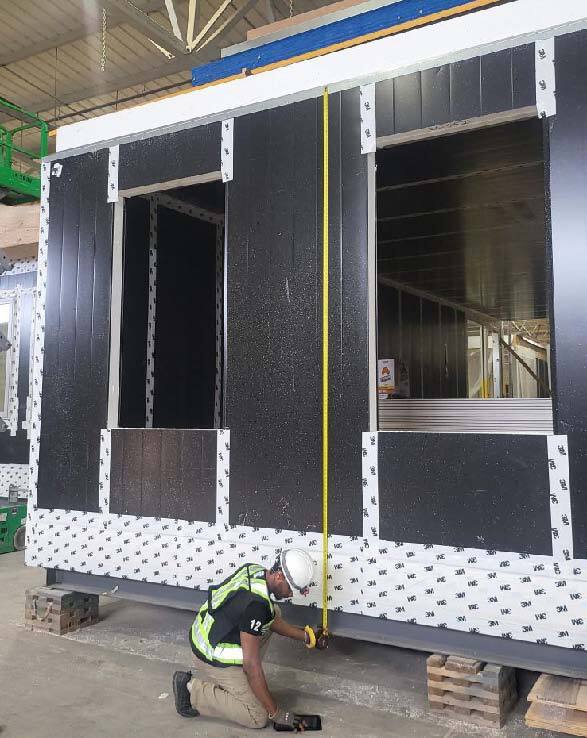
They also run squareness and dimensional checks at multiple stages. “We do what we call a cube test, where we check the squareness of the module in three dimensions,” Hegdahl explains. For a project where 50 modules join to form a single building, dimensional accuracy at the factory directly determines whether site installation goes smoothly. “Tolerances vary depending on exactly what we’re building, but as a rule of thumb, our target tolerance is a quarter of an inch, plus or minus an eighth of an inch, for both wood and light gauge steel construction. Our SIP panels have tighter tolerances. For those, it’s typically an eighth of an inch, plus or minus a sixteenth.”
Document Everything
Modus runs a fully digital QC system in the factory. “The QC team takes a lot of photos, which stay in the project file. Electronic checklists are completed and retained. Non-conformance reports, test records and corrective action documents all form part of the quality package for each project.”
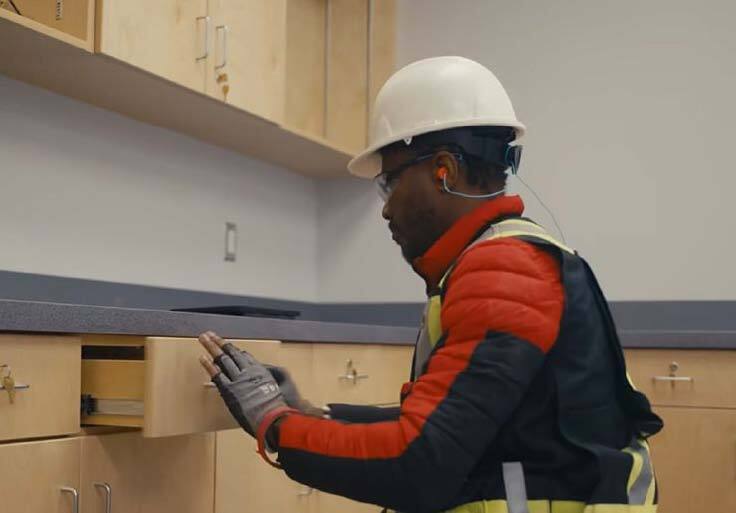
Incoming materials are also “spot-checked to make sure the CSA [Canadian Standards Association] marks are on the products” and that they meet the company’s own quality standards. Non-compliant material goes into a defined quarantine area, with a formal disposition process — whether it’s returned to the supplier, disposed of, or something else.
The guiding document for all of this is Modus’ factory audit manual. Modus’ prefab products have CSA A277 certification, which ensures prefab buildings meet the same standards as sitebuilt construction. The CSA A277 standards “dictate the minimum for your quality program,” Hegdahl says. The manual specifies this minimum, along with the company’s additional requirements. Modus’ program is so effective that their third-party certifier, Intertek, actually uses it as an example of how a QC program should be set up.
Not all of the documentation is shared externally. “The quality package generally stays internal unless it’s contractually required submitted,” Hegdahl says. But certain documents are always provided: “Air balancing reports for HVAC, and pressure and electrical test records are always provided to inspectors at the site. They consistently ask for those.”
Measure It
Modus tracks QC performance through formal metrics. One is First Pass Yield (FPY) — that is, how many modules were built without any non-conformance reports issued against them versus the total produced per year, weighted across multiple indicators. “We consider 95% to be a successful first pass at the end of the year,” Hegdahl says. “The FPY metric helps us identify opportunities for continuous improvement in processes,” he adds.
Another important KPI [key performance indicator] they track is what they call On Time and In Full, or OTIF. “When lead hands call for an internal final quality walk, we do it with a three-headed monster,” Hegdahl jokes. By that he means the final walk team includes the project manager, a QC inspector and the plant manager. “If work is incomplete, the module scores zero for that walk — it’s not in full.” Scores are also tracked for timeliness and for any non-conformance reports against that module. That gives the plant visibility on how well they’ve been doing. “When everybody knows there’s a grading system assigned to something, they seem to try to do better,” Hegdahl says.
Non-conformances at Modus are graded as minor, major, or critical. Anything above a “minor” triggers a corrective and preventative action process — a root cause investigation, an assigned action plan and monitoring for effectiveness up to a year. If the issue recurs, the process starts over again for that particular issue.
Use QC To Win Commercial Work
Hegdahl says that commercial and industrial clients will insist on understanding your processes before they award a contract. “They want to know how you ensure quality,” he says.
As part of that education, Modus runs facility tours for prospective clients. Seeing the stop points in action, watching inspectors work through checklists and understanding that the facility operates under third-party certification has an impact. “They get to see the proof in the pudding in action, live and it really opens their eyes even further and they see how much we do to make sure that, in this massive facility, every little detail is right,” Hegdahl says.
Modus also showcases its quality program on LinkedIn, including through videos.
When it comes to residential work, the marketing tool of choice is the show home. Modus is scheduled to build its first show home in May 2026, which will be located at their manufacturing plant. “A show home is probably the biggest selling feature, whether you’re an offsite manufacturer or you’re doing traditional site construction,” Hegdahl says. Prospective buyers will want proof that the show home is up to the highest quality standards. High-quality renderings and computer walkthroughs are also important because they allow residential clients to walk through a design before committing.
Build a Quality Culture
Hegdahl emphasizes that a quality program works only if the entire organization is behind it. “We have a motto: Everybody’s responsible for quality, and everybody has the authority to raise their hand and say, ‘this isn’t right,’” Hegdahl says. “It doesn’t matter if you’re sweeping floors or if you’re the President.”
This isn’t just lip service. Modus has a Kaizen-based continuous improvement program with suggestion boxes reviewed up through Hegdahl’s level. Suggestions can be anonymous or named.“Named submissions get a feedback loop: a response explaining whether the suggestion was adopted or not, and why. Successful suggestions are recognized at company town halls.”
That’s the formal process, but it’s more common for employees to simply make verbal suggestions. An example Hegdahl gives is a new hire who suggested a different method for installing windows. The old approach required lifting 400-pound classroom windows into rough openings in a way that risked damaging the self-adhered membrane, but that damage wouldn’t be visible. The new method is both a safer way to lift the windows and eliminates that risk of damage. “It’s safety and quality control improvement rolled into one,” Hegdahl says.
The underlying principle of the company’s QA program is “We treat these buildings as if we owned them, as if the money was coming out of our pockets to pay for them. That usually hits the target of what the customer wants.”
Zena Ryder writes about construction and robotics for businesses, magazines, and websites. Find her at zenafreelancewriter.com.