


Writing an Industry Playbook
Emerging standards can reduce uncertainty, streamline approvals and create the conditions for offsite construction to scale.
Builders, manufacturers and other professionals in the offsite construction industry want to be able to scale their businesses, and to make the process of designing, permitting and building structures as smooth as possible. However, there can be barriers to achieving the level of scalability and efficiency they dream of.
One barrier is an inconsistency in regulatory processes across jurisdictions. Another is variability in how factories design and manufacture modules and components. Efforts are underway to make both of those processes more consistent. These efforts will be an important step towards helping offsite construction achieve its full market potential.
Regulatory Inconsistencies
For offsite construction factories that aim to deliver to multiple states, varying regulatory structures force them to navigate a patchwork of requirements, and to adjust their processes for each jurisdiction. That’s true whether they’re shipping volumetric modules or closed panels.
One example is the quality assurance, or QA process. If a modular factory must use a different QA manual, with different procedures, for each state it delivers to, that added complexity will raise costs and will slow the process of expanding to new states, even if there’s strong demand for that factory’s modules.
Another variable is in how each state handles code approvals. We’re not talking about code requirements, which naturally differ between different climate and seismic or wind zones. What we’re talking about is how each state ensures that an offsite project is meeting those code requirements.
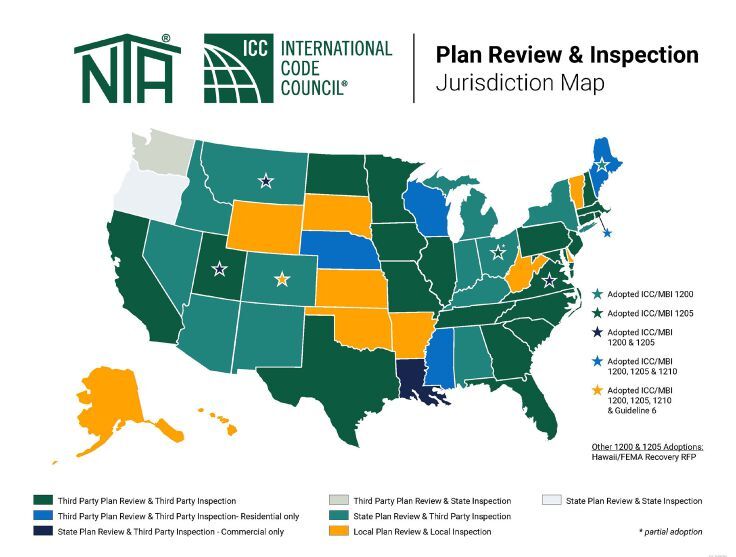
As illustrated in Figure 1, states handle offsite construction approvals differently. Some allow manufacturers to use third-party agencies to conduct plan reviews and to perform in-factory inspections while others rely on state employees to do one, or the other, or both. Some leave the entire approvals process to local governments where processes need to be established by each individual jurisdiction as projects are proposed. It’s a real patchwork.
Consistency in regulatory approaches would address this patchwork by requiring all inspectors and plan reviewers — whether they are contractors or government employees — to follow the same playbook. This would ensure that designers, manufacturers and builders could focus on the creation and delivery of projects rather than having to adjust their processes each time to meet the needs of different jurisdictions and different inspectors.
Updating the Codes
These challenges are why the International Code Council (ICC) and the Modular Building Institute (MBI) came together in 2018 to develop the ICC/MBI 1200 suite of offsite construction standards, which capture best practices from existing state programs as well as internationally. The standards govern details like what qualifications third-party plan review or inspection agencies need, requirements for QA manuals and what specifics need to be included in construction drawings.
As of May 2026, seven states are using the standards, but their full potential won’t be realized until there’s widespread adoption across the US. Fortunately, we’re about to take a big step in that direction, with the incorporation of the standards into the 2027 editions of the International Building Code and the International Residential Code. This is just the first step in a multi-year process — different states adopt code updates on different timelines — but it will put the industry on the path to a consistent approval system.
Of course, these standards will need to be updated on a regular basis, and once they’re incorporated into the code, those updates will be part of the normal code update process. As lessons are learned and the industry evolves, there will be opportunities to introduce new requirements that further enhance the standards’ utility.
The ICC/MBI standards are developed through an open, consensus-based process to ensure that they are effective and that they address the needs of multiple interests. There are numerous opportunities for industry professionals to get involved in this process, including participation as members of development committees or providing comments on public drafts. Once finalized, practitioners can also advocate for the adoption of these standards by policymakers.
Those wanting to get involved with the ICC/MBI standards will find information on how to do so at the following website: https://www.iccsafe.org/productsand-services/standards/is-osmc/
Supporting Scalability
In addition to its code updates, ICC is also working on voluntary design standards. These will be a further aid to helping offsite factories scale, and will also make it easier for different factories to collaborate on large projects.
Factories live or die based on the existence of a consistent project pipeline. However, projects can be hard to line up with developers, insurers, financial institutions and others who are unfamiliar with offsite construction and who harbor fears of failed projects. The standards under development will offer a solution.
Picture this: A developer is considering pursuing a modular apartment building, but has heard about a few high-profile factories closing, causing the need to either redesign the project to meet the requirements of a new manufacturer, or to shift to site-built construction. This uncertainty can make offsite construction seem too risky. However, what if the developer could be assured that another manufacturer could step in if necessary and complete the project with little delay and little re-design?
That is the promise of standards currently being developed by the Center for Offsite Construction (CfOC) at the New York Institute of Technology and ICC. CfOC/ ICC Standards 1220 and 1230 focus on bringing consistency to the connections and configurations of offsite construction components. Such an approach provides numerous benefits that enhance scalability:
• Developers gain confidence that a project can still proceed if a factory closes because, if other factories are building to the same standards, they will be able to step into the gap.
• For large projects that may require several participating factories, the standards help provide interoperability across components.
• If multiple developers adopt the standards, factories can gain assurance that a market exists for their products.
The CfOC/ICC standards are intended to be voluntary for both developers and manufacturers, but they offer an opportunity to address some of the critical gaps influencing the widespread deployment of offsite construction.
The bottom line here is that while offsite construction has enormous potential, realizing that potential will require overcoming barriers rooted in regulatory inconsistencies and manufacturing variability. The ICC/MBI 1200 standards represent a major step toward a uniform approval process across states, while the voluntary CfOC/ICC 1220 and 1230 standards will give developers, financiers and factories greater confidence to invest in offsite methods. Together, these initiatives create a foundation for the kind of scalability and interoperability the industry needs to move from promising niche to mainstream construction.
Author: Ryan Colker, J.D., CAE, Executive Director of Energy Resilience & Innovation (International Code Council) Ryan M. Colker is Executive Director, Energy, Resilience & Innovation at the International Code Council where he leads the Energy, Resilience and Innovation Center of Focus. Prior to joining ICC, Colker served as Vice President at the National Institute of Building Sciences where he directed the Consultative Council and served as staff director of the Off-Site Construction Council.