



Highlights from the 2026 Consumer Electronics Show in Las Vegas, Nevada.
In January 2026, I traveled to Las Vegas, Nevada to check out the Consumer Electronics Show (CES) — the world’s largest annual tech trade show, owned and produced by the Consumer Technology Association based in Arlington, Virginia. My goal was to identify products that could prove useful to offsite construction in the future.
The show gives visitors a look into current and emerging technology offerings, with product categories that include robotics, sustainability, gaming, smart communities and many more. Almost everything on display was infused with AI.
While much of what I saw was either still in a conceptual phase or had a way to go before it could pencil out financially, I believe it’s valuable to understand where things are headed. I will be watching the products mentioned in this article for their potential usefulness in the future of offsite construction and, additionally, will highlight a couple of smart home products I found that could be helpful to homeowners.
Humanoid Robots
These are really interesting, if a bit terrifying. They were the biggest crowd pleaser at CES, showcasing their ability to dance, hug, box, play the piano and participate in a game of ping pong, to name a few things. Humanoid robots can mimic human movement and tasks and, with additional programming and training, will only become more accurate as they are fed data on how people perform specific actions.
They’re already being tested and used in manufacturing settings in the US, but how useful could they really be in an offsite construction scenario? At present, not very. In the future? Possibly — if they are implemented in a thoughtful manner.
Chandra Pittu, Automation Manager at Autovol, a modular manufacturer located in Boise, Idaho that utilizes a sizeable amount of automation and robotics, has been watching the pace of progress with humanoid robots over the past few years. He’s not convinced they have enough human experience yet to create meaningful impact in Autovol’s factory.
“Although these systems may serve as useful tools in limited scenarios, they cannot match the impact of human judgment, adaptability and real-time decision-making,” says Pittu. “The lack of proven real-world field experience makes it difficult to assess whether these solutions can deliver meaningful, scalable value in practical applications.”
However, Pittu does acknowledge that this technology could prove useful at some point. The question is when, but recent developments are promising.
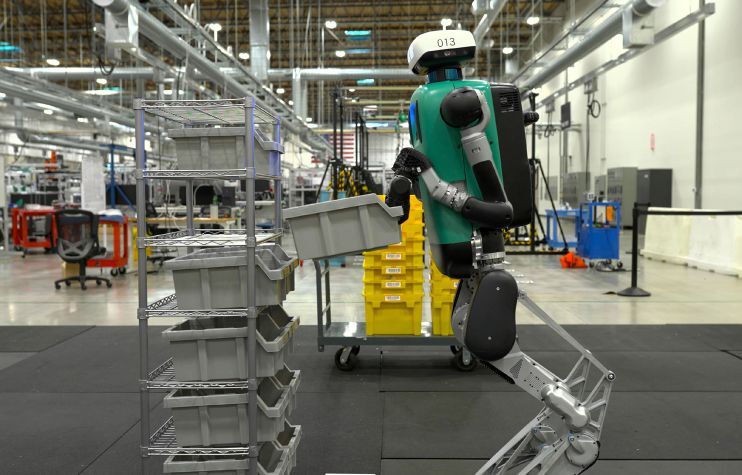
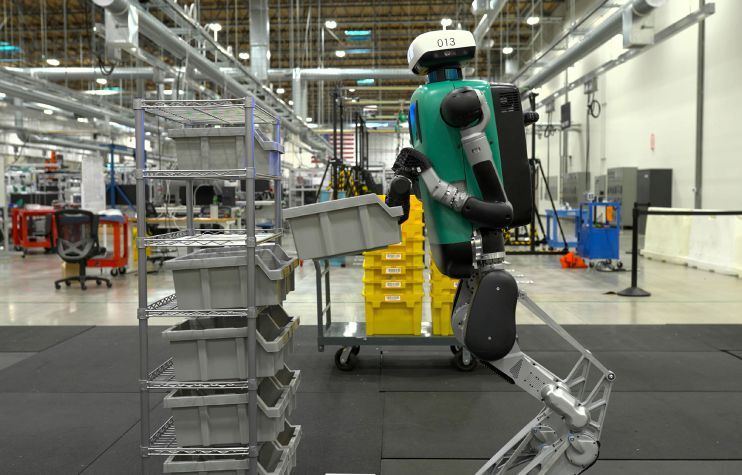
In 2019, Agility Robotics, a privately held humanoid robotics and engineering company based in Salem, Oregon, launched a humanoid robot called Digit, which is 5 ft. 9 in. tall, and can lift a 35 lb. payload 5 ft. 6 in. off the floor. In November 2025, Digit successfully moved more than 100,000 totes at GXO Logistics, a logistic solutions provider based in Flowery Branch, Georgia. The company claims that this milestone validated Digit’s capacity for “high-volume, reliable throughput, effectively establishing a clear, long-term Return on Investment” environments requiring repetitive manual labor. Atlas is water resistant and operates at its full capabilities in a temperature range of between -4 and 104 degrees Fahrenheit.
Another humanoid manufacturing robot is Tesla’s Optimus, which is being trained to organize vehicle parts and to perform work on conveyor belts for the company. Business Insider recently reported that Tesla will soon begin collecting more data in its Texas facility to assist Optimus with learning.
At CES, I was also introduced to Atlas, a general-purpose humanoid created by the Hyundai Motor Group affiliate Boston Dynamics, and noted for its human-like walking gait.
Leveraging AI-driven learning, Atlas can learn most tasks in less than a day. The robot has joints that rotate 360 degrees, can lift 110 lbs. and is able to perform precision tasks. It excels in environments requiring repetitive manual labor. Atlas is water resistant and operates at its full capabilities in a temperature range of between -4 and 104 degrees Fahrenheit.
Hyundai will be deploying Atlas at their Metaplant America in Savannah, Georgia by 2028, initially focusing on processes with proven safety and quality benefits, such as parts sequencing. By 2030, they expect applications to extend to component assembly, and over time, will also take on tasks involving repetitive motions, heavy loads and other complex operations. This should ensure safer working environments for factory employees while also advancing smart factory innovation.
While humanoids may not be perfect for modular factories quite yet, they have the potential to provide value in the future — but prices will need to come down.
Commercial humanoids are currently more expensive than traditional industrial robots for high-volume, repetitive tasks like welding or high-speed pick-and-place. Robozaps, an online platform providing the latest news and trends on humanoid robotics, reported that Digit will likely run between $100,000 to $250,000, Atlas around $150,000, and Tesla is targeting around $25,000 to $30,000 for Optimus (pricing does not include annual maintenance costs or training and integration costs).
Exoskeletons
An exoskeleton is a wearable device that augments, enables, assists, or enhances motion, posture, or physical activity through mechanical interaction with, and force applied to, the user’s body.
The first documented exoskeleton can be traced back to 1890 by way of a patent from Russian engineer, Nicholas Yagn. In 1917, Leslie C. Kelley invented the “Pedomotor,” a steam-powered device designed “facilitate the operation of pedestrianism or running operation.”
And in the 1960/70s General Electric and the US military collaborated to create the “Hardiman I,” which was designed to “amplify human strength by a factor of 25 and allow the wearer to lift up to 1,500 lbs.” It was ultimately found to be impractical for field use.
Created by Ascentiz, a robotics startup based in Wan Chai, Hong Kong, the Ascentiz Exo is a modular exoskeleton with hip and knee modules that can be easily switched out in less than a second. The company claims the hip module can add 35% more leg strength and can decrease heart rate by 30% during strenuous activities. The knee module is said to reduce knee pressure by over 200 lbs., reduce knee joint wear by 40% and provide 30% energy savings by the user.
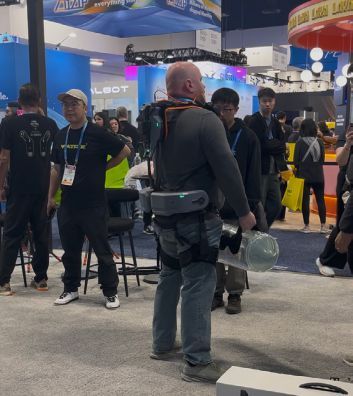
The built-in AI motion assist provides responsive motion recognition and can adjust assistance in real time across activities like walking, stair climbing, cycling and downhill movement. As of January 31, 2026, Ascentiz raised $2,563,257 in pledges on Kickstarter (goal of $49,797).
Although this product is marketed as an outdoor mobility and strength enhancing product, exoskeletons have been viewed as a potential way to support humans in the construction industry for many years. They can help with tasks like repetitive lifting and moving heavy objects and reducing fatigue and joint strain.
A 2022 study from Vanderbilt University’s Center for Rehabilitation Engineering and Assistive Technology projected that exoskeletons had the potential to reduce workplace back injuries in material handling by 20% to 60% and may also “help improve worker recruitment and retention” by reducing on-the-job injury risks.
Solar Robot
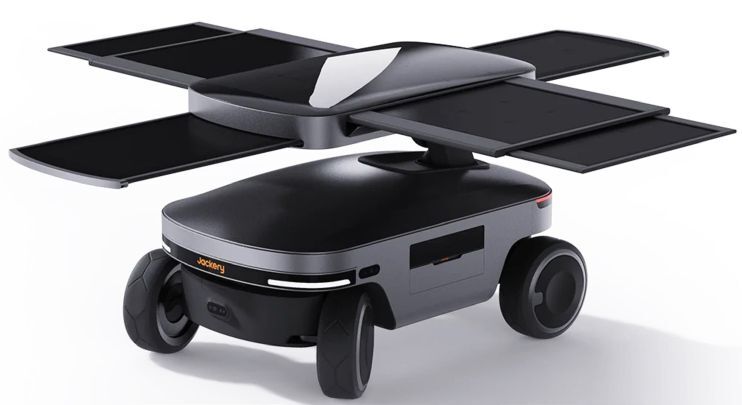
If you’ve ever been caught in a situation where you’ve needed access to power that is only available by pulling extension cords and finding a usable outlet, the Solar Mars Bot might be your new best friend. Created by Jackery, a global leader of innovative portable power and green energy solutions, based in Fremont, California, Solar Mars Bot is a robotic generator that tracks the sun to collect its energy. It has retractable 300w solar panels and can offer power whenever and wherever you need it.
Jackery is known for its large selection of battery technology. I own one of their portable Solar Generator Power Stations that uses a 200W Solar Panel and delivers 1070 watts of power. The Solar Mars Bot allows the user the same freedom in energy use, but without having to think about when and where to recharge the battery system.
Noise-Cancelling Windows
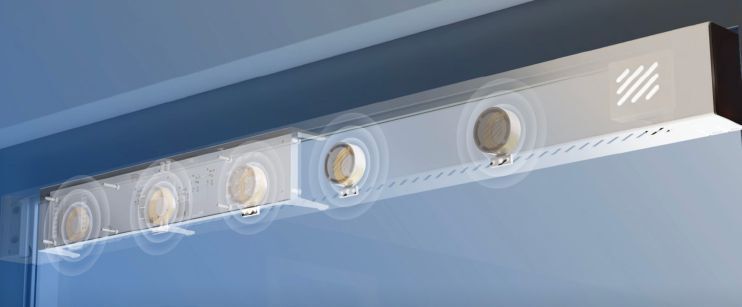
DeNoize, a deep-tech startup based in the Netherlands, has developed a patented active noise-cancellation installation kit for windows. The technology allows noise to be blocked from cars, airplanes, people, outdoor AC units and more. It uses the same active noise cancellation (ANC) technology found in current headphones like the Apple Airpods 4. When an unwanted noise “wave” hits the window glass, DeNoise produces an equal “antinoise” wave. When the two waves meet, they cancel each other out.
The product has been tested near multiple airports. It is currently only available in the Netherlands and requires a technician to install. However, the company is actively seeking window manufacturer partners in the US to bring the technology stateside, and hopes to develop the technology and create a DIY product that homeowners can easily install themselves.
Smart Water Monitoring
WaterSense, a nationwide EPA Partnership Program, reports that the average household’s water leaks can account for more than 10,000 gallons of water wasted every year. That’s equivalent to the amount of water needed to wash 270 loads of laundry.
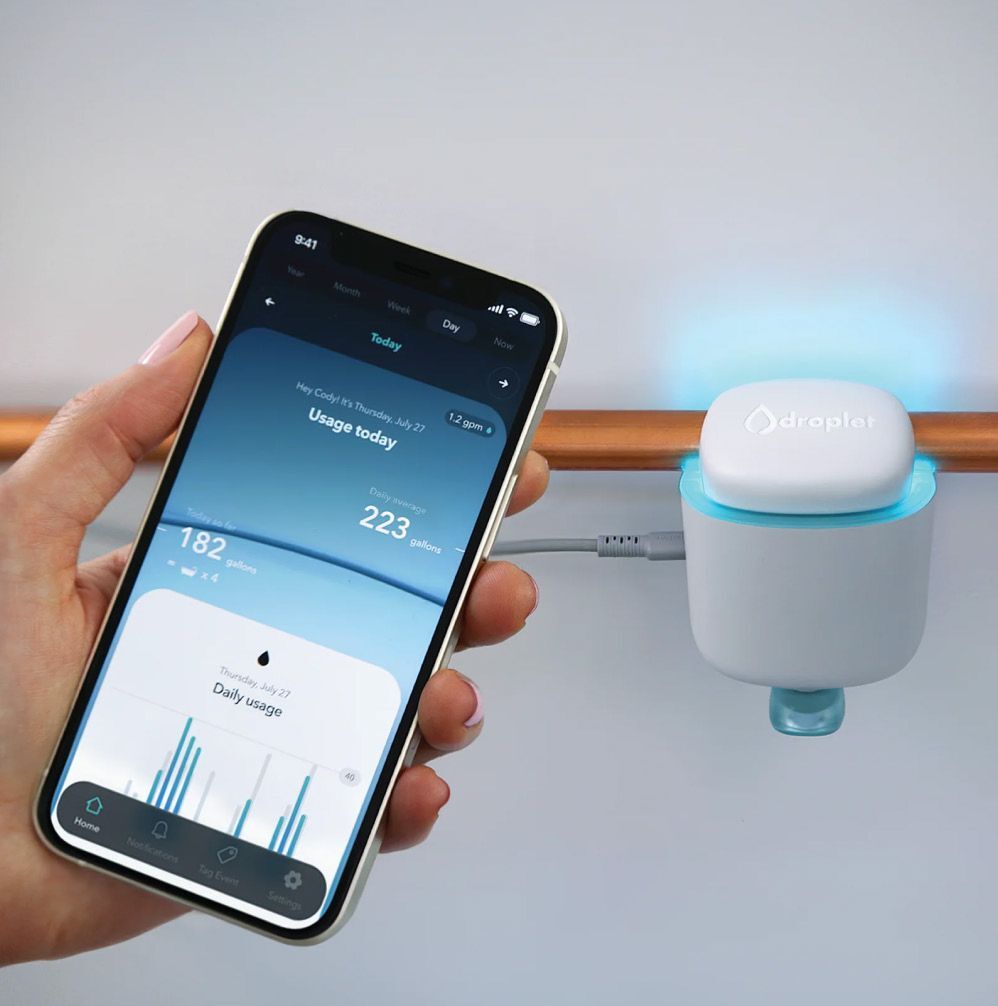
Droplet, a smart water monitoring product by Hydrific, part of LIXIL, an innovator in water technology based in New York, created an ultra-sensitive self-install device that can instantly detect dripping faucets and small leaks with flows down to 0.026 gallons per minute (0.1 liters per minute).
The technology uses ultrasonic sensors and advanced AI to monitor and track household water patterns that users can view on their phones, providing detailed insights on water-use habits, as well as how appliances in the home use water.
Droplet offers DIY ease of install, and fits common residential pipe sizes (½” to 1 ¼”) and materials including copper, PEX, CPVC/PVC, PE, ABS and brass. It can be installed in single-family homes, townhomes, condos and apartments and only requires access to the main water pipe.
Heather Wallace is a freelance writer and industry engagement specialist with over two decades of experience in various areas of the building industry. She has covered topics on construction, technology, workforce development, green building, and sustainable living.