


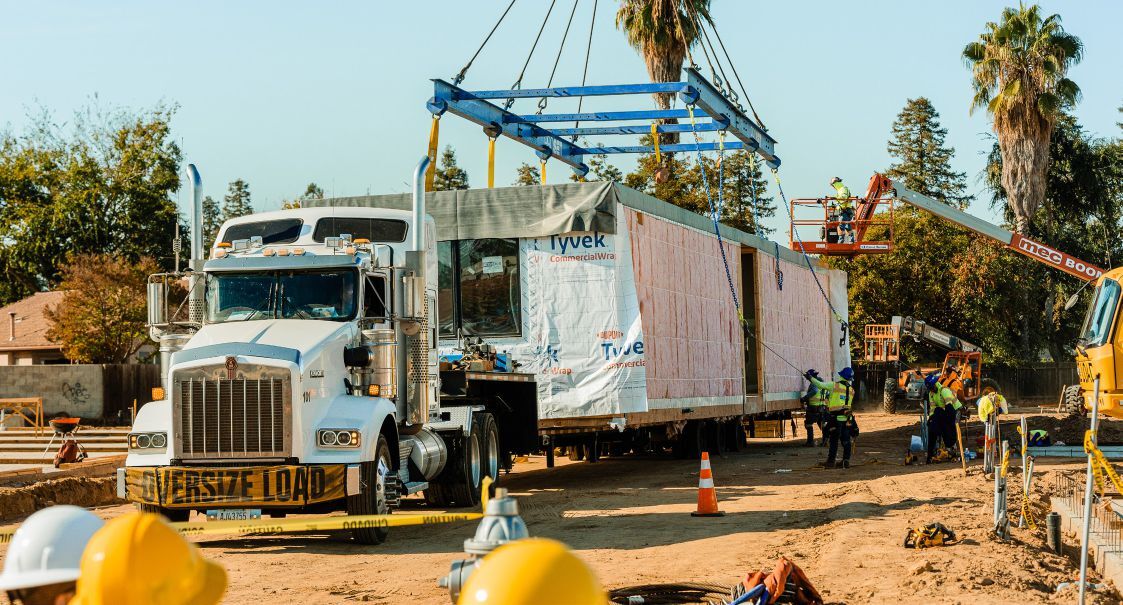
Three industry pros talk about how to avoid the small errors that can turn into big delays.
• Module setting is more than crane work; it requires planning, coordination and a clear understanding of the product.
• Communication gaps between the factory, GC, architect, engineer, AHJ and set crew can create costly set-day surprises.
• The best set crews get involved early, review plans, confirm site conditions and clarify exactly who supplies what.
A modular project can have a good design, a great factory and a capable GC — but still run into trouble on the day the modules are set onto the foundation. Mistakes on set day can cost time and money.
We talked with three people who work in and around the setting side of modular construction about why the set crew matters so much, how to vet one and what pitfalls to look out for.
Setting Modules Isn’t as Simple as It Looks
From a distance, setting modules looks straightforward. A crane picks up boxes, then puts them down. In reality, of course it’s not that simple.
Darren Seary is the Founder and Principal of Optimum Modular Solutions, a modular consulting and development firm based in Los Angeles, California. He mentions that in a previous role (doing risk analysis for a lender) the GC on a modular project said, “We’ll just get our steel subcontractor to do the set.” Seary raised that as an issue to the lender, because he knew that setting modules wasn’t as easy at the GC was assuming.
In the end, the GC hired a set contractor as a consultant on the project, and everything went well. Generally speaking, says Seary, once the value is explained, “it’s not difficult to persuade GCs to hire a good, recognized set subcontractor to do the installation.”
But Seary has seen what happens when the knowledge and experience needed to properly set modules isn’t present on a project. “With conventional construction, you can fix lots of things in the field,” he says. “With modular, once the crane is on-site and the modules are ready to be picked, there’s much less room to adjust without adding real cost and time.”
Based in Encinitas, California, Al Udwin is Co-Founder and CEO of ModBlt, a general contractor that exclusively builds modular projects. He’s also CEO of ModSet, a company that handles setting, both on MoBlt projects and others. Udwin says that in conventional construction, mistakes happen constantly but mostly go unnoticed: a board gets cut wrong and replaced, an electrical box is put in the wrong spot and gets moved before anyone notices. He says it’s “death by a thousand cuts,” but nobody sees those cuts.
Modular can’t work like that. “One little mistake in a modular project quickly becomes one big cut that paralyzes the whole job. If there’s a little problem with a module and it can’t be set, then I can’t set any more of them either.”
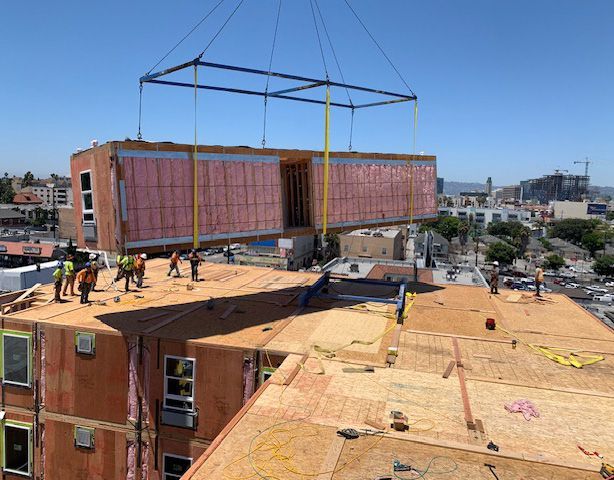
Patrick Dawson is President of Set Works, a structural set and tie contractor based in Edwards, Colorado. His company’s scope is narrow by design: “We get modules off the truck, onto the foundation and structurally connected Nothing else.” He says the most frequent cause of problems for a set is a lack of adequate communication and the most serious communication problem is a gap in scopes. For example, “We don’t put shingles on the roof. It’s not the kind of work we do and we’re very clear about that.” If other parties on a project fail to communicate that fact and there’s no roofer available on-site, the building is at risk of getting wet.
Obviously, the set crew plays a crucial role in a modular project. Who is responsible for vetting and hiring them?
Who Hires the Set Crew
On Seary’s larger projects, many of which are publicly funded, it’s typically the GC who hires both the manufacturer and the set crew, partly because of prevailing wage requirements. Manufacturers don’t have to pay prevailing wage and Seary says most aren’t set up to manage prevailing wage for onsite crews.
Dawson sees a wider mix. GCs hire Set Works on many projects, but factories also hire his crew directly, sometimes as a turnkey installation package the manufacturer offers alongside the product. “We have some high-end manufacturers that hire us directly, and we never communicate with the owner or the GC at all. We come in as part of the manufacturer’s package deal,” he explains. Set Works also works directly with homeowners on smaller jobs, such as single-family homes or ADUs.
It’s rare for manufacturers to have their own in-house set crews, and none of our three sources recommended it as a general approach. Udwin says it comes down to numbers. On average, his crews set 10 modules a day; most American factories produce two to four modules a day. “A set crew can set modules in less than half the time it takes a factory to build them, so the question is what that set crew would do in between if they worked for the factory full time,” he says. He knows of only one company that makes it work, because its set crew is cross-trained to work in both factory and field.
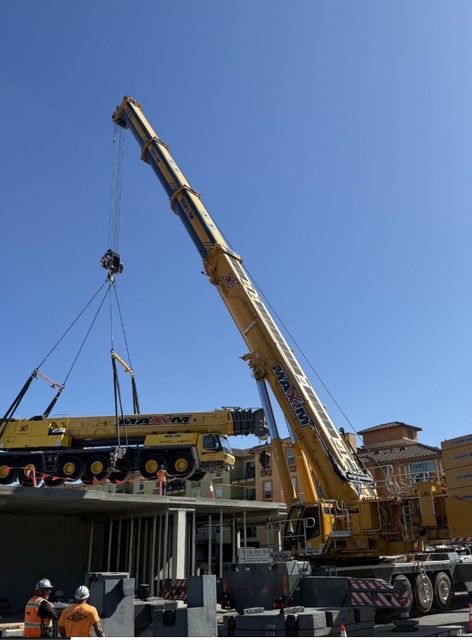
Dawson observes that “The only manufacturers that seem to take an interest in setting are the ones with inconsistent pipelines. When they’re busy with production, they can’t handle the set. When production is slow, they wish they could do the set to keep staff busy.”
How to Vet a Set Crew
Experience specific to the product matters more than general construction experience. Seary points out that steel sets differently than wood, with different pick points. And a crew that hasn’t worked with a given product type is learning on the project’s clock. He also looks at how many crews a contractor has available, since set dates are rarely fixed and they can shift for reasons tied to the factory, transportation, staging, or permitting. Having more crews and more lifting equipment available give a project more scope to absorb that variation. Familiarity with prevailing wage requirements is another factor, since getting up to speed on that for the first time on a live project can cause real delays.
Dawson looks at how a contractor handles the quote itself. “A lot of what separates a good set crew will present itself in how the quote is offered to the customer. Does the quote have a scope of work attached to it? Is it an itemized quote presented with wording the customer can actually understand?” he says. “What you see in the early stages is probably going to reflect what you see later in your project.”
Dawson is also wary of contractors who quote quickly without asking enough questions about the site or schedule. “If somebody gives you a price too quickly, without gathering enough information about your job, that’s a red flag,” he says. The questions a good crew asks upfront, about the site, the schedule, who’s supplying the modules and what equipment the terrain will require, go a long way towards avoiding many problems later.
Udwin’s advice is simple and applies to any contractor selection: check references. “No matter what they tell you, no matter what work you’re getting done, you should get their last three projects, go look at the projects and talk to the developer or client. That’s how you’ll really know,” he says. He’s skeptical of LinkedIn as a vetting tool for this reason: “Everything on it is sugar-coated. You don’t see the disasters on LinkedIn — like when a module recently fell off a truck en route from L.A. to Colorado.”
Why Communication Must Start Early
Every source raised communication as the difference between a set that goes smoothly and one that doesn’t. All three also say it’s something that needs to start well before the modules arrive.
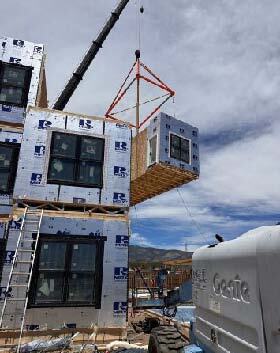
Seary’s process includes a materials matrix that spells out exactly who — the framing subcontractor, the GC, the manufacturer, the set crew, etc. — is responsible for which straps, plates and fasteners, because without it, he’s seen both duplication and gaps. He holds meetings with on-site subcontractors ahead of time and insists that materials be on-site, laid out and quantity-checked two weeks before the modules arrive. The alternative is a set crew of eight to ten people, often at prevailing wage rates, standing idle next to a crane because of a missing strap.
Dawson’s company sends a questionnaire with every quote, asking five or six questions about the project, mainly to get the client thinking ahead of time about things that hadn’t occurred to them. His team also does a pre-construction review of the full set of plans, generating questions for the engineer or manufacturer directly. “Then we know exactly what we’re doing and can give the final scope to the client,” Dawson says.
Udwin’s team takes that early involvement further. His people travel to the factory, wherever it is — Montana or Mexico, Connecticut or China — to check dimensions in-person before the modules are built and they fly to the site a month ahead of the set to check the foundation against the plans. “The whole point is that when the module arrives at the site, there are no surprises,” he says. He says that this extra effort pays off because it’s not uncommon for there to be errors in the foundation dimensions or for embeds to be set into the concrete in the wrong places.
What Can Go Wrong
Udwin says that on a typical project, the architect, the manufacturer and on-site contractors “aren’t talking to each other; they’re working in their own little bubbles.” And, on set day, it’s the first time the set crew has seen either the module or the foundation. This can be a problem because steel embeds are a recurring failure point, which is why his company checks the foundation in person well before set day.
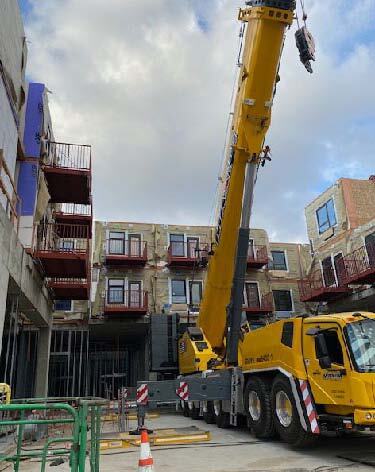
Seary notes that early communication with the local building authority is also crucial. It’s important to have a conversation with them about what falls under their jurisdiction versus the state’s. Otherwise, a project can run into holdups on set day, because the AHJ [Authority Having Jurisdiction] thinks they “need to see every nail, every plate, every strap before it gets covered.” Seary takes the time to educate local AHJs, giving presentations with videos and photos, to walk them through the whole process.
Build quality coming out of the factory is the other major variable, and one that the set crew has limited ability to fix. Dawson describes the extra labor required when a module arrives out of square. “If a box shows up a little racked, that’s a problem once you put it next to another one,” he says. His crew uses rigging and pulley systems to shift walls as well as “bottle jacks in the basement to push one module up so it’s level with another.” Improvisation in the field to correct misalignment is slower and more expensive than setting a module that arrived true.
The point of all this is that a successful set starts long before the crane arrives. The right set crew brings product-specific experience, asks detailed questions early and communicates clearly about scope. In modular construction, problems that might be minor in conventional building can quickly become expensive delays, so don’t treat the set as an afterthought. Vet the crew carefully, involve them early and make sure everyone knows exactly what has to happen well before the first module leaves the truck.
Zena Ryder is a copywriter and content strategist. She writes for magazines and companies, and also helps B2B service business owners and consultants turn their expertise into content that converts traffic and followers into clients. Find her at zenafreelancewriter.com.