

How prefab factories can match digital tools to real workflows and stages of growth.
• Generic ERPs and construction platforms often require integration to support factory production workflows.
• Purpose-built offsite platforms and AI-driven systems unify data across design, production and installation.
• Manufacturers who focus on integration, usability and value outperform those chasing features or labels.
Whether a startup or a legacy factory, offsite manufacturers can look to digital productivity tools to positively affect cost, speed, quality and competitiveness. The right tools can streamline workflows, standardize processes and provide real-time data, helping the operation become more effective.
The challenges include how to determine the type of and timing around adopting a more robust tool that adds value to existing processes. Productivity tools — automation software, Enterprise Resource Planning (ERP), Material Requirements Planning (MRP), scheduling tools — help manufacturers produce more product without the need for extra time.
While the traditional side of the construction industry has many tools available to improve productivity, few are focused on offsite manufacturing, and even fewer offer a full enterprise platform targeted at factories.
Start With a Road Map
Dyci Sfregola, CEO of New Gen Architects, an Atlanta, Georgia-based supply chain consulting group focused on guiding clients through technology tool selection and training, and author of Next Level Construction Management, has spent over a decade helping clients understand how to choose the right tools at the right time for their companies. When manufacturers are considering new software, she says there’s no single most important function. “Time tracking, material tracking, accounting, planning, inventory and reporting all matter.”
This is true in every industry. In addition to offsite construction clients, Sfregola has also worked with customers in wine and spirits, medical devices, pharmaceutical, energy, textiles, e-commerce and equipment manufacturing. Some of her most recognizable clients are Coca-Cola, Stitch Fix, Quip, Chick-fil-A, Soleil Energy Corp, Dexcom and Frederick Wildman and Sons, Ltd.
Sfregola’s experience with different industries has taught her that the real question isn’t whether you need these capabilities, it’s when you need them and that it’s critical to understand which problems are hurting you the most at your current stage of growth.
“If you have someone on your team from a manufacturing background who has built out tons of resources with Excel, or streamlined processes, maybe you don’t need a digital time tracking tool,” she says. “Instead, maybe you need a tool that’s really good at inventory management because your engineering leader doesn’t have any inventory planning experience.”
Road mapping is important here. “You need to figure out what your company is doing now, from a process perspective, and what you’ll be doing later,” she says. “Who on your team is going to own [each process]? How much does it cost?”
Road mapping for an offsite manufacturer would include a strategic planning process that clearly defines the vision and creates a visual, high-level plan to help align the team. It would identify the steps needed to achieve long-term goals, which, in this case, is the adoption of digital tools.
Some steps would include making sure relevant leadership and employees are involved with identifying key challenges and priorities, and ensuring that all processes are documented. That documentation will help the team create a timeline that leads to strategic alignment and the successful adoption of a new digital tool.
Which Tools?
Choosing digital tools is much like choosing tools for digging a fence post hole. If you have a post hole digger and a tape measure you can get the job done, but an auger would really speed up the process. A backhoe, on the other hand, would be overkill.
Integration is another factor companies often underestimate. Most businesses don’t struggle because they lack software. They struggle because their systems don’t talk to each other or their team hasn’t been properly trained on the software.
Let’s say a factory has historically used Microsoft Excel to track client and vendor information, schedules and calculate takeoffs. If the factory is looking to integrate a Customer Relationship Management (CRM) system and a Manufacturing Execution System (MES), they need to make sure both the CRM platform and MES can seamlessly integrate with Excel to avoid any costly errors and missing data. Additionally, if the team has not been fully trained on the new software, employees may become frustrated and may not utilize the software to its full capability. Efficiencies won’t be wholly realized and money will be wasted.

It’s important to remember that the value a tool brings is more important than its price. Free or heavily discounted software isn’t free if it takes time away from running the business, or never gets fully adopted. Companies should adopt software only when the value is clear, the use case is real and the team is committed.
“User adoption and engagement, whether related to processes or technology, contribute greatly to the realization of return on investment,” says Dyci Sfregola. “None [of this] matters if the team does not understand or care to implement these frameworks and processes.”
Five Questions
In her book, Sfregola outlines five key questions companies should ask themselves before adopting any digital tool:
- Does the tool support the company’s strategic objectives, not just the goal of one leader or department? For example, if a Director of Sales wants a CRM tool to improve sales reporting, but the tool doesn’t integrate with existing software and creates siloed data, it probably won’t help overall company growth, and may, in fact, create problems.
- Can the tool scale as the business grows? If your growth projections over the next five to 10 years are exponential and you’ll need to fill hundreds of positions, it’s probably not a great idea to purchase a tool that limits users to 50 seats. Or, if your purchasing department can barely handle 20 units a week, you’ll likely need to think about adopting a more robust supply chain system.
- What is the company’s cybersecurity and compliance policy and plan? Who is responsible for what, and how do you protect your data? What are your rules on passwords, file sharing and access?
- Is the system user-friendly and accessible to all stakeholders? For example, is it available on all types of mobile devices, or in the field? Does it require advanced training for basic tasks that might cause employees to not use it fully, or not use it at all?

5. What is the total cost of ownership? It’s important to look past acquisition cost. What hidden costs are there? What is included in a base license and how much do the add-ons cost? How long is the pricing locked in for? As a manufacturer, what happens to pricing as you scale users, locations, or volume?
Additionally, she recommends asking software vendors about integration options, customer success history, customer service offerings, causes of implementation failure and why past customers canceled contracts.
And while many manufacturers think of themselves as construction companies, the distinction matters. Manufacturing, inventory, planning and workflow tools used in other industries often work well for offsite construction, even if they aren’t marketed that way. The terminology may be different, but the underlying needs are the same: managing materials, labor, schedules, suppliers and cash flow.
The companies that succeed are the ones that focus less on labels and more on building connected, scalable systems that support how their business operates today — and how it needs to operate tomorrow.
A Sample of General Tools
There are hundreds of digital software productivity tools on the market and there isn’t enough time or space to go over them all. However, here are a handful of tools manufacturers have disclosed they have used, or are currently using.
These are in wide use by the industry in general.
Microsoft Excel spreadsheets are still widely used for simple tracking, calculations, takeoffs, schedules, etc. While Excel is flexible, low cost and requires little training, it obviously lacks real-time collaboration, task management, traceability and process automation. And it doesn’t connect tasks, materials, labor, quality, or quality issues. Microsoft Dynamics 365 (Dynamics) is an ERP suite that offers financials, supply chain, HR and project financial control. It offers the ability to choose specific capabilities within the suite and scale, as needed. Dynamics cannot track manufacturing execution without an outside integration.

Oracle NetSuite is a cloud-based-only ERP platform, similar to Dynamics, that provides strong financials, supply chain, procurement and project accounting. As with Dynamics, NetSuite cannot manage factory floor production, or construction field workflows.
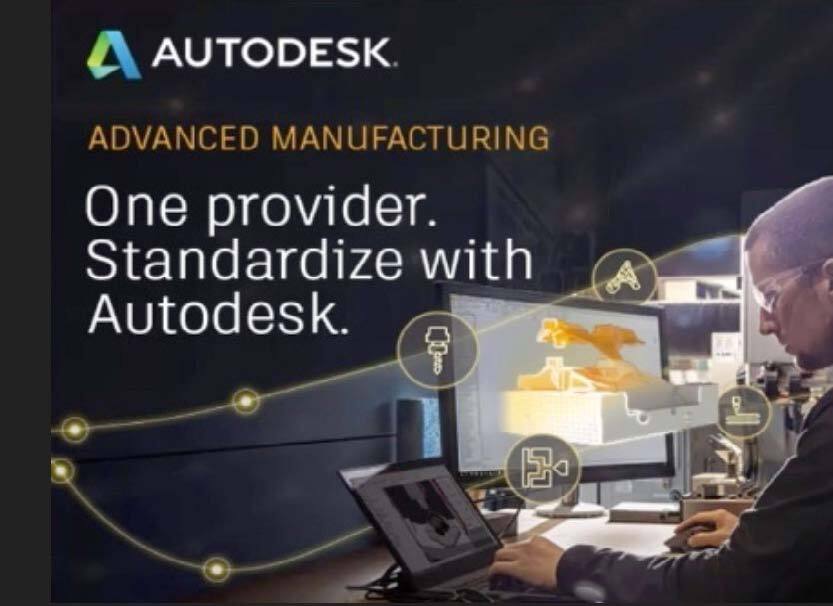
The Autodesk Manufacturing Execution System is focused only on manufacturing operations and can help monitor, track, document and control the production of goods from raw materials to finished products. It uses real-time data to provide information on production progress. The tool offers Material Requirements Planning (MRP), quality management, production scheduling and planning capabilities, but may need to be integrated with a financial tool and site project scheduling tool.
Construction Specific Tools
These tools are specifically designed for companies in the construction industry. Procore is a construction project management platform that connects owners, GCs, subs and specialty teams across bidding, docs, RFIs, submittals, financials and field coordination. Procore was developed by former carpenter and real estate developer Craig Courtemanche, Jr. and requires an integration for factory production management, materials and planning.
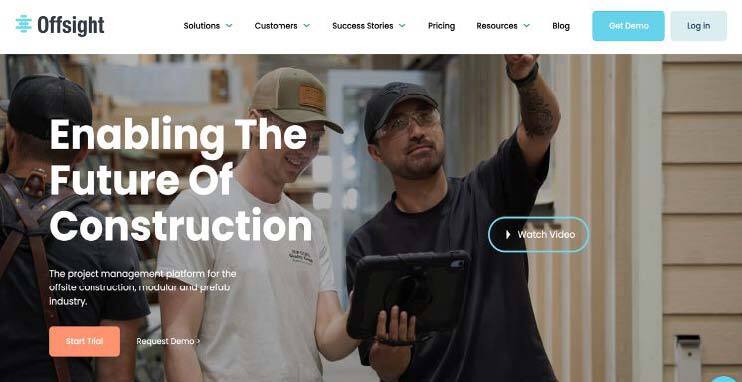
Offsight is a project management platform that assists with collaboration between offsite factories and on-site teams, founded by technology consultants Vikas Murali and Andrew Xue. The tool handles production status and offers AI-based quality control, smart workflow automation and real-time insights to help unlock efficiency at scale, but does not offer full enterprise finance.
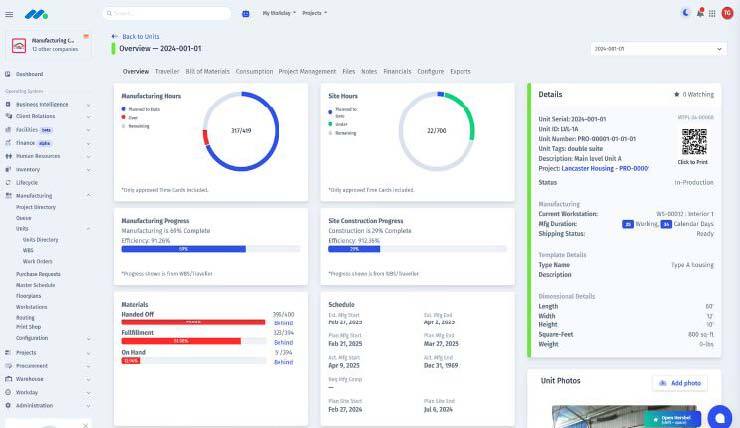
Moducore is an integrated OS/ERP platform built by manufacturers, specifically for offsite manufacturing, managing design-to-installation. The tool includes both traditional ERP features, as well as MES attributes. It offers control of manufacturing operations on the factory floor through real-time data capture and analysis, which optimizes production efficiency. In addition, Moducore also combines CRM and Content Management System (CMS) tools, scheduling and inventory management.“Our entire team from a management and leadership perspective is from the industry,” says Thomas Griffin, Director at Moducore, which is based in Alberta, Canada and Stanwood, Washington. “We’re not building software for any industry. We’re from this industry, building software that’s required.”
He says that Moducore eliminates conflicting information between project teams and factory teams. Everything runs on one shared data set, so project managers and production managers see the same information, just through different lenses. This improves communication and helps teams understand the real tradeoffs between schedule, cost and efficiency before decisions are made.
For companies focused on improving workforce efficiency, it offers step-by-step manufacturing plans for each module; manufacturing instructions via QR codes, instructions, documents, drawing and videos; time tracking tied to production work for continuous improvement; integrated inventory and material consumption data; facility and equipment management and maintenance needs; and built-in quality checks and inspections.
Moducore charges a dynamic flat rate fee per manufacturing operation and fits any sized manufacturing operation. The focus is to make tools accessible to the user to maximize manufacturing output and use of software.
Merlin AI (Merlin), based in Aliso Viejo, California, is an AI-powered Enterprise Operating System that streamlines functions like estimating, procurement, scheduling, project management, finance and CRM. This reduces manual work while increasing efficiency and visibility across projects. The creators of Merlin AI have backgrounds in residential prefab, commercial and data center construction, financial technology and supply chain warehouse management systems.
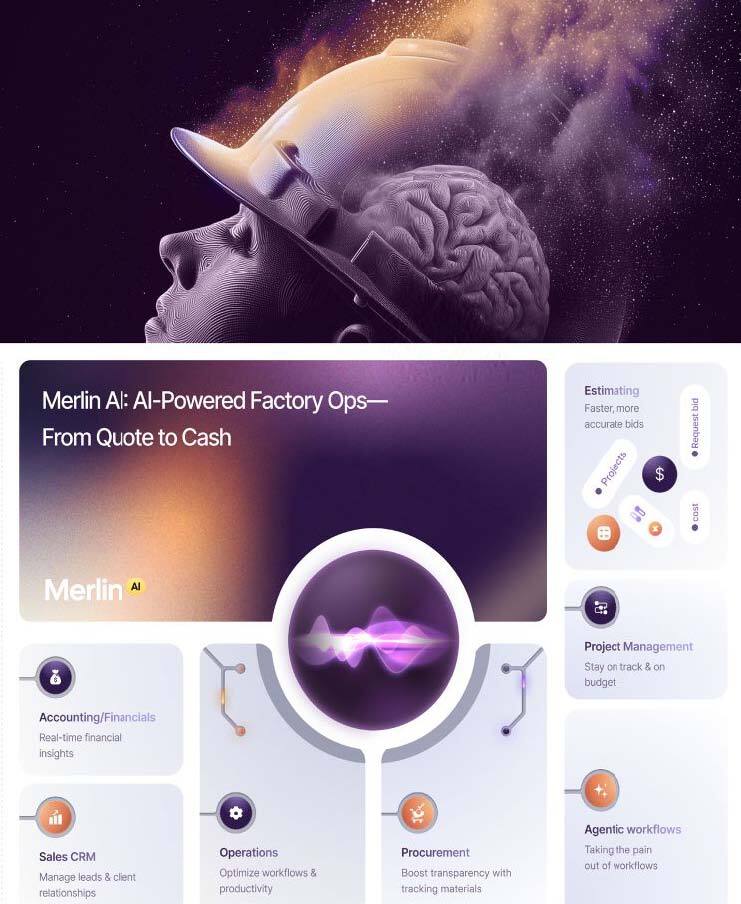
“Most of our customers are on the growth path,” says Co-Founder Sneha Kumari. “They are either using Excel and realizing it is not going to scale, or they are in NetSuite, Odoo (a suite of open-source business apps) or SAP (a German-based ERP software), and realizing it is not working,” says Kumari.
She claims that Merlin can automate up to 90% of procurement workflows (cutting quote turnaround times in half and shortening overall project timelines by around 30%) by using real-time insights and predictive alerts to help prevent delays, improve resource planning and keep projects on track and profitable.
Leads are automatically captured from emails, websites, calls and voicemails, while AI-driven takeoffs generate highly accurate bills of materials directly from PDF drawings.
Merlin also offers AI-powered inventory, procurement and shopfloor tools that ensure materials arrive on time, workstations stay stocked and labor is sequenced efficiently. Real-time dashboards, predictive alerts and cash-flow forecasting give leadership clear insight into project health, risks and scenarios before problems arise. It automatically captures leads from emails, websites and phone calls, helps create accurate estimates from PDF plans, and turns design options into clear pricing, contracts and payment schedules.
When asked if there was any pushback on an AI-heavy platform Sneha says, “[Most of our] customers have a good understanding of tech. They were already using ChatGPT and now they have something at their workplace that is meaningful to the work they are doing so it’s a win for them.”
The bottom line is that digital productivity tools can be a powerful growth lever for manufacturers — but only when they’re chosen intentionally. There is no single correct tool for all manufacturers. The real advantage comes from aligning tools with current pain points, future growth plans and the realities of how work actually gets done on the factory floor, and beyond.
Manufacturers who focus on value, integration and user adoption — rather than labels or price — are better positioned to improve efficiency, protect margins and scale with confidence.
Heather Wallace is a freelance writer and industry engagement specialist with over two decades of experience in various areas of the building industry. She has covered topics on construction, technology, workforce development, green building and sustainable living.