


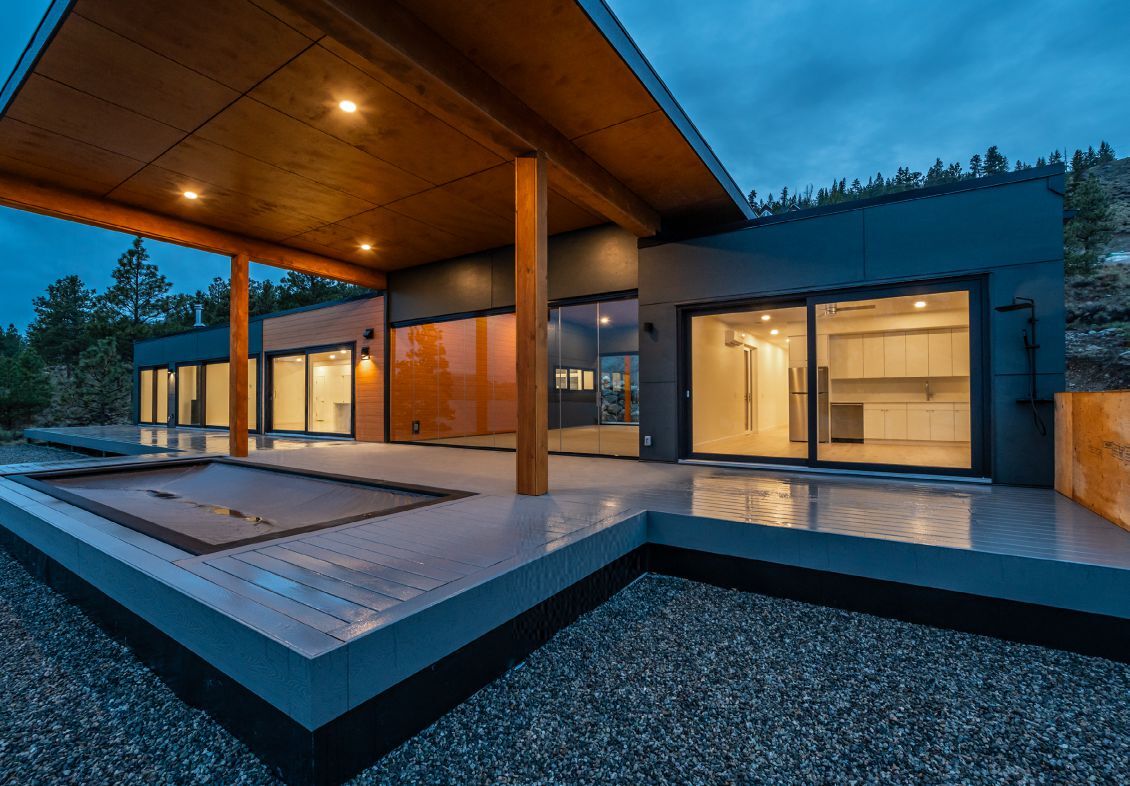
Built Prefab replaced quoting delays, option chaos and inconsistent pricing with a design-driven digital engine that moves customers from curiosity to contract in minutes — not weeks.
• The company replaced manual quoting with a configurator-driven system that offers immediate pricing clarity and customer understanding.
• An integrated configurator, a sales console and analytics tools streamline operations, prevent production mismatches and accelerate qualified sales conversations.
• Digital transparency empowers remote buyers, supports Indigenous communities and signals how modular firms can modernize without losing fundamentals.
When James Rosowsky began working in modular housing over ten years ago, he faced the same ongoing issues as everyone else. Customers wanted clear pricing, factories needed precise specifications and sales needed a way to advance conversations without drowning in spreadsheets.
What makes Rosowsky different was not that he saw the problem; it is his refusal to accept the status quo.
Rosowsky leads the Built Group of Companies from Kelowna, British Columbia (BC), Canada — which includes Built Prefab, Built Labs, Lake Country Modular and One Sky Communities. Together, they serve both the higher-end, design-driven modular homebuyer and the mid-market customer who wants something efficient, affordable and quick.
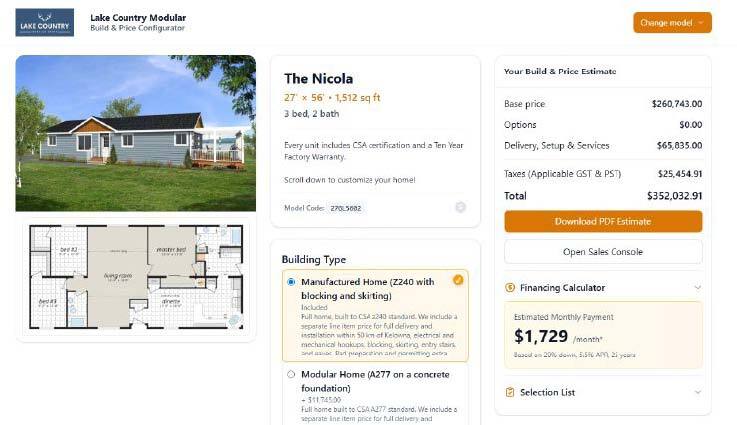
By concentrating exclusively on design, sales and processes, the company has developed a technology stack tailored to what most modular firms consider the most challenging part of the job: selling homes with clear and accurate specs and pricing.
For an industry still dominated by manual quoting, paper processes and decades-old habits, the story of how Built Prefab got here and what other builders can learn from that journey is both timely and instructive.
Built on Design, Not Manufacturing
Although Built Prefab’s brand suggests a factory-first operation, the opposite is true. The company does not run its own production facility. Instead, it partners with modular plants across Western Canada and the US, selecting fabrication partners based on capacity, proximity to the site and the specific build requirements of each home.
Rosowsky’s team handles permitting. They also engineer and specify everything, from windows and doors to flashing, insulation and siding, before a factory with the capacity fabricates the unit. The company issues, in his words, “a prescriptive order” for the factory.
In an industry that often struggles with quoting delays and inconsistent information, Rosowsky believes clarity isn’t just a sales tactic; it’s the foundation of trust. After more than a decade of development, his team has built a configurator-driven ecosystem that replaces the outdated, slow and uncertain sales process with immediate feedback and understanding, offering an experience that most modular homebuyers rarely encounter.
Pricing — The Universal Pain Point
Modular builders are familiar with the question that hangs over nearly every customer interaction: “How much does it cost?” The answer, of course, depends on models, materials, codes, location, site conditions and hundreds of small variables that make modular pricing notoriously complex. For years, Rosowsky observed potential customers getting stuck, unable to move forward because they were waiting for a quote or didn’t understand how their choices affected the final number.
He explains that traditional pricing methods tend to rely on a salesperson manually assembling dozens of option lists, cross-checking materials, crunching numbers and preparing documents. This leads to delays, errors and a lot of back-and-forth.
So, he flipped the model. Instead of hiding pricing behind phone calls and spreadsheets, he made it visible, dynamic and linked to every decision a customer makes.
“What used to take a week or two now takes two seconds,” he says, referring to the speed of the pricing configurator compared with the traditional quoting cycle. When customers can explore models, choose materials and immediately see how those decisions affect the price, the biggest bottleneck in the modular buying journey disappears.
It also shifts the conversation. Customers no longer call to ask, “How much does it cost?” They call because they’ve already built a budget, explored the design and want to discuss specifics related to their site or project. Sales teams no longer spend hours fielding basic questions; they focus on helping people who are ready to move forward.
Journey to Digital Integration
The company began developing its first configurator in 2013, leveraging Rosowsky’s previous experience with Karoleena Prefab Homes, also in British Columbia. Progress was slow and challenging because modular builds are not well suited for generic configurator software. Variations in building codes, materials, factory capabilities and installation methods are too broad to be fully covered by a one-size-fits-all tool. “I’ve looked around,” Rosowsky says. “Personally, I think our configurator is unique. Major developers tell us they’re building their own, but then it never shows up.”
What allowed Built Prefab to succeed where others faltered was its deep operational understanding. “If we weren’t integrating into the business, designing units, buying them, understanding the entire process, I don’t think you’d end up with anything that valuable. We use our prototype every day in our business, modifying it as we go along.”
Three Engines Working Together
The platform the company uses consists of three interconnected components: the customer-facing configurator, an internal sales console and an analytics dashboard. Each has a specific role in shortening the sales cycle and enhancing accuracy.
The configurator is the most visible piece. Customers browse models, select options and witness realtime pricing updates with each choice. At the end, they download a PDF estimate. The immediacy of this process benefits customers accustomed to long wait times for quotes.
Behind the scenes, the sales console allows Built Prefab’s team to access customer configurations, refine line items, prepare formal quotes and generate complete purchase agreements with signatures and terms.
Finally, the analytics dashboard monitors everything from website activity and configurator engagement to the quotes issued and deals closed. “I look at it every day,” Rosowsky says. “We track conversion rates from top of funnel to closed deals.” Additionally, user behavior helps shape the system’s development. “Every single user gets an email asking for feedback,” Rosowsky notes, “and their comments influence future iterations.”
The configurator platform’s expanding dataset reveals which models people engage with most, which options they choose and where they drop off. It provides the kind of structured intelligence that the modular industry often lacks, mainly because few companies have built the digital infrastructure to gather it.
Digital Consistency, Scalable Ops
The operational impact of this system has been profound. Rosowsky emphasizes how it unites all the relevant parties, eliminating the drift that often occurs when teams rely on manual tools. “It’s a tremendous way to bring our customers, the salespeople, the designers, all onto the same page,” he says. “I couldn’t imagine running our companies without it.”
The configurator also dramatically reduces employee onboarding time. A new salesperson no longer needs weeks of training to learn pricing and options. “What’s the training curve? It’s almost zero,” he says. “They need to go into the configurator for an hour.”
Consistency extends to customer experiences as well. “Our older customers sometimes prefer to sit down with us in person, and that’s fine,” he notes, referring to Lake Country Modular’s demographic. “But the salesperson is still using the configurator, where everything is centralized, accurate and presented the same way across the board.”
The platform minimizes errors, a common issue with manual quoting. When everything is locked into the configurator, it’s impossible to forget an item or misprice an option. Because configuration options are linked to specific plant capabilities, it helps prevent production issues caused by mismatched expectations before they occur.
A Tool That Builds Trust
One of the more surprising outcomes of Built Prefab’s digital transformation is that automation has reinforced the importance of human connection. Rosowsky is clear that selling a home relies on genuine conversations.
“Selling a house is an intimate thing,” he says. “You still need a salesperson. The configurator just guides prospects down the funnel so they’re more qualified when they talk to you.” Instead of spending hours with tire-kickers, salespeople focus on serious buyers who already understand their preferences.
Their digital approach has also allowed the company to dramatically broaden its reach. Built Prefab’s mailing list now includes more than 10,000 interested individuals. “We reach way more people than with the old system,” he explains. “Some of them have been on the list for two or three years before they’re ready to move forward. It’s more about educating them on the product and making sure that it’s the right fit for their project.”
Serving Indigenous and Remote Communities
Another area where the company has seen the configurator’s value is in Indigenous and remote communities, which One Sky Communities — the Built Group’s Indigenous-led housing and infrastructure partner — supports through development and modular housing projects. These include 17 homes for the Lytton First Nation fire rebuild, as well as Indigenous housing projects in northern Alberta and northern British Columbia.
For buyers who live hours or days away from major centers, or who have limited access to builders or show homes, the ability to instantly generate a price is game-changing. “If you’re sitting in a remote cabin somewhere, you can price a home in five minutes,” Rosowsky explains. “It’s very, very useful.”
On a broader level, the transparency provided by the digital pricing platform supports the growing need for affordable housing, where budgets are limited and expectations for clarity are high. Digital tools don’t reduce the cost of materials or labor, but they do remove ambiguity — something lenders, municipalities and developers increasingly demand.
Supporting Fundamentals
Despite the benefits, Rosowsky doesn’t criticize competitors who haven’t adopted similar tools. Many successful operators rely on notebooks, personal experience and relationships rather than software. However, he also anticipates change. Younger professionals are entering the field, and they expect the clarity and speed that digital infrastructure provides.
Still, he warns against the trap that ensnared billion-dollar startups like Blu Homes and Katerra. “They forgot the basics. You need to build a house for a certain price and sell it for a higher price. Everything else is secondary.” Digital tools should support fundamentals, not overshadow them.
When asked whether mass-market CRM or configurator tools will eventually fill the gap, he doubts it. “Modular is such a specific business,” he says. “You have the car-dealership element mixed with the complexity of construction.” In his view, a tool built outside the industry would struggle. “I couldn’t imagine trying to hire somebody to come in and do this.”
Modular’s Digital Future
Will digital transparency change how municipalities, developers and lenders view modular construction? Not on its own, Rosowsky believes. Modular is a tool, not a blanket solution. “Modular has better applications in certain situations,” he notes. It excels in remote areas with limited access to labor or materials, but is less advantageous “if you’re building downtown next to a Home Depot.”
Still, transparency helps speed up go/no-go decisions. Seeing models, prices and specifications upfront reduces the friction that often stalls modular projects early.
And for buyers, transparency builds trust. “We built this for the customer,” Rosowsky states. “I don’t even care if they take the quote to another dealer.” Education comes first, sales second. Trust isn’t a technology feature, but in Built Prefab’s case, their tech is designed to create it.
Modular construction has long been hampered by a mismatch between product and process. It offers precision, repeatability and schedule control, yet it too often relies on analog quoting and inconsistent customer experiences.
Built Prefab’s digital approach demonstrates what can happen when a modular company embraces technology without losing sight of the basics. It also offers a compelling counterpoint to the industry’s assumption that digital transformation must start in the factory. In this case, it began with design, sales and customer education, and the factories simply followed.
Whether or not other modular companies choose to build their own systems or adopt off-the-shelf tools, the message is clear. Customers want transparency. Sales teams require consistency. Builders need reliable data. The next decade of the modular industry’s development may depend less on radical new building systems and more on the digital pathways that help customers understand, trust and ultimately choose modular.
Jim Mahannah is a freelance B2B technology writer specializing in construction, energy, water/ wastewater treatment, and cleantech. He is an engineer, and his work experience includes construction project estimating and management in addition to founding and operating a structural components fabrication company supplying residential and commercial building projects.