

Why the future of offsite construction favors hybrid approaches over rigid standardization.
- Housing consumers demand personalization, making pure standardization economically and culturally unrealistic.
- Industry veteran Derrick Morris notes that component-based systems allow selective customization while preserving predictability and manufacturing efficiency.
- He believes that technology and AI will accelerate adaptable offsite systems, positioning hybrid builders to lead future growth.
Offsite construction comes in many flavors. Builders would do well to focus on combining the available techniques — modular, panelized, etc. — based on cost, speed and customization. The value of such an approach is a mantra for industry veteran Derrick Morris.
At an early age, Morris wanted to be an architect. He loved conjuring up ideas and drawing them. A high school guidance counselor killed that dream though, saying his handwriting was too bad.
As a result, he leaned into his math and science skills, focusing on chemical engineering. But his enthusiasm for design and construction remained, and he knew it was his true calling. So, he pivoted back to that, earning a degree in construction management from Georgia Southern University. He understood it would give him a role in the design side without requiring him to be 100% focused on architecture.
Throughout his forty-plus year career, Morris has built houses of all types — from affordable to ultra-luxury — across all 50 US states and 20 countries. He’s worked with various building systems, including traditional stick building, modular construction, panelization and tilt-up concrete.
His initial foray into offsite was a modular project for the 1990 International Builders Show in Atlanta, Ga. He and his colleagues at John Wieland Homes, which is based in Smyrna, Georgia, assembled it as a fourplex at the show, disassembled it and then reassembled it as two duplexes for graduate student housing at a nearby university. Morris says he was impressed by the versatility, engineering and innovation that went into the product.
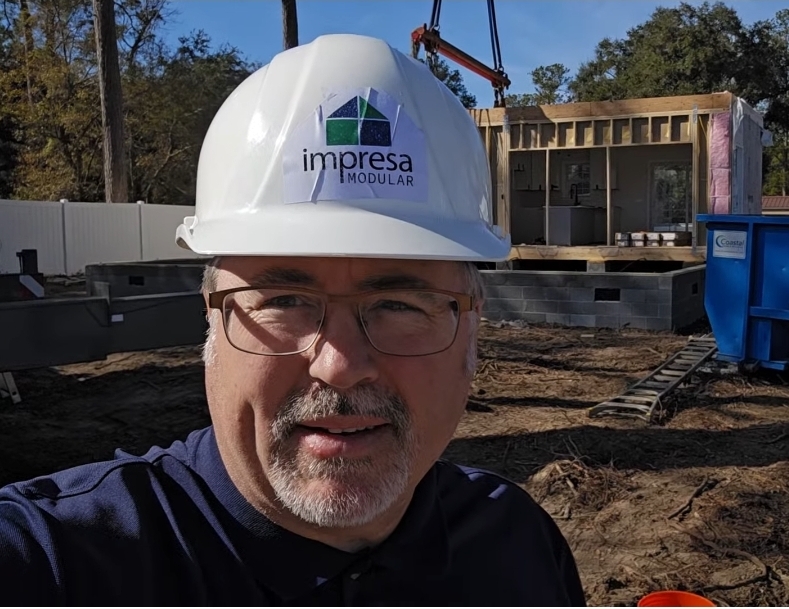
In more recent roles, Morris has focused primarily on volumetric modular. He has served on the Board of Trustees for the Building Systems Council of the National Association of Home Builders and currently works for Impresa Modular as a Franchise Success Coach, helping builder franchisees improve and grow their businesses. He is a strong advocate of combining multiple building techniques for optimal outcomes.
Here, we gain more insight into Morris’ perspective on the industry.
Q: You’ve said that modular is a method, not a product. Can you elaborate?
A: I mean that it’s a way to get to an end product. If your product is a house, you can use modular as the method to get there. There are a million ways to build a home, and modular is just one of them. Every method that’s out there, whether it’s volumetric modular, panelization, pre-cast concrete, or even stick built, can be applied to deliver the product.
The question becomes, what is the best method? With my forty years of experience in the industry, I’m of the mindset that there is space to combine those different methodologies; put them together to make the best product. For example, we might produce a home that uses precast concrete walls for the foundation, volumetric modular for most of the residence and fully integrated panelization for the garage.
But at some point, you must choose a starting position — an anchor — and I believe that volumetric modular is a great position to start from.
Q: Why do you think the industry is resistant to this hybrid approach?
A: I think there are multiple reasons. First, people are comfortable with the systems they’ve been using. So, they play within the sandbox they’re in and don’t think outside of it.

Second, they look at construction as a linear process — build a foundation, then a frame, then install MEPs and then do the finishes inside and out. They don’t necessarily step back and consider what the impact would be of doing things in parallel paths. For instance, building the foundation and home simultaneously allows for an increase in speed of production, among other benefits.
I also think it’s because we get into these echo chambers of our own space and are protective of our proprietary knowledge. So the volumetric guys rarely consider timber frame as a companion method of building, and vice versa.
Another element is that we recycle the same people. They move from one modular factory to another. But I’ve talked to people in factories where they have folks come in from different industries, and they say it’s a game changer. I worked with a company that was both a builder and manufacturer whose leadership team included people with a background in traditional residential, modern architecture and aerospace. We produced award-winning modular residences across the Western US.
Q: The general industry thinking is that standardization improves production time and the bottom line. However, you say it’s holding us back. Explain.
A: You must go back to the end product. In any other industry, you can provide the same product over and over, and consumers will buy it —cars and phones, for example.
When it comes to houses, a lot of people want something different, and they’re not necessarily eager to buy a home that’s exactly the same as every other home in the neighborhood. So, you must create the ability to provide customization and personalization.
That, of course, drives up costs unless you can find a way to provide those options while breaking things down to the fewest standard components.
Q: Elaborate on that.
A: Lego are a good analogy here. If you’re building something the same size with ten pieces as something that has 65, you can reduce your expenses.
There are manufacturers out there right now who are working on breaking things down to the fewest standard components to make that work. Some focus solely on building bathroom pods. They can build them in 20 million different shapes and sizes, but what they’re doing is building within this combined box, and everything that’s inside of that space, they control. Ultimately, however, it’s still a bathroom pod.
Q: If teams input a different bathroom pod into each home, won’t that increase the price and manufacturing time?
A: Absolutely. It comes down to the calculus of your project and your key objectives as a builder/developer/owner. But as the industry evolves, some of those assemblies will become more like individual components. After all, most “standard” secondary baths in production homes are 5’ by 8’ with a vanity, toilet and tub/shower. That alone could be a substantial assembly that saves a lot of cost in the long run.
Q: How do you suggest offsite builders balance between costs and customization?
A:It’s about predictability. From a manufacturing standpoint, you want to have a line of sight on what your customer is going to need at the time that you’re going to get to that point of production.
Say you’re doing a closet system that you install the framework for in the factory. The door faces can be installed later with client determined finishes.
The challenge is how to create spaces within the design infrastructure that allow for customization while ensuring other things stay the same.
Q: Is your vision possible today?
We’re getting there with advancing AI technology. We’ll be able to change a component like a window, and the AI design tool will not only select different materials, but also apply necessary engineering and generate new stamped drawings.
The ability to do that, and then to see how that impacts your inventory flow and other pieces of the project, is where the system integration becomes an advantage. Factories and manufacturers who robustly adapt their systems will have an advantage in the future.
However, manufacturers with fixed systems that aren’t adaptable and require customers to adhere to standards will still have a market. When I look for value-driven product, I go to a manufacturer with fixed specs. Workforce housing is a great example, as there’s little expectation for customization. However, when I deliver more bespoke projects, it costs more to produce because of all the selection possibilities.
It’s just like there’s always going to be a market for Toyota Corollas.
Q: Is this happening now? If so, where? Explain. If not, when do you see this happening? Is anything even close?
A: It’s evolving. The challenge is that the few players who are evolving in the volumetric space are also hamstrung by the physical limitations of transport. However, much is occurring in the assemblies or subcomponent space.
Q: Does the extreme customization that you refer to apply only to single-family homes?
A: This applies across the board — single-family homes, multifamily, town homes and other structures.
If you’re doing multi-story towers, the challenge that you run into in offsite systems is the engineering integrations. That’s because materials will perform a certain way within certain parameters. For example, I can stack a wood frame three stories high and be okay, but if I stack higher, I need to increase the strength of the materials on the bottom.
At a certain point, I exceed the limits of that product. So, the design becomes more complex because it exceeds the parameters of the base structures of the components.
Q: Are you bullish on the future of offsite construction?
A: Very bullish. We, as a nation, are six million housing units in the hole. The only solution is to build our way out of it.
And there are not enough resources, especially labor, to do it the way we’re doing it today. Offsite solutions are the force multiplier in this.
Larry Bernstein is a freelance writer based in northern New Jersey. He focuses on all things construction. Learn more about him on his LinkedIn profile.
Photos by Jen Morris