

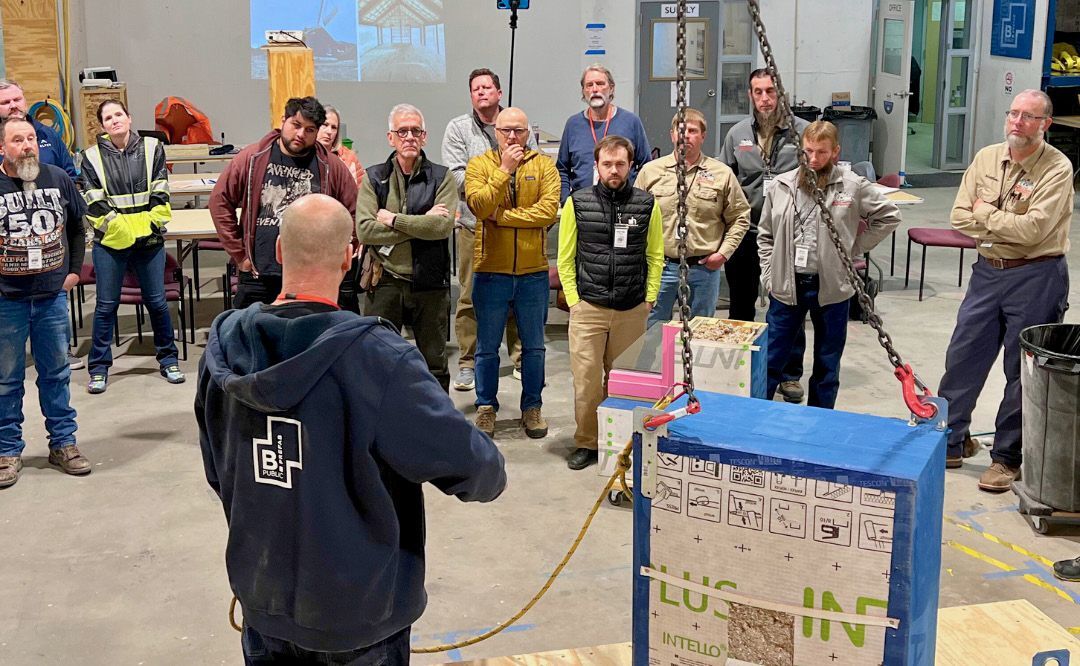
Offsite factories succeed when they recruit for mindset and build competence through structured, hands-on training.
• A tight labor market forces modular firms to recruit from retail, service and nontraditional backgrounds.
• Companies like Bensonwood and B.Public emphasize apprenticeships and six-month training to build commitment.
• Clear growth paths, technical training and early engagement help convert new hires into long-term team members.
Plenty of ink has been spilled in the trade press lamenting the construction worker shortage. Questions like when did the shortage begin, how severe it is, and why does it exist have been answered, debated and asked over and over again.
There is consensus that a shortage does exist, that it negatively impacts the industry and that it’s poised to worsen due to retirements.
One obvious response to the construction worker shortage is offsite construction. It’s less labor-intensive than site building and fewer skilled laborers are needed. However, staffing a modular factory and ensuring the workforce is up to the task is a challenge.
What should those hiring to fill modular factory positions consider? How can they attract and retain a quality workforce?
Finding Applicants
Throughout 2025, the unemployment rate in the US has hovered just above 4%. While this is traditionally low, it’s slightly higher than the 3.5% we saw in 2022 and 2023. The labor participation rate is about 62.5%, which is the vicinity it’s been in for over a decade.
The point is that it’s a tight market. Anyone hiring for a modular factory understands this all too well.
Companies take different approaches to tackling this dilemma For instance, B.Public Prefab (B.Public), a manufacturer of high-performance wall panels based in Santa Fe, New Mexico, has used several approaches, including advertising through workforce development offices in the region, going to workforce fairs and advertising on Craigslist. “We’re always challenged to find good candidates,” says Edie Dillman, B.Public’s CEO and Co-Founder.
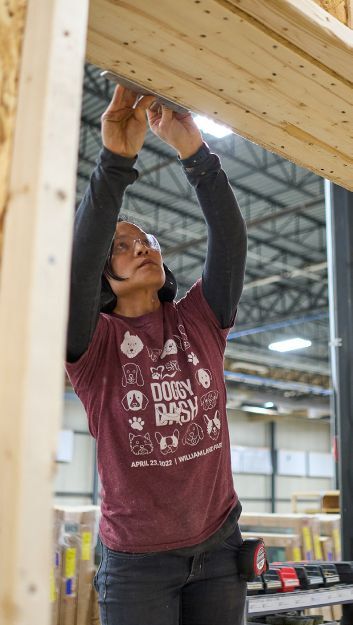
Another way to find help is to partner with educational programs. After the pandemic, New Hampshire-based Bensonwood — a design/build firm producing sustainable, energy-efficient residential and commercial buildings via offsite fabrication — found that resumes were barely trickling in. The company, which has a strong educational bent, decided to partner with a community college to create an apprenticeship program.
The ideal candidate for the apprenticeship program and Bensonwood employment is someone who came out of a construction trade program in high school. To attract more applicants, the company has expanded the program to include people with no prior experience using tools.
“The main qualities we seek are a good attitude and interest in the field,” says Emily Benson, an Employee Success Officer with the company. “We like employees who are positive thinkers, excited to come to work and are good team players.”
Who Is Applying?
Having sufficient applicants is excellent, but what about the quality?
“We didn’t have a hard time finding applicants, but finding high-quality applicants was a challenge,” says Clifton Dial, who assisted in hiring and recruiting for Volumetric Building Companies (a vertically integrated global volumetric modular construction company) from 2018 to 2022.
Although VBC is headquartered in Philadelphia, Pa. its plant is in Hamlet, North Carolina. Dial says that the location made it easier to find applicants, thanks to the region’s rich history of mobile home manufacturing. “We threw a net out and whatever we caught we caught,” he says.
Aaron Curley, who worked as a program manager at Ilke, the UK’s largest low-rise residential modular construction company from 2021 to 2023, describes the new hires his company dealt with. “While all who applied had some interest in modular construction, many came from outside the industry with backgrounds in retail and other service roles.” They ranged from recent high school graduates to those changing jobs in search of something more interesting.
Ilke had 600 people working across two shifts on the factory floor and completed one module every 75 minutes. By breaking the process into over 300 steps, the work became accessible to a wide range of people, with 90% of the workforce coming from non-trade backgrounds. Employees were given one week in the classroom to learn the principles and then did work shadowing for a couple of weeks while settling into a role.
There’s no one singular type of person who is striving to work in modular factories, according to Jackie Clark, a Talent Manager for Ritz-Craft, a modular manufacturer in Mifflinburg, Pennsylvania. However, Clark says applicants are predominantly men who have worked in factories before.
“They want something more challenging,” Clark says. Others have done some DIY at home, some have been in skilled trades, some are two to three years out of high school, and some are just fulfilling unemployment requirements. She estimates 25% of applicants are worth interviewing.
“For people who are coming out of the retail or fast-food world, working in an offsite factory represents stability,” Dillman says. “Similarly, those who have worked on construction sites, they know they’ll get forty hours a week no matter the weather and they won’t get cut when the project is done.”
What to Look For
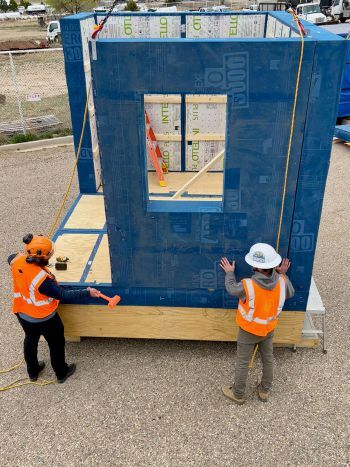
Sifting through resumes and determining whom to interview is time-consuming. What are some things to consider when deciding if a candidate is worthy of an interview?
“We look at job history and how long people stayed in their jobs to try and determine their level of commitment,” Dial says.
Job history is also a factor for Clark. “If people are constantly switching jobs, it feels like we’re next in line, so we look for people who have held steady jobs.”
And once a candidate is brought in for a job? Soft skills win the day.
“It comes down to things like showing up, following up, expressing themselves clearly, showing interest and demonstrating an ability to show up in a professional way,” Dillman says.
“We try to gauge the candidate’s attitude during the interview process and determine if they have a genuine interest in what we were doing,” Curley says.
Clark has sat in and conducted interviews with candidates. She and Ritz-Craft try to determine if candidates have a good work ethic, are trainable and have a good attitude. “One good indicator of dedication is people who participated in clubs or sports during high school,” Clark says. “It shows a commitment to something and an understanding of teamwork.”
Some of the questions Clark asks while conducting an interview include:
• What do you like to do outside of work? “If they have lots of activities, it shows a drive to be active.”
• Would you rather lead or follow? “This helps me figure out where they’d be a good fit and sets the tone for type of person they are.”
• Would you prefer to work in a team or as an individual? Why? “This question helps me determine where I can place them so they can thrive. If I put them in a bad situation, they’ll quit and I’ll have to find more people.”
• What is your greatest strength/ weakness? “I want to know if they are aware of their weakness so that they can improve on it.”
• What is your biggest pet peeve, and how do you deal with it? “This lets me know how they’ll handle working with others. Will they be able to call a teammate out or go to a supervisor about it?”
• What would your former boss say about your work ethic, attendance and attitude?
• What did you like most/least about your last job? If people talk negatively about their previous job, it’s a red flag. A typical answer is that they loved the team, but hated the hours, which is reasonable.”
During the interview, Clark explains the company’s activities and asks, “If you weren’t building a house, what would you be interested in learning about? Is there any area where you don’t want to work?”
After the discussion, Clark brings candidates out to the floor, and many are awed by what they see. “Good candidates will either ask questions about what people are doing or watch them, indicating interest. Those who don’t interact or engage … I have a good feeling if they want to be there or not.”
Ultimately, Clark also introduces candidates to the foreman to get another view of the candidate.
Retaining Employees
The final step of the hiring process is retention. After all, the goal is to build the team.
After Dial and his team established a technical testing program for applicants and developed a structured onboarding program for new hires, they were able to increase retention of new hires to 92 days. “If we could get employees to the 90-day period, which is when they complete the probation period and get a raise, they were apt to stay a year.” The primary reason for turnover was poor attendance.
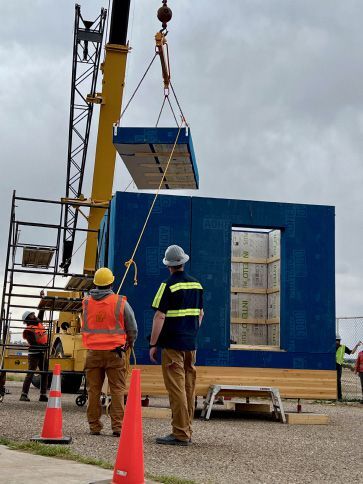
As the factory became more technical and automated, Dial and the company recognized the need to prepare for training and developing new hires in automation and technical tasks. “In the industrial construction world, you really need engineers and process control team members to become trainers and be handson with the builders to teach these higher-level skills.”
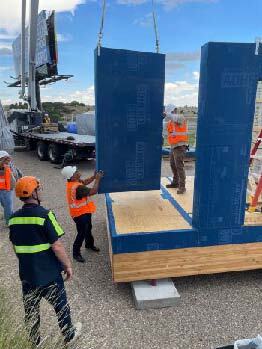
Dillman and B.Public both put great emphasis on retention as evidenced by the company’s six-month training period. New Mexico’s Job Training Incentive Program reimburses for the training since the job falls under the manufacturing/green jobs umbrella.
“The training builds a lasting relationship, and most everybody at the shop has been there awhile,” Dillman says. “Someone who is not dedicated, typically lasts less than three months.”
The increase in technical automation of the factory has led B.Public to adapt. “As we grow as a company and deepen our commitment to the trades and innovation, we are developing a skills assessment program for potential candidates,” says Dillman. “We are committed to training and meeting great candidates where they are, but we also see the need to measure baseline competency to create meaningful pathways and plan for more technology and computer-assisted work on the manufacturing floor.”
While offsite construction helps address the broader labor shortage in the construction industry by reducing the need for skilled labor, it also introduces new challenges in finding and retaining workers capable of adapting to technical tasks. The challenge has increased as modular factories become more automated.
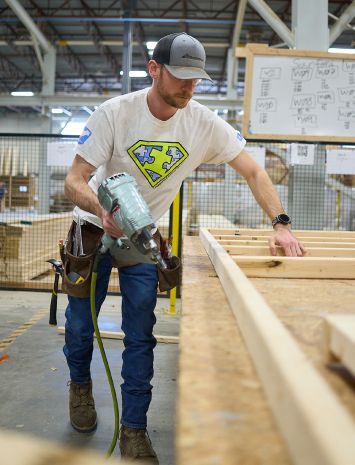
Despite this, employers are seeking employees with soft skills, assuming they can be trained. Companies are responding by developing hands-on training programs, creating skills assessments and involving technical teams in onboarding. These efforts not only prepare workers for more complex tasks, but also improve retention by building confidence and engagement early on. In a tight labor market, meeting candidates where they are — and providing clear pathways for growth — is essential to creating a resilient, future-ready workforce.
Larry Bernstein is a freelance writer based in northern New Jersey. He focuses on all things construction. Learn more about him on his LinkedIn profile.