


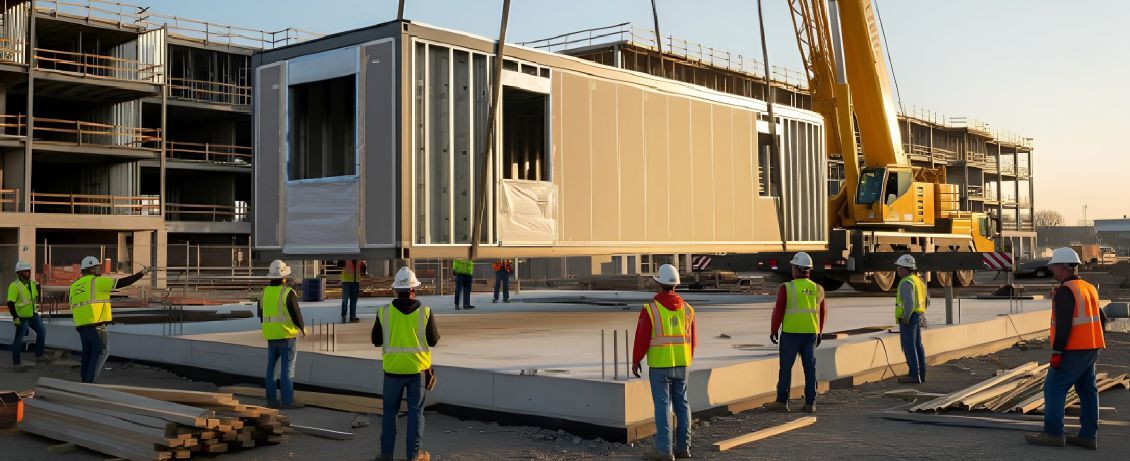
Here’s how to ensure a smooth transition from the factory to the jobsite.
- Factories optimize internal results, but full value is only realized when work flows cleanly to installation.
- Handoffs fail when they’re treated as logistics events instead of transfers of responsibility, momentum and risk.
- Using Jobs-To-Be-Done, readiness criteria, and takt aligns both factory and site around downstream success.
Walk through nearly any offsite factory, and you’ll see a mix of ambition and struggle. Some workstations are dialed in, while others are cluttered or out of sequence. Flow is uneven. Work piles up between operations.
At a glance, finished modules or panels may look good, but that result often depends on temporary workarounds, local fixes, or decisions deferred to later stages. Progress is being made on paper but the underlying system strains to move work forward consistently. Then those same units arrive onsite — and suddenly the wheels wobble.
Crews wait. Cranes sit idle. Someone is trimming, shimming, drilling, or improvising a fix that “should have been done in the factory.” Schedules slip. Tempers flare. The factory insists the product was fine. The site manager insists it was not install-ready.
This is the moment of truth in offsite construction. And it’s where many offsite strategies quietly fail.
The problem is not quality in the traditional sense. It’s not something you can inspect away with another checklist. The problem is that the factory-to-site handoff is rarely designed at all. It is treated as a transfer of product when in reality, it is a transfer of responsibility, momentum and risk.
If offsite construction is going to deliver on its promise, this handoff must be deliberately designed — because this is where value is either realized or destroyed.
Why Handoffs Fail
Most offsite manufacturers optimize what they know they control — what happens inside the factory walls. They focus on measurable outputs, even if overall flow is uneven and work is piling up between steps. Meanwhile, the site faces a very different reality — weather, inspections, access constraints, trade stacking and constant schedule pressure.The handoff sits between those two worlds, but belongs fully to neither.
The questions that factory managers ask about handoffs show that they consider it a logistics issue. Did the unit ship on time? Did it arrive undamaged? Was the paperwork complete? But while these are necessary questions, they’re far from sufficient.
The more important question is this: did the arrival of that unit allow the installation crew to start productive work immediately?
In many cases, the answer is no. Modules arrive “complete,” but require field modifications. Panels are dimensionally correct, but install‑critical features are missing. Interfaces between panels or modules look good in the drawings, but fail under real conditions. The site absorbs the friction, and the factory never sees the true cost.
This failure is structural, not personal. Factory and site are designed as separate systems and the handoff is treated as a boundary instead of a transformation. In offsite construction, value is only created when work flows cleanly across that boundary.
Misaligned Metrics
Even organizations that recognize handoff problems often struggle to fix them. The reason is usually hiding in plain sight: success is measured differently on each side of the handoff.
Factories are rewarded for units completed, shipped and passed through internal inspections. Sites are rewarded for installation productivity, crew utilization and schedule adherence. Logistics teams are measured on delivery timing and cost. None of those metrics, on their own, reflect whether the handoff actually worked.
The result is predictable. The factory can “win” by shipping on time, while the site “loses” days absorbing rework, waiting and improvisation. Inspection-heavy cultures feel safe because they produce clean reports, but they do not guarantee readiness. What gets measured gets shipped — even when it is not truly install-ready.
Until leaders align success measures around downstream outcomes, handoff problems will persist. Readiness, flow and installation success must matter as much as factory completion, or the system will continue to optimize the wrong things.
Reframing With Jobs-To-Be-Done
A more useful way to think about handoffs is through a Jobs‑To‑Be‑Done lens. Instead of asking what is being shipped, ask what outcome the next team is trying to achieve.
The site is not trying to “receive modules.” The site is trying to start installation without surprises, rework, or waiting. Logistics teams are trying to deliver predictably without fire drills. Supervisors are trying to keep crews productive and schedules intact.
From this perspective, the primary job of the handoff becomes clear: when a factory‑built component arrives on-site, it must enable immediate, productive installation under real field conditions.
That requirement is very different from passing a factory inspection. It shifts the focus from internal completion to downstream success — and it explains why so many handoffs disappoint. They were never designed to deliver the outcome the site actually needs.
Mapping the Handoff Job
Most organizations already have process maps for shipping and receiving. What they lack is a clear map of the handoff job itself.
Traditional process maps show steps. Job maps show what must happen for the outcome to succeed. That distinction matters.
When you map the handoff job from the site’s point of view, a different picture emerges: preparing for delivery, receiving and staging, verifying readiness, installing and integrating. Each phase contains decisions, dependencies and assumptions that can either support flow or quietly destroy it.This work should be done with factory, logistics and site leaders together, using a real recent project rather than an idealized future state. The goal is not to defend current practices, but to expose where work stalls, where information is missing, or where conditions are being misjudged.
The most valuable insights almost always appear at the seams. These are the places where responsibility is unclear, or where one team assumes the other will “figure it out.”
Value Versus Waste
Once the handoff job is visible, the next step is uncomfortable but necessary: separating value creation from waste.
In the context of a handoff, value creation is anything that makes installation faster, safer, or more predictable. Waste is everything else.
Waste shows up quickly. Field trimming that compensates for unclear tolerances. Searching for missing parts or documentation. Re‑sequencing work because access was blocked or interfaces were misaligned. None of these activities add value. They simply mask upstream design gaps.
A simple test helps clarify things. If the site crew would not willingly pay for an activity, it is probably waste. And waste at the handoff is especially expensive because it multiplies. One small issue can delay multiple trades, extend crane time and ripple through the schedule.
The factory rarely feels this pain directly — which is why it persists.
Designing Readiness Criteria
One of the most powerful shifts an offsite organization can make is moving from inspection to readiness.
Inspection asks whether something meets specification. Readiness asks whether the next job can start without friction.
Readiness criteria are explicit, binary conditions that must be met before a unit is released. Not “mostly done.” Not “good enough.” Ready.
Are all interfaces accessible without temporary workarounds? Is the installation sequence confirmed and supported by the design? Are any known field‑dependent fixes being deferred “for later?”
If readiness cannot be verified in the factory, it will be paid for onsite. That is not philosophical — it is factual.
The key is making readiness visible and treating it as a gate, not a suggestion. When readiness becomes part of the definition of “done,” behavior changes quickly.
Using Takt and Flow
Even a well‑designed handoff will struggle if the rhythm between factory and site is misaligned. This is where takt and flow‑based thinking matter.
Takt is often misunderstood as a scheduling tool. In practice, it is a shared cadence that aligns production, delivery and installation. It creates predictability — and predictability is exactly what handoffs need.
Many factories batch work to maximize internal efficiency, while sites need steady, reliable releases to keep crews productive. When those rhythms clash, the handoff becomes a shock absorber.
Flow‑based thinking forces a harder question: how does this unit move from raw material to installed asset without stopping, waiting, or rework?
The goal is not speed. It is reliability. A slower, predictable handoff will outperform a faster, erratic one every time.
Mini Case Study
Consider a composite scenario that will feel familiar. A modular manufacturer was hitting its internal metrics. Output was on plan. Inspections passed. Yet every project experienced site delays. When the team mapped the handoff job, the problems were obvious in hindsight. Installation assumptions were buried in drawings. Minor field modifications were treated as inevitable. Delivery cadence varied week to week.
The fix was not dramatic. The team defined explicit readiness criteria tied directly to installation success. They aligned factory releases to a simple takt agreed upon with the site. They tested the approach on a single product line.

The results were immediate. Field modifications dropped. Installation windows tightened. Tension between factory and site eased — not because anyone worked harder, but because the handoff finally worked as designed.
Practical First Steps for Leaders
Handoffs do not improve on their own. They are a leadership responsibility.
A strong starting point is walking the last handoff backward from the site. Ask crews where they lose time in the first hours of installation. Pilot readiness criteria on one product or project instead of attempting a wholesale redesign.
Avoid over‑engineering the solution. The biggest gains usually come from clarifying expectations and aligning rhythms — not from adding complexity.
Most importantly, treat the handoff as a system, not an event.
In offsite construction, the factory does not finish when the unit ships. It finishes when the site succeeds. The handoff is the moment of truth. If it is poorly designed, downstream chaos is guaranteed. If it is deliberately designed around real jobs and real conditions, it becomes a competitive advantage.
The biggest gains in offsite construction are not hidden inside the factory walls. They live at the boundary between systems — waiting for leaders willing to design them properly.
Daniel Small helps offsite manufacturers increase factory throughput and eliminate waste using Lean strategies. As a specialist in Lean for offsite construction, he optimizes offsite production for scalability and efficiency. Contact him at 719-321-1953 or [email protected], or visit www.DaVinciConsulting.co.