



Website Marketing in the Age of AI
Builders have a choice to make: structure their websites to be found by AI searches or lose business.
• Buyer discovery is moving from keyword searches to AI-driven, natural-language recommendations.
• Builders must structure website data to answer lifestyle-based questions, not just market keywords.
• If AI can’t clearly interpret a builder’s offerings, it will exclude them from recommendations.
Most builder websites assume one primary audience: human buyers typing keywords into Google.
That assumption is outdated.
Increasingly, buyers are asking AI systems — ChatGPT, Grok, Gemini — to identify builders and home plans they might like. These aren’t keyword searches, however. They’re natural-language requests that combine lifestyle, family structure, location and long-term needs.
Will you be found by a potential buyer typing the following into ChatGPT? “We have three kids and a dog, and want to live near a good school system with nearby parks near Raleigh, N.C.” According to John Lee, if your website data isn’t structured to answer that kind of query clearly and structurally, an AI search will pass you by.

Of course, a little digging on the buyer’s part might identify your company as a good fit. But as AI becomes more powerful, buyers become less inclined to do any digging.
Lee is CEO of Anewgo, a tech company based in Holly Springs, N.C. that prepares homebuilders for AI-based discovery. It does so by creating structured, content-rich, interactive websites for those builders — websites that AI can interpret and use to answer buyer questions.

He says that builders who want to prep for AI search need to focus on three things, for which he uses the acronym IPA: Infrastructure, Platform and Application.
Think Scenarios, Not Keywords
Infrastructure is about data. AI doesn’t look for “new homes in Raleigh, N.C.” Instead, it looks for solutions to the customer’s stated problems. Because of this, your website data needs the ability to explicitly answer a range of possible queries. For example:
• Who a plan is good for (people with children, multigenerational households, retirees)
• How specific plans can adapt to different needs (home office, in-law suite, ADU potential)
• What problems a community solves for the buyer (highly rated schools, distance to work, walkability)
If those answers exist only in a salesperson’s head — or are buried in PDFs behind a firewall — AI can’t surface them.
Futureproofing means writing for context, not clicks.
It’s in the Details
Specificity really matters here. Broad descriptions don’t help AI make distinctions.
Rather than “spacious floor plans” or “flexible living,” you might want to use “primary bedroom on first floor suitable for aging parents,” or “lot zoning allows detached ADU up to 800 sq. ft.,” or “plan accommodates multigenerational living without shared bedrooms.”
AI systems compare builders against each other when trying to address a customer’s query. This type of granularity is needed to win those comparisons.
As Lee puts it: “Your difference may be all the difference.”
Make It Machine- Readable
Your infrastructure, of course, includes your website copy and graphics. Well-written copy, as well as nice photos and helpful videos, still matter to visitors. But when it comes to AI, structure matters more.
AI needs content that’s clearly labeled and consistently organized. It wants to see detailed descriptions of the home’s features and also wants descriptions of the photos or renderings. It needs to understand how a specific plan or community will meet the potential buyer’s use case.
Photos and videos help humans. Structured data helps AI understand what those visuals mean so it can deliver those humans to you.
How these features are described can make a big difference. A buyer from New England might want a house in Florida with a screen porch. “But the buyer, might not know that in Florida it’s called a Lanai,” explains Lee. “The data has to be structured to make it possible for the AI to find those homes and to recognize that two terms might mean the same thing.”
Ungate Critical Information
It’s also important that all of your marketing platforms are searchable and scrapable.
Traditional marketing encourages gated content: registrations, forms, hidden details. However, AI doesn’t fill out forms. If key information is locked behind lead capture, AI will treat it as missing data — and either move on or make (often inaccurate) guesses.
That doesn’t mean giving That doesn’t mean giving everything away. It means making the facts that customers need to make buying decisions available to them.
These facts include:
• Floor plan attributes
• Community features
• Build options
• Zoning flexibility
• Lifestyle suitability
If AI can’t read it and properly interpret the above, then it will be less likely to recommend you to potential buyers.
Also note that AI evaluates trust the same way people do — by cross-checking various platforms.
Future-proof builders strive to ensure consistency everywhere they appear. That includes their website, listing portals and social media. If your website says one thing about your company or home plans, but review sites, your Instagram page, or third-party listings say something else — or say nothing at all — AI discounts you.
Add an On-Site AI Assistant
The application is the connection between the seller and the buyer. And to make that connection, you’re going to want an AI agent.
Lee predicts that buyers will increasingly use their own AI agents to look for homes. “A buyer won’t need to go to portals like Zillow. The agent will go out and pull content from the MLS and various builders’ websites, then deliver it to the buyer.”
In fact, he foresees buyers putting agents to work finding new homes while they go about their business. They’ll simply check in periodically to see what the agent has come up with. And he believes that builders will benefit from having their own AI agents to talk with buyers’ agents.
A builder’s AI agent can answer open-ended buyer questions, translate builder-speak into buyer-speak, remember a specific buyer’s preferences across visits, and send the buyer to a human salesperson when needed. “Your agent should know everything about your products, your pricing, your options,” he says. And it will be set up to convey that information in ways that work for the buyer’s agent.
Without this capability, you’re leaving it up to a third-party LLM (Large Language Model) to decide whether a competitor is “better.”
Test Yourself
One of the simplest steps builders can take today is to go to an AI tool and ask a real buyer question that does not include your brand name.
For example:
• “Find a builder in Raleigh that supports multigenerational living.”
• “New homes near good schools with ADU potential.”
• “Builder experienced with aging-in-place design.”
If you don’t show up — or show up vaguely — that’s not an AI problem. It’s a website problem.
AI shifts much of the early buyer journey into private exploration. By the time a buyer contacts you, they may already know what they want, what they don’t want, and why they’re talking to you.
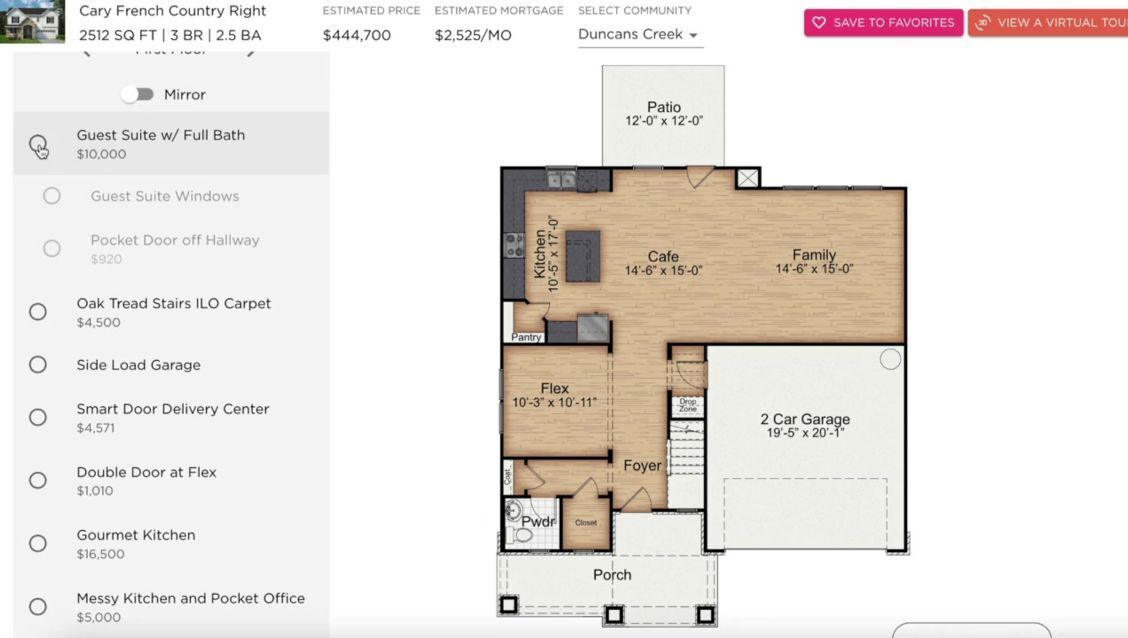
That’s a win — if your website helped to educate them.
Future-proof sites reduce friction and confusion upfront so that salespeople can focus on guidance. Futureproofing your website isn’t about chasing the latest tech trend. It’s about answering one question: Can an AI system confidently recommend you when the buyer describes their life, not your keywords? Builders who have platforms with properly structured data, along with genuinely helpful AI agents, will continue to found by potential customers.
Those who don’t won’t be rejected — they’ll just be invisible.