



Sponsored Article by ModularHomeSourcePro.com
ModularHomeSourcePro.com views education as infrastructure — and is removing the friction that keeps modular from scaling.
• Modular projects don’t fail in factories; they fail when they’re sold, managed, funded, or inspected using site-built assumptions.
• The industry has relied on tribal knowledge to train the modular ecosystem. That approach hasn’t worked.
• If you want modular to scale — or your projects to stop stalling — then ModularHomeSourcePro.com is for you.
It’s time for the modular industry to stop defending itself. The argument has been settled. Factory-built modular homes offer higher quality, tighter schedules, better energy performance and fewer defects than conventional builds. Offsite Builder readers know this. Many have lived it, and have seen what happens when you take the work out of the weather, out of the chaos, and into a controlled process.
Of course that begs a question. If modular is so good, why has it only captured a tiny slice of the new home market? The answer is that the quality argument isn’t enough to scale modular. Scale won’t happen until the ecosystem learns how to work with it.
Unfortunately, that learning is not happening consistently, swiftly or at scale. Some real estate agents still confuse modular with mobile/ manufactured homes. Some appraisers base comps on manufactured homes rather than site built. Some lenders try imposing conventional draw schedules onto modular projects.
The industry has spent decades perfecting manufacturing and improving products. What we’ve not done at scale is to train the professionals we need to help move modular forward. The bottleneck is no longer engineering: it’s education.
That education would be simple if modular was just a construction method. Build in the factory, ship, set, finish. Done. The challenge is that it’s also a delivery system with sequences and deadlines that differ from site built.
For instance, in a modular build there are no “allowances,” that let homeowners postpone product choices like tile until the last minute. Decisions must be made before manufacturing begins. Inspections are also different, with some done in the factory and some on-site. Appraisal and lending processes aren’t the same, either.
The people and processes outside the plant are what cause deals to stall, projects to slow and customers to lose confidence.
If you’ve been in this industry long enough, you’ve seen it:
• The realtor who mislabels a modular home as manufactured and loses the sale.
• An appraiser who uses manufactured comps and undervalues the home.
• A lender who misunderstands the timing of funding and delays the project.
• A building official who wants to inspect what was already inspected in the plant, which leads to conflicts and more delays.
• An architect who doesn’t understand that while site-built homes are designed in 2 ft. implements to optimize materials, module dimensions need to be optimized for over-the- road transport (13 ft. 9 in. or 15 ft. 9 in. widths)
• A buyer who hears conflicting opinions from the above-mentioned realtors and lenders — as well as from builders who don’t understand modular — and decides it’s safer to build the old-fashioned way.
We’re asking the market to adopt an industrialized delivery method without giving it the training and tools it needs to operate inside it. Until we provide that training and those tools, we’ll keep hitting the same wall.
Introducing a New Educational Platform
Until now, that education has consisted of scattered PDFs, informal tribal knowledge and a handful of local “modular experts.” The hope was that people would just figure it out. But, of course, hope isn’t a strategy.
That’s why I built ModularHomeSourcePro.com (MHSP), a new educational resource.
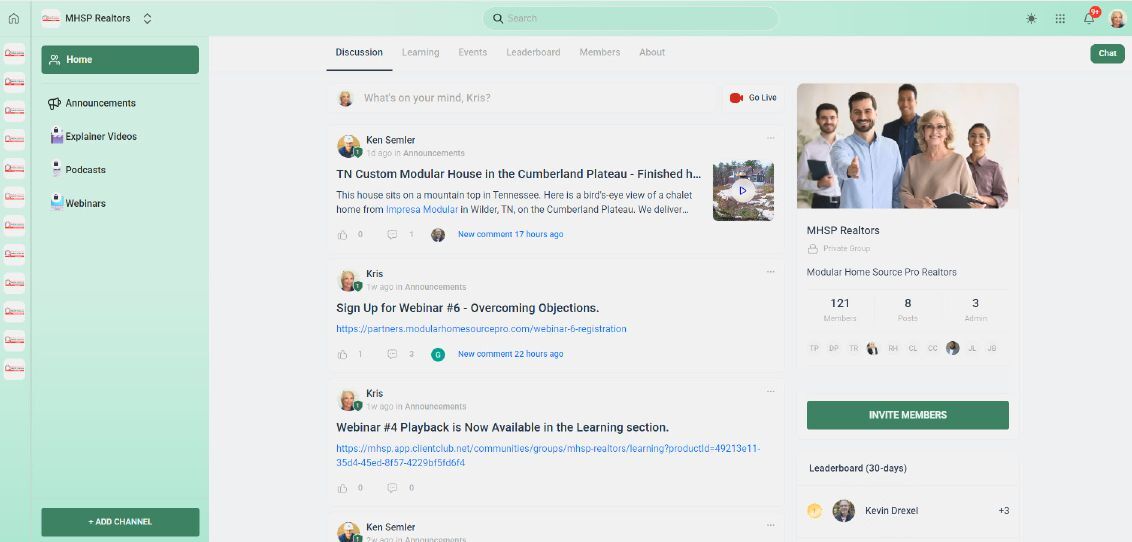
MHSP offers something for every professional that touches an offsite-modular project. It provides them with information and updates about the industry, and enables the sharing of this information.
I didn’t build ModularHomeSourcePro.com because we needed another modular website. I built it because we need infrastructure. It’s designed to train the broad offsite ecosystem in ways that are:
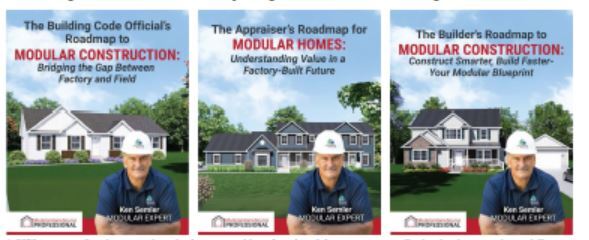
• Role-Specific. We support 12 partner groups on the website: realtors, lenders, home inspectors, building code officials, appraisers, developers, investors, and more.
• Repeatable. We provide information that, when consistently applied, can be used as a roadmap for each of the partner groups to work with offsite modular.
• Accessible. Information is presented in each partner group’s language, and is available in formats that include written guides, audio recordings, webinars and infographics.
• Updated. We update the website weekly with partner-specific information. We also offer a daily blog.
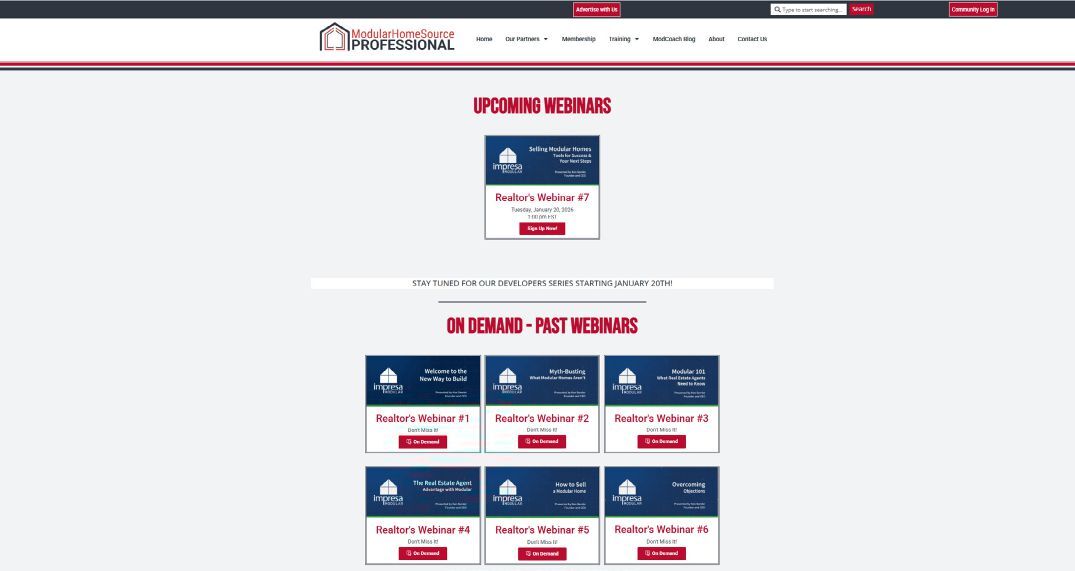
• Practical. We’re currently offering webinars for realtors —including a 7-part series on what modular is, how to sell it and how to support clients — and will be adding similar programs for the other partner groups.
This is not content marketing. It’s enablement. MHSP is offering educational content that will help everyone in the ecosystem support the growth and understanding of modular construction.
Who We Train, and Why
To illustrate the importance of this education, let’s look at five of MHSP’s partner groups: realtors, appraisers, lenders, inspectors and designers.
- Realtors: The First Domino in Adoption
Realtors shape consumer beliefs. They are often the first voice buyers trust. If they explain modular wrong, everything downstream suffers, and the reality is most realtors don’t understand modular delivery. So they fall back on assumptions: “Isn’t that manufactured?” Or they play defense: “Be careful, modular can be tricky.” Or they avoid it entirely. MHSP’s blogs, webinars and communities explain modular in terms realtors can appreciate. We help them understand:
• Modular vs. manufactured vs. site built
• Realistic timelines and sequencing
• How to talk about cost without losing trust
• What happens in the factory and what happens on-site
• How to position modular as premium construction
• How to build a referral pipeline using modular leads
The more realtors we train, the easier modular becomes to sell.
2. Appraisers: The Value Gatekeepers
The appraisal system wasn’t designed to handle modern modular.
Appraisers who are unfamiliar with modular construction struggle to find comparable properties. They confuse modular with manufactured and default to lower values. That kills financing.
But educated, well-versed appraisers know that a modular home’s quality and energy efficiency support higher, defensible values. When appraisals catch up, financing follows. And when financing follows, modular expands beyond cash buyers and niche markets.
3. Lenders: The Quiet Bottleneck
Although this is one of the least-discussed barriers, it’s one of the biggest. The modular funding sequence is different. The contracts look different. The milestones are different.
What do lenders do when they don’t understand these issues? They avoid modular. Or worse, they force it into a site-built lending framework. This creates delays and friction, making projects look riskier than they are. ModularHomeSourcePro.com trains lenders on how to adapt their construction financing to modular realities. This means funding deposits for factory orders and matching draw schedules with actual modular milestones.
When lending becomes modularliterate, modular adoption will accelerate dramatically.
4. Building Officials: Where Confusion Becomes Cost
One particularly damaging myth about modular is that it’s “hard to permit.” It shouldn’t be. What makes it hard is inconsistent interpretation. Many building officials have limited exposure to modular, confusing it with HUD Code manufactured housing, or not clearly understanding how modular approvals work. They can be unsure of where their responsibility begins and ends.
That confusion turns into unnecessary delays, redundant inspections, job site disputes, change orders, frustrated customers and projects that take longer than they should.
MHSP trains code officials and inspectors on:
• How modular fits within state and local jurisdiction frameworks
• What is inspected in the factory and what must be inspected locally, such as foundations, sitework and utility connections (These can vary by local processes.)
• How modular improves code compliance
When jurisdictions understand modular, permitting gets faster and more predictable. Predictability is what investors and developers want most.
We’re already seeing this in Virginia. The state has adopted the 1200 & 1205 sections of the International Residential Building Code (sections that stipulate the way modular is inspected) thereby ensuring a consistent inspection processes state-wide, which, in turn, has helped to make Virginia a leading state for modular construction.
5. Architects and Designers: Factory-Compatible Design
Architects are talented. But modular requires them to adopt some different approaches.
Many architects don’t understand the efficiencies of building offsite. They put marriage walls in expensive areas. They divide kitchens and baths across modules and don’t create natural module breaks at 13 ft. 9 in. and 15 ft. 9 in. MHSP offers them education on these issues, and invites them into a professional community where they can ask questions and get answers from other architects.
The training for architects and designers includes:
• Transportation limitations
• Module dimensions and structural boundaries
• Mate wall realities (and why windows aren’t happening there)
• MEP coordination and chase planning
• Design-for-manufacturing principles
• How to reduce redesign and change orders while maintaining design flexibility
When design becomes modular-friendly, modular becomes more profitable. And profitability fuels growth.
It should be clear from the above that MHSP enables the ecosystem to receive consistent training across regions, roles and experience levels. It’s a scalable education platform that’s role-based and constantly updated. Whether you’re a realtor, a code official, or some other construction professional, you get the information you need in language you understand.
The offsite industry cannot grow to the scale we need if we continue to rely on informal learning. Continued growth requires structured education.
That’s the outcome ModularHomeSourcePro.com is designed to create: not hype, but competence.
What the Offsite Industry Needs Next
I’ll say it again: Our industry has spent too much time trying to prove that modular works. We’ve already proven that. Now we need to embrace the next step: training the ecosystem so modular can scale without friction. We need to treat education like infrastructure. Not as a side project. Not as optional.
Ultimately, modular must become a specialization that people want to own. Whether it’s a builder or a realtor, we want to help them speak confidently and win buyers. We want to make them the subject matter expert, and to enhance their position as a trusted advisor.
ModularHomeSourcePro.com is one piece of the infrastructure needed to make this happen. It was built to help the ecosystem catch up to what we’ve already proven on the manufacturing side.
If you want to grow the industry and grow your position in the industry, be sure to share ModularHomeSourcePro.com with the partners you deal with directly. If you are a realtor or builder, share it with appraisers, lenders and home inspectors. Everyone needs to learn more about this better way to build if it is going to grow and scale.
Modular doesn’t win when we talk louder, it wins when the ecosystem knows what it’s doing.
Ken Semler serves as Publisher at iMedia Group, whose properties include Modular Home Source Pro and Offsite Builder.