


These finalists from the 2026 Best in American Living Awards used offsite construction to create striking architecture in commercial, multifamily and single-family residential projects.
• An art gallery, urban apartments and a custom home reveal offsite’s versatility across building types.
• Each project demonstrates how factory-built components support flexibility, speed and higher-quality outcomes.
• These award finalists show why top designers increasingly trust offsite methods for challenging work.
Design competitions such as the National Association of Home Builders’ Best in American Living Awards attract some of the best builders and architects in the industry, including those who are designing and building with prefabricated construction systems. These three inspired offsite projects were finalists in the 2026 competition.
Mass Timber Beauty
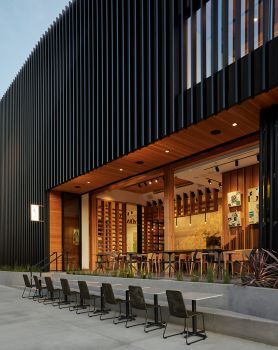
At the very center of downtown historic Morgan Hill, California, a small empty lot marked the location of the original Edes building, long lost to demolition. A new masstimber building on the site, also called “The Edes” in homage to the original building, is an art gallery with a focus on local and regional northern California artists.
In addition to being a gallery, The Edes houses a café, a wine bar and an event space for hosting artists’ workshops and public art and music events. The intent is to provide an immersive experience for visitors, says Mark Oberholzer, an architect with the Los Angeles office of KTGY, the firm that designed the building.
The building’s owner wanted the project to showcase many types of art including paintings, prints, drawings, ceramics, jewelry and sculpture. “That vision inspired us to think of the gallery as an adaptive space that was interactive, not a simple white-box gallery,” Oberholzer says.
Art is displayed on pivoting and sliding walls that can be moved to one end of the building and stacked to make space for events and installations. The two-story building positions the restaurant/ café on the first floor and the gallery on the second floor.
The structural system is mass timber, including cross laminated panels for the horizontal spans, and parallel beams and columns. The timber was left exposed, which creates a warm, welcoming interior that is both sophisticated and approachable.
A variety of community events, including art workshops, music, festivals and events for children, are held at The Edes. “It’s like a community hub,” Oberholzer says. “That really drove the flexible approach to the display of art.”
The building is located in a flood plain so needed to be raised about three feet above the sidewalk. The design team treated this requirement as an inspiration to create a concrete plinth for the building to sit on. The plinth serves as an adaptive base — providing an elegant ramp, planters and steps. A small patio and banquette are part of the concrete plinth where the café opens to the street.
The timber’s exterior finish uses a traditional Japanese method of wood preservation called Shou Sugi Ban, in which the surface of the wood is charred, which enhances its durability and fire resistance. Oberholzer says that approach also provides an interesting contrast to the interior. “You have a very dark exterior with clear glass and a very warm wood interior with the art,” he says.
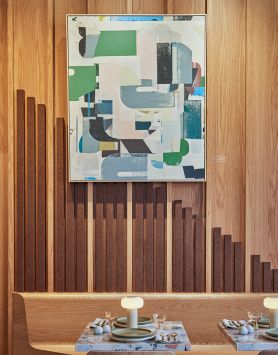
The exposed timber on the inside of the building expresses its character. “The interiors, with their slats that run along staircases and all the built-in cabinetry, are a part of the same language,” Oberholzer says.
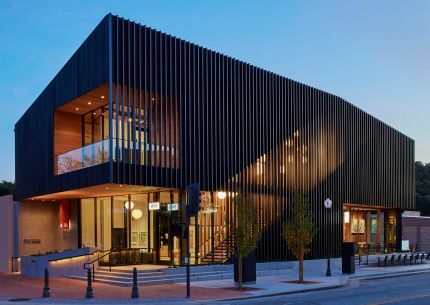
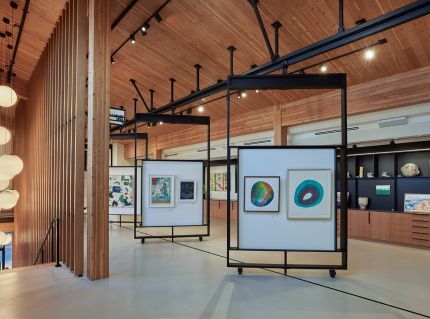
Photo: Mike Schwartz
Constraints Drive Innovation
(Note: To see photos of this project, go to https://kephart.com/portfolio/revival-on-platte/ )
“Revival on Platte” (Revival) is a new multifamily project in a fastchanging urban pocket of Denver, Colorado. The 9-story, 200-unit, market-rate project targets young professionals, students and Gen Z’ers who want to live in Denver’s Stadium District.
“The client had this piece of land and reached out to us to do a density study,” says Steve Martinez, Co- Principal and Director of architecture firm Kephart Architecture in Denver. “We initially intended the building to be a stick-built, steelframe structure with seven levels of steel studs on a podium.”
As the design process moved forward, however, Mortenson, the project’s developer and GC (a national firm with 12 locations), decided to try something different: preassembled panels from St. Paul, Minnesota-based BLUvera, an affiliate of Mortenson. Some of the panels were as large as 40 ft. long by 10 ft. tall. All of them arrived at the site with cladding already installed.
“The biggest panels did affect the exterior design a bit because there needed to be a waterproof and airtight assembly between two finished panels,” Martinez says. The joints would form a grid-like pattern, extending from the top to the bottom of the building, as well as horizontally at each floor. “Our team came up with a rhythm that allowed us to hidet he joints within different material transitions,” he says.
The units at Revival have an average of just 594 sq. ft. of floor space, so the architects wanted to give residents room to breathe outside of their homes. The building offers a variety of community spaces: a rooftop lounge, indoor and outdoor fitness areas, a yoga and barre studio, a club room and speakeasy adjacent to an exterior elevated courtyard and spa, as well as landscaped green spaces along the river trail. There’s also a co-working space with individual cubicles for remote work and conferencing.
Kephart’s deep dive into the local context sculpted the building’s exterior character. Drawing inspiration from the neighborhood’s historic identity as “New Brooklyn,” the design celebrates a legacy of craftsmanship and industrial grit through a blend of simple forms and detailed masonry. The building features a striking corner “SkyLounge” that anchors the block, complemented by an active ground floor designed to enrich the pedestrian streetscape.
The site and its location posed several challenges. High-powered electrical lines stretch along the east side, with a 60- to 70-ft. easement below. “We could put parking or landscaping there, but no buildings,” says Martinez. “And we only had around 20 feet from the face of the building at the top levels in which to do panel installation.”
The Platte River runs along the east side of the building with the Lakewood Gulch to the south, putting the property squarely in a flood zone. Martinez explains: “We had to keep the building above grade, at a finish floor above the flood plain, in order to keep exterior materials and habitable areas out of that zone.”
Big-Timber Artistry
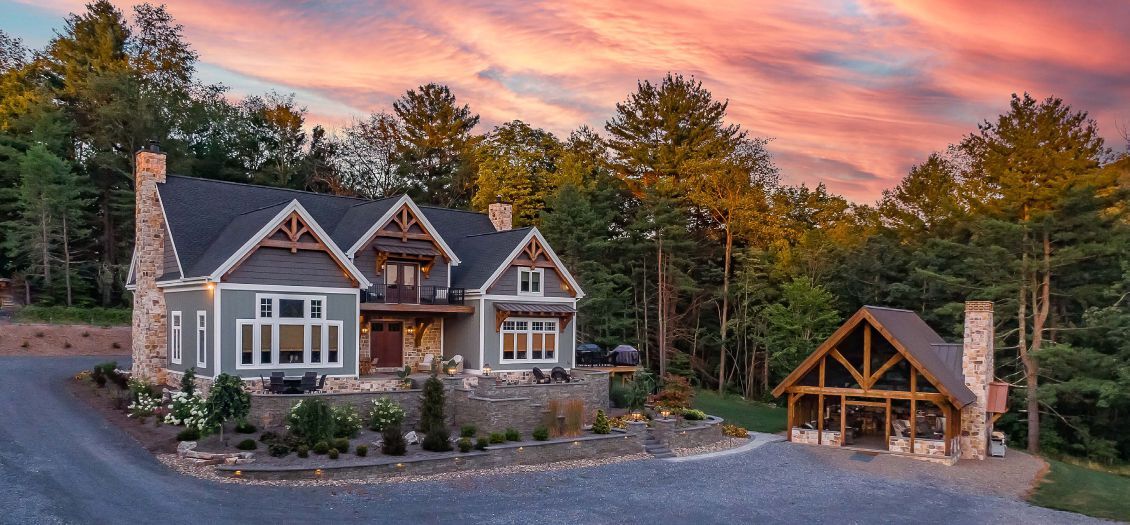
A one-of-a-kind custom home in Trout Run, Pennsylvania, takes timber framing to a new artistic level. Timberhaven Log & Timber Homes (Timberhaven) in Middleburg, Pa., designed and built the 4365 sq. ft. home in the Allegheny Mountains for a family that likes to host large gatherings.
Soaring cathedral ceilings and massive, handcrafted timber trusses frame mountain views. Inside, a feeling of grandeur was achieved by customizing the timber trusses in the great room, using large timber materials for a more “massive” architectural aesthetic, says Lynda Tompkins, Timberha-ven’s CEO and Principal. “We used a lot of larger timbers such as 8 x 12s, and integrated them with a custom ceiling finish,” Tompkins says.
The design was done primarily by the clients, Tompkins explains. “We had worked with them previously on a custom timber-frame pavilion. They initially approached us about incorporating timber elements into their home, which developed into a full timber-frame project.”
The goal, she says, was to integrate the full timber frame with minimal impact on the clients’ design. They chose a beam-and-purlin (B&P) style roof system instead of a timber rafter system. The B&P system consists of timber trusses with purlins running perpendicular to the trusses. “This can present challenges in valley areas,” Tompkins says. “Since the home was not a traditional timber frame with aligning timber bents, the truss timber and purlin depths were not the same.”
Timberhaven designed each truss to work based on its location in the design. To ensure that the components would fit together well, each valley area was cut in the company facility.
The open-concept floor plan encompasses a family room, dining room and kitchen that flow together seamlessly. On the second floor, an expansive master suite offers panoramic vistas. Meanwhile, the exterior’s mix of timbers, lap siding, shakes and stone grounds the home in its mountain aesthetic.
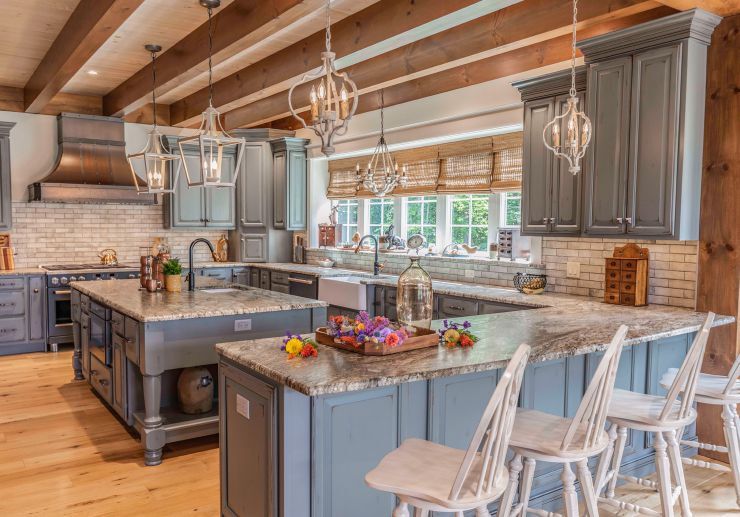
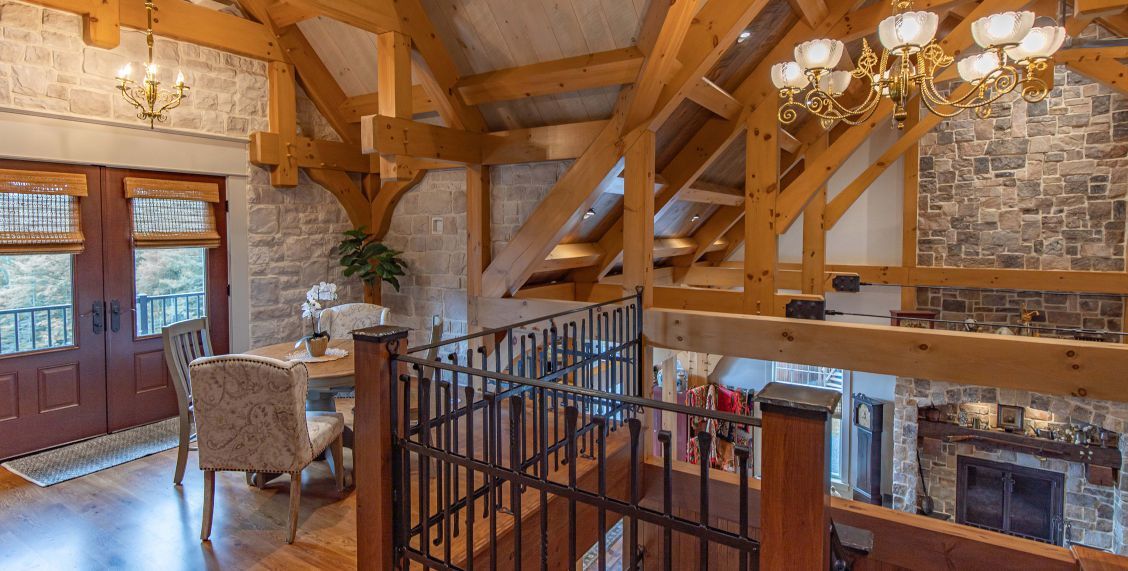
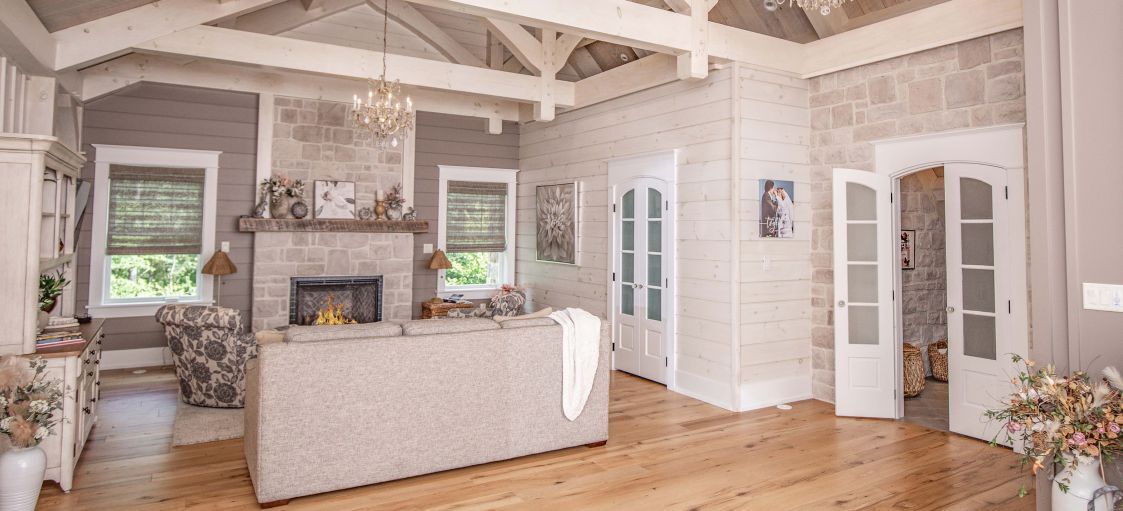
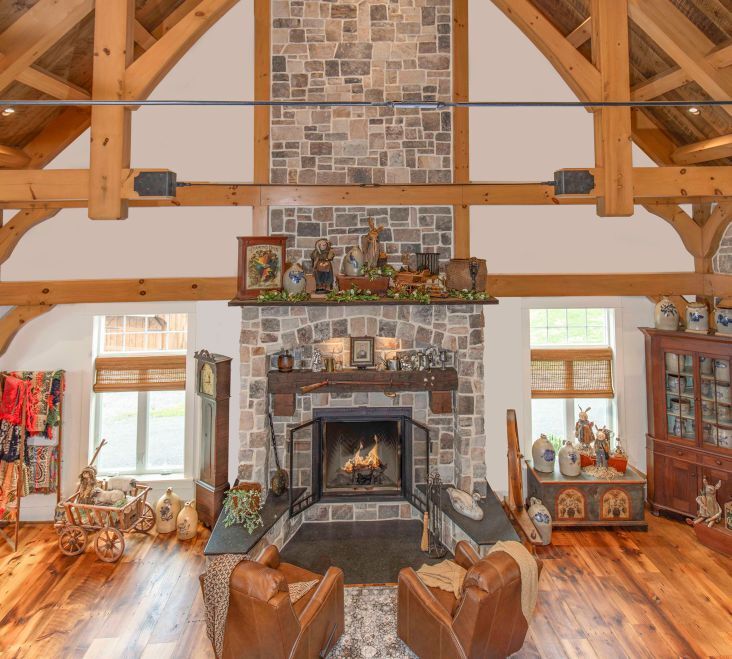
Outdoor living spaces extend indoor space. A spacious stone patio invites family cornhole tournaments, and a timber-frame pavilion provides shelter for yearround enjoyment.
The entire timber frame was manufactured in Timberhaven’s facility, numbered and lettered accordingly, and erected on-site per the fabrication plans, which detailed how the frame, trusses, etc., were to be installed.
“Every design challenge — blending grandeur with warmth, scale with intimacy — was met with intentional details that elevate comfort without sacrificing elegance,” says Tompkins.
Susan Bady is a freelance writer based in Chicago, Illinois to Muskegon, Michigan, who focuses on residential and commercial design and construction topics including sustainability and building technology.