


This Factory Thinks Like a Builder
Reframe’s microfactories, vision-based robots and AI design tools could finally make industrialized housing a reality.
- The company merges design, robotics and AI in compact factories, with the aim of reinventing modular efficiency.
- Its integrated model reduces architecture hours, limits customization and compresses the value chain from blueprint to delivery.
- With scalable robotics, AI design tools and apprentice programs, the company hopes to be building 60 homes per year by 2026.
In a field crowded with startups promising to “disrupt” construction, Reframe Systems is quietly doing something harder: rebuilding the value chain. It’s rethinking how homes are designed, manufactured and delivered — using robotics, AI and a vertically integrated model that leaves no part of the process to chance.
The result isn’t just faster builds or lower labor costs. It’s a blueprint for how modular construction might finally fulfill its decades-old promise of high-quality, affordable housing at scale.
Reframe was founded in 2022. It’s headquartered in Andover, Massachusetts, where it operates a 16,000 sq. ft. Microfactory that makes a portfolio of modular products. There are plans to build a second facility in Southern California, but the exact location has yet to be finalized.
A Vertically Integrated Business Model
Vikas Enti, Reframe’s Co-Founder and CEO, describes the company as a “master builder,” that works directly with developers to oversee every step of the building process. “In contrast with traditional modular, where a manufacturer makes the boxes while other subcontractors stitch them together, we’re a single, full-service provider that takes care of everything from design and manufacturing to on-site installation,” Enti explains.
As the designer of record, Reframe has made significant investments in technology, with the goal of reducing the number of architecture hours required to design a building.
Enti says that the company’s vertical integration approach addresses one of the main reasons offsite construction hasn’t taken off: the fact that most modular factories only focus on one part of the process.
Traditional stick-building relies on the coordination of about 25 subcontractors for even a simple home, Enti says. “Each contractor brings their own schedule, markup and inefficiencies, thereby creating friction.” Modular reduces the number of subs, but the factory is still slotting itself into this existing model and operating as one of those subs.
The result is that customers don’t end up saving money. “Subcontractors misprice, or Gcs keep costs the same while pocketing schedule savings.” Enti says this has become the industry status quo.
For Reframe, simply making factories efficient wasn’t enough. “The factory is just one piece of the system that helps us get efficiencies in how we produce a building,” says Enti. For the savings to reach the customer, the company also needs to control the “final mile” of delivery and installation. “At the beginning, we didn’t intend to do it all, but through the process we realized we had to own the full experience. Otherwise, we wouldn’t move the needle,” he says.
Reframe’s Customers
Reframe’s primary customers are smaller-scale developers who lack in-house architecture or general contracting functions. It has also worked with private retail customers, though usually by treating them in the same way as developers, i.e. with minimal opportunities for customization.
The company can serve retail customers directly, but only if they don’t require customization. “We caution them that it won’t be a traditional homeowner-driven process,” he says.
Although there are some options for finishes like countertops, cabinets and paint, the company doesn’t offer redesign. “We’ll make the project legal and compliant with zoning, but we’re not in the business of customizing because someone wants a different kitchen. The goal is unlocking the maximum number of projects while also being compliant with local conditions,” Enti explains.
Developers tend to be comfortable with this model. Some may request minor adjustments — for example, relocating a toilet so it isn’t visible through an open bathroom door — but they don’t need full customization. Retail customers are more varied, Enti says. Some are well informed and value speed and efficiency, while others expect traditional customization or dramatic cost savings.
Reframe has turned away some retail customers and referred them to other builders, though Enti notes that “we’re beginning to see more informed homeowners who understand the productized approach. But many others still need education, which we haven’t focused heavily on yet,” he says.
Reframe’s Products
Reframe has developed a portfolio of modular products. “We usually work off reference products and customize those to meet site conditions,” says Enti.
Like other modular manufacturers, the company makes fully finished modules. What differentiates it is the process it uses to make them. Reframe assembles panels into modules only towards the end of the manufacturing process. This allows for smaller, more efficient factories — the Andover factory is only 16,000 sq. ft., which is small for a modular operation. “We keep everything panelized until just before shipping,” Enti explains.
He says that regulatory structures have evolved to favor modular approaches. Forty states already have programs for factory inspections of modular units, which streamlines approvals. “Specialized trades are only needed for a day or less to make final connections.”
Enti says that Reframe also aims to make its products resilient. “I believe that, today, most companies are optimizing to build code-minimum products,” he says. By contrast, Reframe’s homes are designed for higher wind, seismic and snow loads, as well as for energy efficiency. The challenge, Enti says, is to achieve this without adding costs for customers. He says that, by driving efficiency in design, factories and installation, the company can deliver homes for about 20% less than comparable stick-built homes in infill markets.
“We really believe that by applying technology and compressing the value chain, we can deliver higher-quality homes at the same or lower price than people are paying today,” Enti says.
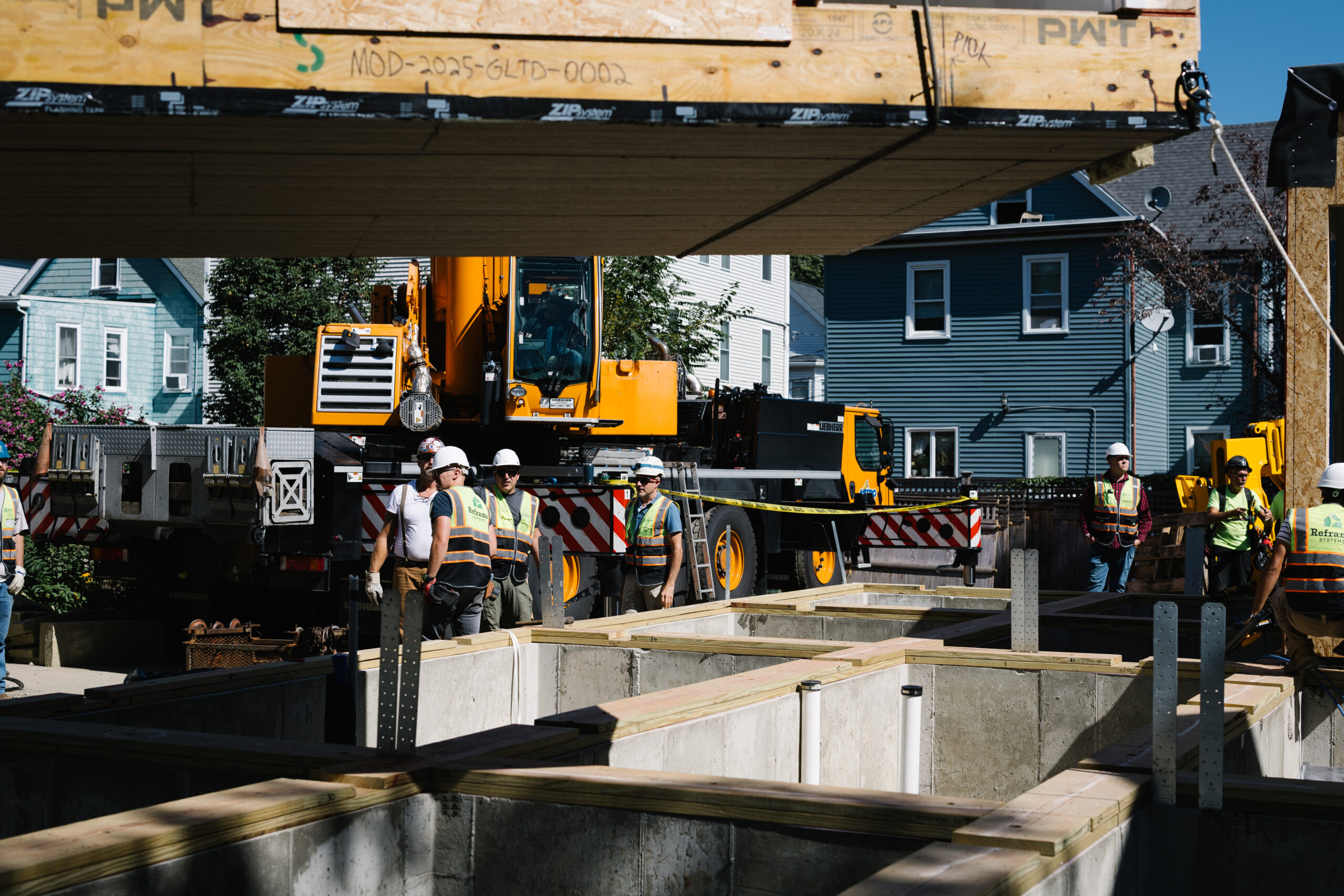
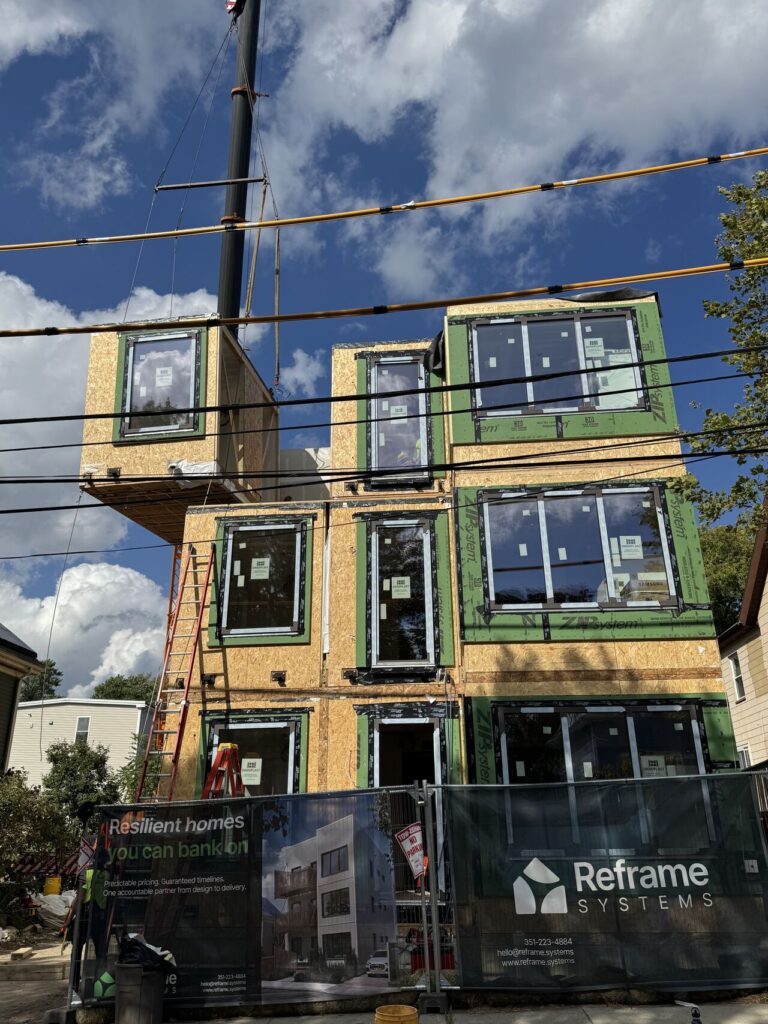
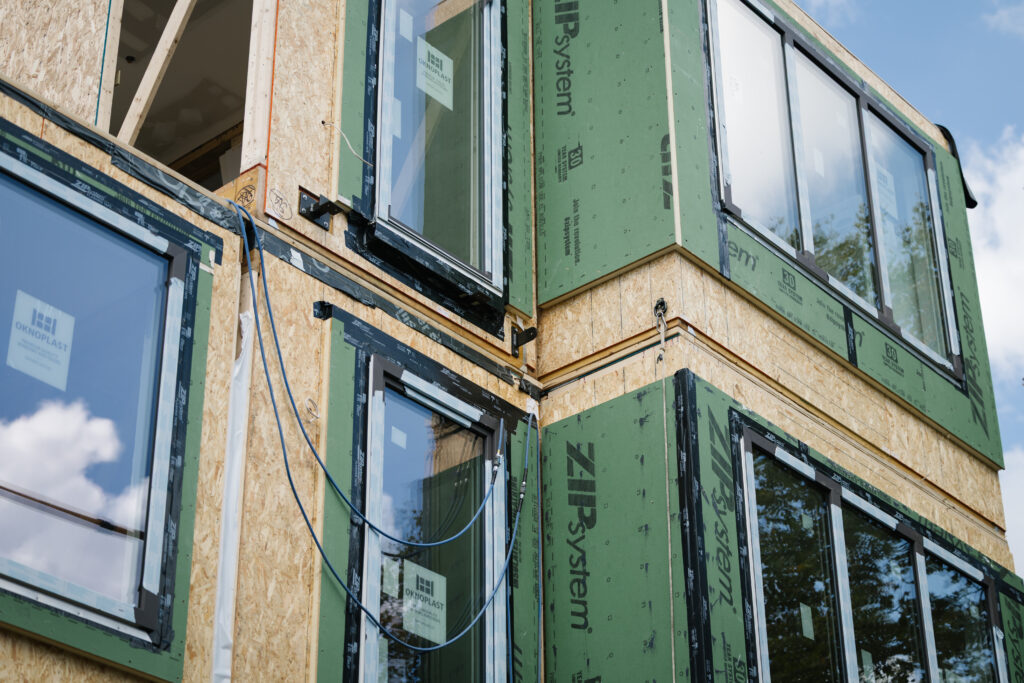
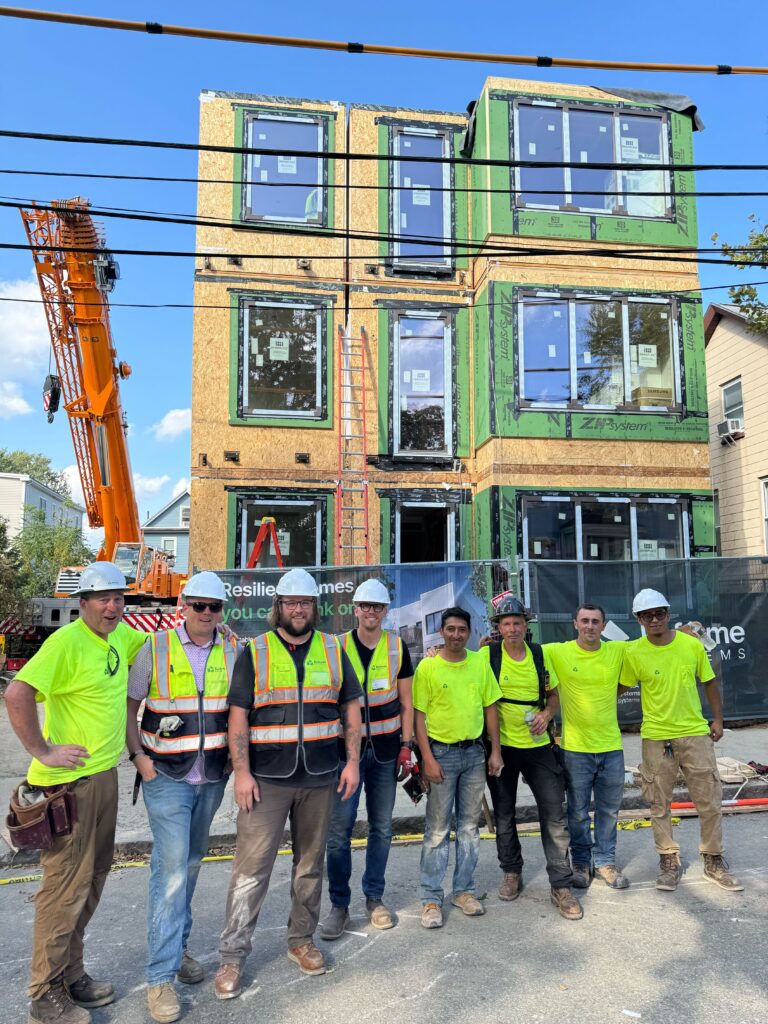
The company is still young. Its first home, completed in 2024, was a 900 sq. ft, two-story ADU in Arlington, Massachusetts, which is now occupied. In the summer of 2025, Reframe built a three-story building in Somerville, Mass. It consists of 24 modules with a three-bedroom unit on each floor and will be used for inter-generational living. Another building of this type will be built for an affordable housing developer, and the apartments will be rented at 50% AMI [area median income].
“[In 2025] we’ll close with around 12 to 13 homes,” Enti says. “We want to end 2026 with about 60 homes fully built,” he adds.
Reframe’s Technology
Some construction robotics companies have modeled their systems on the auto industry. “Traditional robotics for construction are huge and expensive,” says Enti. “Their framing cells cost $5–10 million and are larger than our entire factory.” Those kinds of numbers would have prevented the company from achieving its cost-cutting goals.
Instead, Reframe has taken a very different path. Another one of its Co-Founders worked on Amazon’s robotics team and understood the advantages of vision-based robots. “Our robots can see and locate studs without needing expensive conveyors,” says Enti. The company also frames walls vertically rather than horizontally, which allows one robot to handle larger walls.
“Our robotic work cell costs $200,000, frames at the rate of two carpenters and meets our throughput needs of 30 linear feet per hour. If we need more, we add another small work cell,” Enti says.
They use off-the-shelf robotic arms, with Reframe’s intellectual property lying in the custom “hands” they design. Tools can be swapped out for different tasks. Depending on the size of the facility, a single cell may handle multiple tasks, or tasks may be split across cells.
Because these small, decoupled cells can scale with demand, the company was able to reject the model of high-speed assembly lines that require high throughput to sustain them.
Software plays a central role. “Every building is modeled in 3D down to the level of fasteners. The CAD data flows directly to the robots. They know the ‘recipe’ for each wall, when to switch tools and the sequence for executing operations,” Enti explains.
In addition to the robots using AI to perform their tasks, Reframe uses AI in several other areas, including design automation, helping generate framing patterns, routing for pipes and wires and performing code compliance checks. “It has already caught three zoning issues that local officers missed,” Enti says.
For workers, the 3D data is passed to iPads used in factories and on jobsites. AI helps simplify instructions, sometimes parsing manufacturer manuals — for installing a water heater, say — into step-by-step guides. “Apprentices have described the process as similar to assembling IKEA furniture,” Enti adds.
Why Start With Framing?
So far, Reframe has automated about 20% of the manufacturing work, with a goal of reaching 60% to 80%. Enti says framing was the natural place to start. “It was the intersection of what we felt was our fastest capability to build and what was so repetitive that we wouldn’t get pushback from our builders,” he explains.
Reframe succeeded in getting operational quickly. Within six months of acquiring a robot, it framed its first wall with all the software and specialized hardware the company created. To date, the robot has framed more than a thousand linear feet.
Framing is also a task many carpenters would rather avoid. “Given the choice, they’d prefer to learn finish carpentry and get good at it. So, this was a good synergy — a dull, repetitive task that builders were happy to give up and a strong candidate for automation,” Enti says.
Framing represents about 20% of the work in a building, making it a substantial single-trade area to target. Today, Reframe’s system can handle walls and ceilings, with a version in development for floors, which tend to have more variation. In the future, the same system could potentially build trusses.
Enti explains that Reframe’s goal is to reduce its reliance on skilled trades, meaning 60% to 80% of manufacturing work will be done by people who are good at following instructions. Reframe will provide the training and tools. The company has hired apprentices and even high school students through its co-op program. (The co-op program is a partnership with a local vocational trade school. High school students participate in the program,splitting their time between classroom learning and hands-on experience in Reframe’s Andover microfactory.)
The program is designed to give students exposure to real-world manufacturing, construction and automation processes. Reframe has already hired two of the student co-ops as full-time employees. Enti says, “The more we industrialize, the more we can expand the available workforce.”
Zena Ryder writes about construction and robotics for businesses, magazines, and websites. Find her at zenafreelancewriter.com.